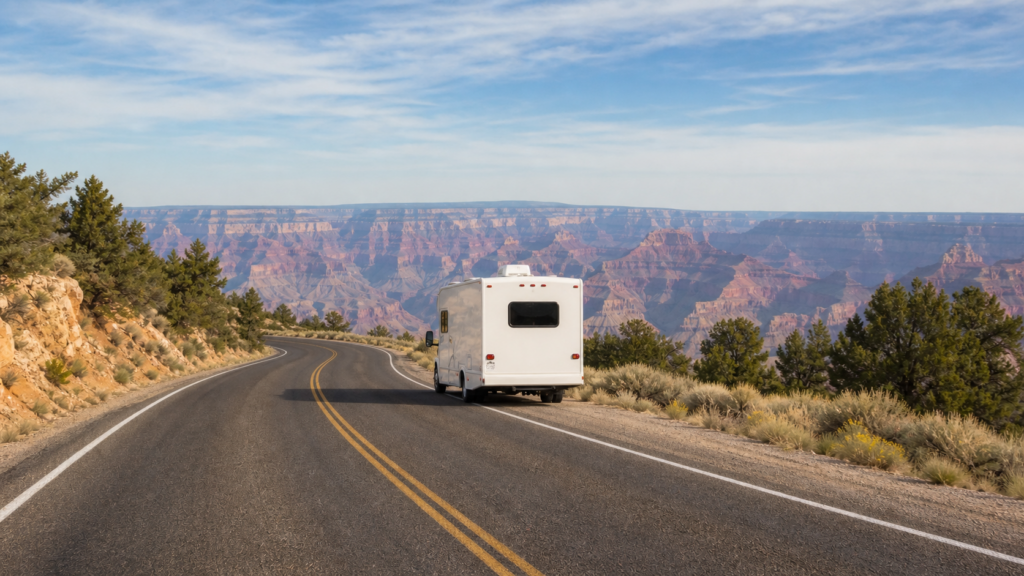
Grand Canyon RV Trip Planner: South Rim, North Rim, Campgrounds & RV Tips
On a map, Grand Canyon can seem like a piece of cake, but once you add a motorhome, fifth wheel, travel trailer, truck camper or campervan to the mix, that’s not always the case. The viewpoints are "famous", the roads are "paved", and there are real services on the South Rim, but RV travel alters all of that. A fitting location is required, parking is a must, water is essential, and a safe location for sleeping is important if the day is going to be extended, and a legal one at that.
This is a Grand Canyon RV trip planner that concentrates on the most important RV choices that you can make: South Rim vs North Rim RV strategy, Grand Canyon RV camping strategy, campground reservations and shuttle use, routing your RV safely, and desert logistics. Prior to booking anything write down actual height, total length, combined truck-and-trailer length, loaded weight, fuel range, water capacity, battery limits and if you have a tow car. If you’re unfamiliar with that workflow, begin with the RoadReviewer planning guide to RV-safe route planning before you hit the road.
Why the Grand Canyon Needs RV-Specific Planning
The South Rim is accessible, but not effortless in an RV
Most first time RV travelers find the South Rim more practical. It offers Grand Canyon Village, shuttles, groceries, close to fuel, in-park campgrounds and easy access on I-40 at Williams or Flagstaff. There’s also not much room and limited large parking.
Grand Canyon National Park considers RVs longer than 22 feet and vehicle + trailers longer than 22 feet to be oversized for parking. That catches many rigs that feel normal in private RV parks. Arriving early at the South Rim is no joking matter. It’s included with the route plan.
The North Rim is much quieter, seasonal, and not so easy for larger rigs
The North Rim is cooler, quieter and more remote. It can make a great addition to a Grand Canyon campervan tour as well as a short towable from Utah, Page, Kanab or Jacob Lake. It’s not a speedy backup when the South Rim is full.
It is approximately 215 miles and 5 hours to drive between South Rim Village and North Rim Village. The North Rim Campground reopened June 1, with booking through October 15 in 2026, although the North Rim services are still limited and water and RV hookups are unavailable. Check road conditions, services, water and fire restrictions before committing a big or high-profile rig.
Distance, temperature, crowds and parking alter the entire plan when in the desert
The Grand Canyon is an area of high desert. Tires get hot, brakes are important, pets should not be left carelessly in a parked RV and batteries lose power quickly when fans, refrigeration, charging and inverters are operating off battery. Grand Canyon is not the RV road trip with the most stops. It is the one you get to with daylight, set up the site and park it once and have a legal overnight backup.
Choosing between South Rim vs North Rim: Which Rim is Right for Your RV Trip?
If you are looking for year-round access, services and additional campground choices, then head to the South Rim
I would normally begin my first trip to the Grand Canyon on the South Rim. It provides you access to Mather Campground, Trailer Village RV Park Grand Canyon, Desert View Campground, Tusayan, Williams, Flagstaff, and the nearby forest (where legal and available).
If you are using a larger RV, desire more services, or are new to dry camping, or want to add this canyon to a trip on I-40 or Route 66, the South Rim is the best choice. When used in conjunction with RoadReviewer’s Route 66 RV trip planner, this plan will give you a fantastic way to enjoy Route 66 with Williams included.
If you are looking for a quieter trip and your rig/site plan is compatible with the season, select the North Rim
To enjoy Grand Canyon North Rim RV camping you must be prepared. A confirmed site, current road status, sufficient fuel, sufficient potable water, food and a realistic service plan are required. The smaller rigs offer greater flexibility. When traveling with a large fifth wheel or long motorhome, you must perform a fit check, site by site, as well as develop a conservative weather plan.
Consider the West Rim as a separate trip
The West Rim does not have campgrounds operated by the campground system of the South Rim/North Rim of Grand Canyon National Park. It has unique access, fees, management and route logic. Don’t treat all three rims as "close together" attractions on one park loop for your first trip to the Grand Canyon.
Best Grand Canyon Campgrounds and RV Bases
Mather Campground is best for getting on the South Rim, but there are also length and no-hookup restrictions
The classic in-park South Rim base is at Mather Campground. Located in Grand Canyon Village, close to Market Plaza, shuttle stops, the Greenway Trail, Trailer Village and visitor services. It is helpful for RV camping on the Grand Canyon South Rim when you want to stay within the Grand Canyon but don’t need any hookups.
Reservations currently state that they allow a maximum of 30 feet for motorhomes or trailers, and that not all sites accommodate the largest allowed trailers. Please check current Recreation.gov listing and your actual footprint before booking. When planning for Mather Campground RV length, consider the length of the racks, bikes, hitch, the vehicle you will be towing, parking angle, and whether the truck will fit on the campground.
Trailer Village RV Park is the best in-park full-hookup option for larger RVs
Trailer Village RV Park Grand Canyon is the most RV friendly in-park South Rim option as it features paved RV sites with water, sewer and electric hookups. Operator info states sites for vehicles from 28 to 50 ft and campground is close to shuttle and village logistics.
The first one that I would check was if it was a larger Class A, long Class C, or a traveller requiring hookups for heat, battery management, medical equipment, or hot-weather comfort. However, check for the up to date booking terms, type of site, and rig length before booking.
The East Entrance to the park is quieter, with fewer services at the Desert View Campground
Planning for Desert View Campground RV is not the same as planning for the camping village. It is located close to the East Entrance, approximately 26 miles from Mather Campground in the Grand Canyon Village area, and is best accessed from Cameron, Page, Monument Valley, Marble Canyon or from a more general route from northern Arizona.
Current NPS guidance indicates that Desert View will be listed for seasonal use in 2026, no-hookup camping and 30-foot combined total length maximum for RVs or vehicles pulling travel trailers. The importance of that combined-length language. Don’t use Desert View because you are expecting the same services that you would receive at Grand Canyon Village, but do use it when the East Entrance route is a good match for your trip.
The North Rim Campground is a nice place, but is open only seasonally and offers limited amenities
The North Rim Campground may be ideal for a smaller rig and a more adventurous dry camping experience. As of the current 2026 guidance, potable water and RV hookups are unavailable, so plan accordingly and bring potable water with you or plan ahead where water can be purchased in the area. Always verify fire restrictions, road access, campground rules and service availability immediately prior to traveling.
Off-site bases include Williams, Tusayan, Flagstaff, Jacob Lake and Kaibab area bases
It may be easier to camp near Grand Canyon outside the gate. Tusayan is near the South Entrance and is great for the summer shuttle plan, groceries and gas. Williams provides access to I-40, Route 66 background and easy access to the South Rim. More distance but Flagstaff is more equipped for repairs, medical requirements, grocery shopping and weather options.
For the North Rim check out Jacob Lake, Kaibab National Forest options, Fredonia and Kanab depending on season and rig size. Always check dates, laws, water availability, and road conditions prior to basing on anything!
Prepare for a safe ride to the Grand Canyon
From Williams and I-40 to the South Entrance
For many, the easiest way to reach the Grand Canyon from the South Rim is by the Williams AZ to Grand Canyon RV route. AZ-64 continues north from I-40 to Tusayan and the South Entrance. It’s a popular RV journey with facilities available in Williams and Tusayan, yet fuel margin, daylight and a parking plan are necessary.
From Flagstaff to the South Rim
The Flagstaff to Grand Canyon RV road often travels through Valle and then onto AZ-64. It is picturesque and popular, yet winter weather, wildlife, shoulder season travel conditions and wind must be respected. During winter or shoulder season, make comparisons between Arizona road conditions compared to the I-40/Williams approach.
East Entrance from Cameron and Desert View Drive
The Cameron route is west from US-89 on AZ-64 to near Desert View. It is effective from the Page, Marble Canyon, Monument Valley and the Navajo Nation side of the area. There are viewpoints on Desert View Drive, but not all of the pullouts are rig-friendly.
From Utah or Page to the North Rim and Jacob Lake
This is the route for the North Rim RVs, normally passing through Jacob Lake and AZ-67 when the road is open. It is further back than the approach on the South Rim. Refuel before you begin to think about it, bring water, get maps and check the wind, fire, and road conditions.
While a standard car GPS can be helpful, it shouldn’t be the final decision
Your GPS won’t know how high you’re going, how long everything is put together, if you have any restrictions on propane, when you are going to arrive at a campground, or how comfortable you are with making tight turns. To route an RV safely to Grand Canyon, look at the official park pages, the Arizona DOT’s conditions, the directions to the campgrounds, the satellite view and an RV-aware routing tool. The same rules for scenic roads apply to RoadReviewer’s Yellowstone RV trip planner and Going-to-the-Sun Road RV trip planner: rules are rules.
Parking, Shuttle, and Day-Use Strategy for RV Travelers
The South Rim is a place where early arrivals are a crucial part of the event
There is not a lot of Grand Canyon RV parking available. The current NPS recommendation is to arrive no later than 9:30 a.m. to maximize the chance of getting a good space on the South Rim. There is pull-through for RVs and trailers etc. at Lot 1 at the Visitor Center and it tends to fill early. Market Plaza Lot B can accommodate RVs up to 30 feet or less, and Lot D is located near the Backcountry Information Center and is also a designated RV site.
Never pull across several regular spaces. Parking in Tusayan and taking the shuttle may be more of a good idea than driving around the village in the heat of the day.
Avoid driving the RV throughout the day – use shuttle routes
After parking, utilize the shuttle system to get you where you need. Depending on the season, South Rim shuttles are available to transport visitors from the Visitor Center to Mather Point, the Market Plaza, the lodges and campgrounds, the Historic District, the Hermit Road transfer points, and certain viewpoints. Check plan of the trip and again on arrival.
If a rig is large, then it will have limited flexibility available
In some circumstances, a camper van may come close to acting like a car. A 40′ diesel pusher with toad cannot. If you don’t have your own vehicle, make fewer stops and select viewpoints that have known RV parking. When you have a tow car, use the tow car for groceries, viewpoints, sunset runs, and set the RV in camp.
Here’s a practical 3-day Grand Canyon RV trip
Day 1: Arrive, settle camp and use the rim/shuttle system
Get there in time to get set up without any stress. Stop at Mather or Trailer Village, check hookups or dry-camp systems, check shuttle stop and take an easy first walk to the rim. Make sure Day 1 isn’t too long with a desert drive and a viewpoint chase.
Day 2: Walk to the South Rim viewpoints with time to relax before moving on to no-rush logistics
Take advantage of the shuttle and trail around the rim. Center the day around Mather Point, the Yavapai area, Grand Canyon Village, Hermit Road (while it is open), and a laid-back rest break. Before evening, check tank levels, battery status, pet safety and weather.
Day 3: Desert View Drive, exit strategy or backup weather day
If your rig and parking plan permits, take Day 3 on Desert View Drive or eastbound off-ramp to Cameron. Should weather, wind, crowds or fatigue intervene keep it as buffer day.
The Grand Canyon RV route 5-7 days is longer
The longer the Grand Canyon RV trip, the more time you’ll have to enjoy it. Stay at the South Rim for 2-3 nights and then include Williams, Flagstaff, or a stretch of Route 66. Depending on the season/mileage, add Page, Marble Canyon, Lees Ferry, Kanab, Jacob Lake, or the North Rim as a separate leg.
Avoid planning for a South Rim and North Rim as quick opposite side viewpoints. Include a laundry day, a dump day, a water fill day, a grocery day, a propane/fuel day, a tires check day, and a low-mileage rest day.
Grand Canyon RV Planning Checklist
Before departing your final major service town:
- True RV height, length, total combined length, hitch length and loaded weight
- Campground reservations, site size, hookup information, generator policies and arrival times
- Up to date NPS campground pages, shuttle routes, road conditions, fire restrictions and water alerts
- Fuel range plus margin for traffic, wind, idle time and detours
- Potable water plan, dump station plan, groceries, pet supplies, and medication
- Offline maps, campground confirmation screenshots and emergency contacts
- Legal backup overnight outside of the park if plans change
When it comes to booking an RV at the Grand Canyon, there are some pitfalls you should avoid
Booking a campsite before determining the total combined length
Your trailer isn’t necessarily your campsite footprint. Add the truck, hitch, rear rack, bikes, tow car and parking angle.
Assuming every viewpoint has easy RV parking
Certain lots are RV friendly. Some do not. Take note of what the park tells you to do: stick to their designated RV lots and use their shuttles.
Failure to anticipate summer heating and water requirements
Heat impacts people, pets, tires, batteries, refrigerators and tempers. Always take more water than you will need and never leave pets in a parked RV without a dependable and monitored climate plan.
Planning South Rim and North Rim as if they are near each other
Roads are not adjacent. If you do not have the time, season, fuel range, and overnight plan to join them, treat them as separate bases.
Late arrival without legal overnight backup
Don’t improvise overnight parking in a long rig at Grand Canyon. Be aware of where you can legally stop if the day is changed by reservation, road closure or mechanical delay.
Final Takeaway: Make the Trip around the Rig, Not Only the View
With a bit of patience, RV planning for the Grand Canyon can yield great results. Select the rim that is appropriate for the season and setup. Book the appropriate sized campground for your footprint. Avoid driving the RV through busy lots; use the shuttle instead. Count water, fuel, heat, pets and legal overnight stops as part of the route.
With the rig as the centerpiece of the trip, the canyon becomes what you came for: quiet rim walks, huge evening light, cool morning coffee, and the once-in-a-while joy of seeing one of America’s great landscapes without parking concerns.