Shenandoah National Park RV Trip Planner: Skyline Drive, Campgrounds, Marys Rock Tunnel, and RV-Safe Blue Ridge Routing
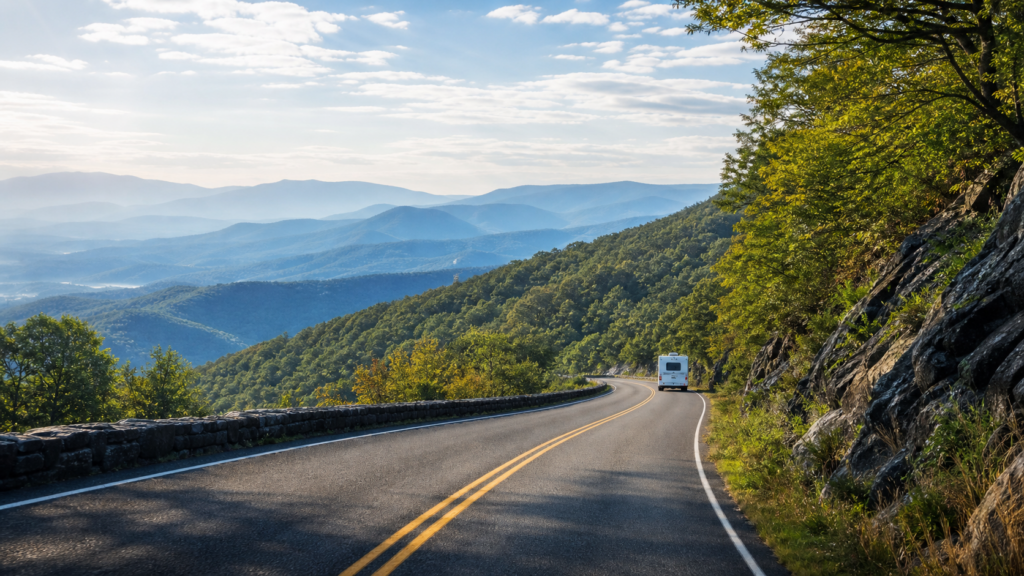
A map of Shenandoah seems straightforward. For 105 miles, Skyline Drive hugs the crest of the Blue Ridge, has four entrances, provides a clean north-south route and small towns nestled on both sides of the ridge. That’s a nice view ride on a car. In a motorhome, a 5th wheel, travel trailer, truck camper, camper van or tow vehicle, it is a true routing choice.
This RV trip planner for Shenandoah National Park is for the second version of the trip. The one that strives to find that height at Marys Rock Tunnel, campground loops are more important than campground names, overlooks are sooner than anticipated, and 35 mph turns into a full travel day!
I enjoy Shenandoah in an RV as the park rewards slower travel. It isn’t a place to rush. The key is to know your sizes, choose the appropriate entrance, book a campground that can accommodate your gear, and come ready with fuel and water and take Skyline Drive as the scenic mountain path that it is, not the shortcut it appears to be.
Is Shenandoah National Park RV Friendly?
Quick answer for motorhomes, camper vans, travel trailers, and fifth wheels
While Shenandoah is RV friendly for many travelers, it is not an RV resort, nor is it a place to improvise with a tall or long rig. Vehicles such as RVs, campers, camping trailers and horse trailers can be used on Skyline Drive, but the park does warn drivers to ensure they can make their vehicles through Marys Rock Tunnel, which has a maximum clearance of 12 feet 8 inches.
That is the number that makes all the difference when it comes to the Shenandoah RV route discussion. A Class B camper van, truck camper, compact class C or moderate travel trailer will generally fare better here. If you have a high rig, whether it be a Class A, fifth wheel, toy hauler or roof loaded, it will require some careful measuring before buying the full drive.
What makes Shenandoah different from a car road trip?
Skyline Drive is not a high-speed parkway, it is the main road through Shenandoah. The NPS reports it is 105 miles in length, has a speed limit of 35 mph in most areas, and four vehicle access points. The complete drive should take around 3 hours on a clear day. I wouldn’t plan a trip based on that minimum in an RV.
You will slow for grades, curves, fog, wildlife, entrance lines, overlook stops, campground check-in and hard braking at the sight of a bear or a view. With a trailer and the day is long again. When there is margin in the plan, Shenandoah is easy. This is cumbersome to use as an interstate.
Deciding who should drive the Skyline Drive in the RV and who should basecamp outside the park
Choose to use Skyline Drive if you are in the RV and your height doesn’t exceed the tunnel height, your length fits the campground or day-use plans, if you are comfortable driving in the mountains, and if you are not in a hurry.
If your rig is tall, total combination length is not ideal, you want full hookups, or you are primarily visiting very busy trailheads like Hawksbill, Old Rag or Dark Hollow Falls, then you should consider staying in basecamp outside the park. Staying in one of the private RV parks near Front Royal, Luray, Elkton, Waynesboro or one of the other valley towns can make the travel less difficult. Rig parking, tow vehicles/smaller cars and enjoy the ridge without worrying about all the pullouts.
The same conservative approach is used in RoadReviewer road trip planners such as RV-safe route planning and the Blue Ridge Parkway RV trip planner.
Distance, Speed, Entrances, and Pacing Are RV Basics on Skyline Drive
How long it actually takes to drive Skyline Drive in an RV
Avoid taking Skyline Drive as a short scenic spur; rather, think of it as a half-day or day-long trip on the RV. The drive time is listed at approximately three hours, but RVers don’t usually drive that fast without stopping. But with overlooks, lunch stops, slow descents, campground loops, weather, traffic and bathroom breaks, the whole road can easily be the highlight of the day.
If towing, I prefer driving one good section over all 105 miles exhausted. Divided by mileposts, Shenandoah makes it easy to take a section by section approach to planning.
There are four main entrance stations and the time when each is appropriate
There are four vehicle entrances to Shenandoah on Skyline Drive:
- Front Royal Entrance at mile 0, good for northern Virginia, approaches to Washington DC, northern Skyline Drive.
- The Thornton Gap Entrance at mile 31.5 is great for access to Luray and trips to the central part of the park, but it is close enough to the Marys Rock Tunnel to require a plan for tall rigs.
- Swift Run Gap Entrance at mile 65.5 (for positioning in the middle/southern park and Elkton).
- Rockfish Gap Entrance at mile 104.6 for Waynesboro and direct access to the Blue Ridge Parkway.
This layout is great for the RVs. You don’t have to journey all the way around the park to have a great Shenandoah trip. Choose the entry that fits your campground, tunnel clearance and destination.
This 105-mile scenic road can be a full RV travel day
Slow is the speed of traffic on Skyline Drive. All the posted pace, the wildlife, fog pockets and overlook traffic play a role in squeezing the time. During the fall foliage season, the road may seem much busier than the map indicates. During rainy weather or low cloud, it is a visibility / braking achievement.
Schedule for the day based on daylight and arrival of fuel and realistic campground check-in window. One case of an overlook that isn’t caught is better than a dry camp run at night with a tired driver and a still-towed trailer.
Why not have the final course dictated by generic GPS?
The NPS in particular warns general visitors to not use GPS as a sole source to find Shenandoah as it may be incorrect. In an RV that warning is more pertinent. Generic GPS can take you the shortest path to an entrance or campground when the safer path for your height, length, grade tolerance, and turning radius would be a longer one.
Obey park rules, use an RV-safe navigation system, listen for updates and use your own common sense. The last few miles is something that matters.
Marys Rock Tunnel Clearance Has the Primary Restriction for Your RV
Where Marys Rock Tunnel is located on Skyline Drive
Marys Rock Tunnel is located at mile 32.2 of Skyline Drive just south of Thornton Gap. This is significant due to its proximity to the northern-central region of the park. If it proved to be impossible for your RV to safely clear it, you might still be able to enjoy Shenandoah by dividing the park into northern and southern halves, rather than attempting to through-drive.
If you have a taller rig, the 12’8” clearance is important
The posted clearance in the Marys Rock Tunnel is 12′ 8”. This is the measurement for both lanes, according to the park. You should not compare that number to the brochure height that the RV was measured at when it was empty at the dealer lot. Set your own loaded height.
Things that could alter the margin include roof air conditioners, satellite domes, solar mounts, vent covers, cargo boxes, lifted suspension, and uneven road position. If you are at the edge, consider “close” as “no”. A tunnel strike is no vacation issue – it’s a costly, hazardous and trip-ending error.
Avoid this tunnel by taking the southern or northern routes
If Marys Rock Tunnel is the problem, then design the Shenandoah RV route around entrance stations. Go up north using Front Royal and avoid the tunnel. If you wish to connect with the southern or Blue Ridge section, you can do so at Swift Run Gap or Rockfish Gap, and will have to plan around the lower half of the park.
Thornton Gap is still useful – but only if you know if your path right away takes you to the tunnel. Don’t have a navigation system do that for you.
How to measure true RV height before committing
Check rig on flat ground fully loaded for travel. Put the tallest roof that is fixed, not just the roof line. In case of towing, be familiar with the height of the trailer in addition to the tow vehicle. Write number on a card and place in close proximity to driver seat. There are also notes for length, length with mirrors, total combination length, and loaded weight.
It’s simple RV-safe route planning, but that’s where simple discipline is rewarded: Shenandoah.
Here are some things to consider before booking an RV campground in Shenandoah
The Big Meadows Campground is centrally located and will use a reservation system
The traditional Shenandoah center is Big Meadows Campground. Located in the central portion of the park, near Big Meadows, Byrd Visitor Center, trails, wayside services and a balance of north/south opportunities. It is the most convenient base for many RV travelers.
The compromise is demand. There is a popular Big Meadows and all Big Meadows sites are "reservation only" according to NPS campground guidance. Please consult Recreation.gov for specific equipment, site length, pad notes, generator regulations and current operating season.
Mathews Arm Campground: north access and Skyline Drive placement
Mathews Arm is the campground to the north, good if you are coming off of Front Royal or are looking for camping in the north part of the Skyline Drive. It can be a good choice for those who have arrived from the northern Virginia/DC area, Maryland, or Pennsylvania, and don’t wish to begin the day with an extended ridging drive.
The question for RVs isn’t whether Mathews Arm takes RVs in general. Whether the specific campground is a right fit for your RV, trailer, tow vehicle and turning comfort.
Lewis Mountain Campground has smaller-rig expectations
Lewis Mountain is quieter, and smaller. Camper vans, truck campers, compact motorhomes, and travelers with a more subdued look would find it attractive. Unless you know the specific location of the rig or trailer, I would be wary about using it for a larger rig.
Lewis Mountain also serves as a reminder that "campground in a national park" is not the same as "full service RV resort." Don’t take water, dump access, generator rules and services for granted.
Loft Mountain Campground is the southern terminus of the Skyline Drive and the Blue Ridge Parkway
Loft Mountain is the best in-park choice for RV travelers seeking access to the southern half of Skyline Drive or a direct route to Rockfish Gap and the Blue Ridge Parkway. If you’re heading south to your larger destination, this is a great spot to avoid backtracking.
This is also where Shenandoah can be a part of a longer RV trip throughout the Blue Ridge Mountains. Simply make sure you don’t rush the handoff. The Blue Ridge Parkway to Shenandoah RV trip planner would better fit a slow-paced day by day trip, perhaps in an RV or a RV and trailer combination.
Dundo is not an ordinary RV campground and shouldn’t be treated as one
Dundo isn’t a normal RV campground. Current NPS camping guidance says there is no group camping at Dundo, while group camping is available at Loft and Big Meadows. When older Dundo listings are found elsewhere, confirm with current NPS and Recreation.gov listings before scheduling around this information. Instead, for most RV trips, concentrate on Big Meadows, Mathews Arm, Lewis Mountain or Loft Mountain.
Hookups, dump stations, potable water, generators and seasonal opening dates
When you camp at Shenandoah National Park, don’t expect to find full hookup facilities within the park. Consider Shenandoah RV camping as dry camping with campground specific services which need to be checked. Before booking, check:
- Availability or not of electric, water and sewer hookup.
- Location and status of dump stations.
- Potable water availability.
- Generator hours and generator-free loops.
- Opening and closing dates according to the season.
- RV length and length of the trailer for individual site.
- If your tow vehicle will fit on the same pad.
Please check campground status, fees, services, and rules for reservations at NPS pages and Recreation.gov near the time of departure, as these provisions may change.
This is a route strategy for RVs based on Entrance
Front Royal Entrance: suitable for access to northern Skyline Drive and access to Washington DC / northern Virginia routes
The clean northern entrance is Front Royal. It is good if you’re travelling from I-66, northern Virginia, DC or the Mid-Atlantic and would like a straightforward first day. If you are taller and don’t want to miss out on Marys Rock Tunnel, Front Royal can also accommodate a northern out-and-back scenario.
Thornton Gap Entrance: Luray access, central park strategy and Marys Rock Tunnel awareness
Thornton Gap is convenient from Luray and US 211 and is close to the central park. It’s also near Marys Rock Tunnel. If you can make it under the tunnel, and you’re not afraid of the road, it can be a good entrance. Caution, if you are tall or not sure about the height, don’t just walk south from Thornton Gap without first checking on the tunnel.
Swift Run Gap Entrance is the middle/southern park position
Swift Run Gap is good for the middle and south portion of the park. It can be a functional option for visitors not only from Elkton or Harrisonburg, but also from the Shenandoah Valley who don’t wish to begin at either end of the park.
Rockfish Gap Entrance: good for Blue Ridge Parkway connections and basecamps in Waynesboro
The southern terminus of Skyline Drive and the northern terminus of the Blue Ridge Parkway is Rockfish Gap. This is the logical spot for RVers continuing on to Shenandoah or Waynesboro basecamps, or for a longer road trip along the East Coast, continuing on to the Parkway.
In the case of heading to the Great Smoky Mountains National Park, ease up the itinerary. The Great Smoky Mountains RV trip planner is a whole other driving in the mountains discussion, not an add-on to a long Shenandoah day.
Parking, Overlooks, Trailheads and Day-Use Stops for RVs
Early starts are important at popular overlooks and trailheads
The key to parking an RV in Shenandoah is to get an early start and practice selective stopping. Overlooks range in length, angle and crowding. Parking at trailheads can be limited during busy times and on fall weekends.
Determine the selection of stops with pull-off space
Avoid stopping at all overlooks simply because they are there. Be sure to read the angle, the length that you have, and the exit before committing. If you are towing, be able to back out of traffic. If you can park your RV and enjoy a light tour, then Shenandoah will be much easier with a tow vehicle or smaller runabout.
The additional planning that is required for Dark Hollow Falls, Hawksbill, Old Rag and crowded trailheads
Popular trails require greater planning than scenic overlooks. Dark Hollow Falls and Hawksbill may be busy. Old Rag is located outside of the Skyline Drive corridor and has access and planning considerations all its own. These are no "we’ll find a spot" stops in a large RV.
When a tow vehicle or a smaller vehicle enhances the trip
If you already have a car towing apparatus, then it is a good place to use it. Park the camper and leave heavy equipment out of the crowded trailhead campgrounds and let the smaller vehicle deal with the overlooks, trailheads and grocery runs, or side trips into Luray or Waynesboro.
Fuel, Groceries, Dump Stations, and Service Planning
To drive into the park with a full tank of gas
Come in to Shenandoah fuel done. The Park writes that there are limited opportunities to fill up; that’s reason enough not to gamble. Margin is consumed by mountain driving, generator use, detours and traffic.
The Big Meadows Wayside and the danger of using only one in-park fuel source
The main service area many people consider is Big Meadows, but it’s not a plan to use just one in-park gas station. Service hours, hours available, season and service status are subject to change. Fuel before riding up the ridge, use in-park gas as a last resort.
Front Royal and Luray RV parks as well as Elkton, Waynesboro, and local service bases are available outside of the park
The valley towns are your service network. Front Royal, Luray, Elkton and Waynesboro are good for groceries, fuel, restaurants, repairs, dump, and private RV Parks. When you need hook up, laundry, propane and other things or a larger site look outside the park first.
No casual overnighting if you do not have a campground for your RV
Avoid overnight camping in overlooks, pullouts, picnic grounds, or any other parking lot. RV camping Shenandoah National Park is camping in designated campgrounds or camping overnight in legal areas outside the park. It’s good for the park, good for safety and it’s good for no one getting a knock on the door at midnight.
Best Time of Year for a Shenandoah RV Trip
Spring provides the waterfalls, openings and campground season checks
Spring is a great time for waterfalls and a cooler hike, but it’s a time to check the details. Campgrounds and services are seasonal and weather can still impact Skyline Drive.
During the summer, you can get access to everything, heat, crowds and slower pacing of scenery
Access is easiest during the summer months but keep in mind that places like this will be busy and in lower areas, hot! Allow extra time beyond the time recommended in an auto tour.
The color of the season, the need for space and the urgency to book, all in the fall
Fall is a wonderful time – and busy time. Foliage weekends may result in increased difficulty in making parking and campground reservations. Book in advance for your fall Shenandoah RV vacation and do not arrive late in the day.
Winter: Skyline Drive closures and why it’s not a standard RV loop season
Even though it is winter, don’t assume that Shenandoah is a winter destination. Skyline Drive may close at any time due to bad weather, and there will be limited service. When thinking about winter, please see the NPS alerts and have a back-up plan for the valley.
Here are some example Shenandoah RV itinerary options
2 days in Shenandoah: one basecamp and one stretch of Skyline Drive
Day 1: Come in on the side that is most appropriate for your campground. Handle water and tanks, take one short overlook or meadow walk set up in daylight.
Day 2: Take a drive along one of the sections of Skyline Drive early, take a hike or overlook a realistic one, and get back before the parking mania kicks in.
This 3-day Shenandoah RV trip includes the central park and either the northern or southern section
Luray/Waynesboro outside base or Big Meadows base. Visit the central park one day, north or south one day (based on tunnel clearance and interest), and one day for a less strenuous walk or a weather contingency/visiting the visitor center.
This 4-day route goes from Shenandoah to Blue Ridge Parkway and does not rush the rig
Day 1: Northern or central Shenandoah arrival.
Day 2: Day on Skyline Drive and campground day.
Day 3: Go south to Loft Mountain, Rockfish Gap or Waynesboro.
Day 4: Start out the Blue Ridge Parkway with a different driver and different plan for a more conservative route.
It can be done conservatively with big-rig and smaller-vehicle touring – basecamp is outside
If you’re looking for a tall or longer rig, book a private RV park located outside of the park. Consider using a tow vehicle or rental car for Skyline Drive, trailheads and overlooks. This is more likely to be a good trip rather than a compromise.
There are some common mistakes people make in planning their Shenandoah RV trip
They believe that Skyline Drive is a regular highway
Wildlife, overlooks, grades, fog and slow traffic – it’s a scenic mountain road. Treat it accordingly.
The Marys Rock Tunnel clearance was forgotten
The big headliner RV restriction is the tunnel clearance of 12 feet 8 inches. Find out your true height before you depart.
True equipment length is not checked for when booking a campground
Length limits at RV campgrounds are not recommendations. Look at the specific location, not the campground.
As a general rule, one should not anticipate finding "full-hookup" RV resort facilities within the park
Shenandoah National Park campgrounds are not RV resorts with full hookups. Unless official information indicates otherwise for your specific location, plan for dry camping.
Arriving with low fuel or late in the day
Both errors decrease your margin. Fuel up first, arrive earlier and make backing and leveling boring.
Using overlooks and pullouts as places to stay the night
Stay at legal campgrounds or in designated outside accommodations. Shenandoah is not a "boon dock" park.
Shenandoah RV Planning Checklist
Before you depart, check the following measurements
- Actual RV height (with roof equipment).
- Length of RV, trailer and combination length.
- Width including mirrors.
- Loaded weight, tow rating and brake controller set-up.
- Tire condition and pressure.
Official Road, Alert and Campground pages to check
Please refer to the NPS alerts, Skyline Drive conditions, campground websites, Recreation.gov information and official entrance signs for current conditions. Do this again close to departure.
Campground fit and reservation items
Verify length of site, type of equipment, generator restrictions, dates of operation, access to dump stations, potable water, check-in regulations and tow vehicle fit.
Fuel, water, dump, grocery and back-up-stop plan
Fuel outside the park, fill water where appropriate, know your next dump station, bring enough groceries, have a legal back-up overnight dump station outside Shenandoah.
Weather, fog, wildlife and descent driving reminders
On downhills, use low gear, don’t go too fast, be alert for wildlife and don’t be overwhelmed by traffic. Wait for fog, wind or rain to clear or implement a valley plan if the weather makes the ridge uncomfortable.
FAQ
Is it possible to drive an RV on Skyline Drive?
Yes, RVs, campers, travel trailers, etc. are allowed on Skyline Drive, but please check for height, length, weather and driver comfort. The key clearance issue is Marys Rock Tunnel.
How high is the Marys Rock Tunnel?
A posted tunnel clearance for Marys Rock is 12′ 8”. Check the height of your loaded RV (with roof gear) before you book a trip through the tunnel.
Are big motor home visits allowed at Shenandoah National Park?
Yes, some big motorhomes can make the journey to Shenandoah, but it must be carefully planned. Inspect for tunnel clearance, fit of campground sites, parking facilities, fuel, and if an outside basecamp would help with the visit.
What is the best campground for RVs in Shenandoah?
Big Meadows is the most central, while Loft Mountain is strong for southern Skyline Drive and Blue Ridge Parkway connections, Mathews Arm is better for the northern section, and Lewis Mountain is better for the smaller rigs and simpler setups. The best Shenandoah RV campground is the one that has a site that is an exact fit for your equipment.
Does Shenandoah National Park have any hookups in its campgrounds?
No hookups are assumed. Camp as dry camping unless otherwise specifically stated in current official campground information and on Recreation.gov for your specific site in Shenandoah RV camping.
Is it possible to boondock in an RV in Shenandoah National Park?
Casual RV boondocking should not be scheduled within Shenandoah. Overnight RV camping requires designated campgrounds or legal camping/lodging outside the park.
How long does it take to drive Skyline Drive in an RV?
According to the NPS, Skyline Drive is 105 miles long and approximately 3 hours long on a clear day without stops. In an RV, make more plans for time. If you’re stopping, towing, camping or even driving during a busy season, a half day to full day is more realistic.
Before or after the Blue Ridge Parkway, is Shenandoah better?
Either works. Northbound, Shenandoah can be the prize after the Parkway. If your destination is towards the South, Shenandoah may be just the warm-up for a longer drive down the Blue Ridge Parkway. The better answer for RVs is whichever way you will have more daylight, better weather, campground timing and driver energy.
Bottom Line: Take a “slow” RV trip in Shenandoah, not a “tight” RV trip
Though a relatively easy national park mountain trip to understand, it’s by no means one to be winged. The road is simple. What is not is the details.
Check how tall you are before Marys Rock Tunnel. Choose the entrance that corresponds to your route. Campgrounds by exact length of equipment. Fill up before the ridge. Get an early start to overlooks and trailheads. When the rig is too tall, too long or too reliant on hookups, use the outside basecamps.
Do that and Shenandoah will be what it is supposed to be: a quiet RV trip along the Blue Ridge with long views, reasonable miles, and a route plan that holds the hard stuff up front.