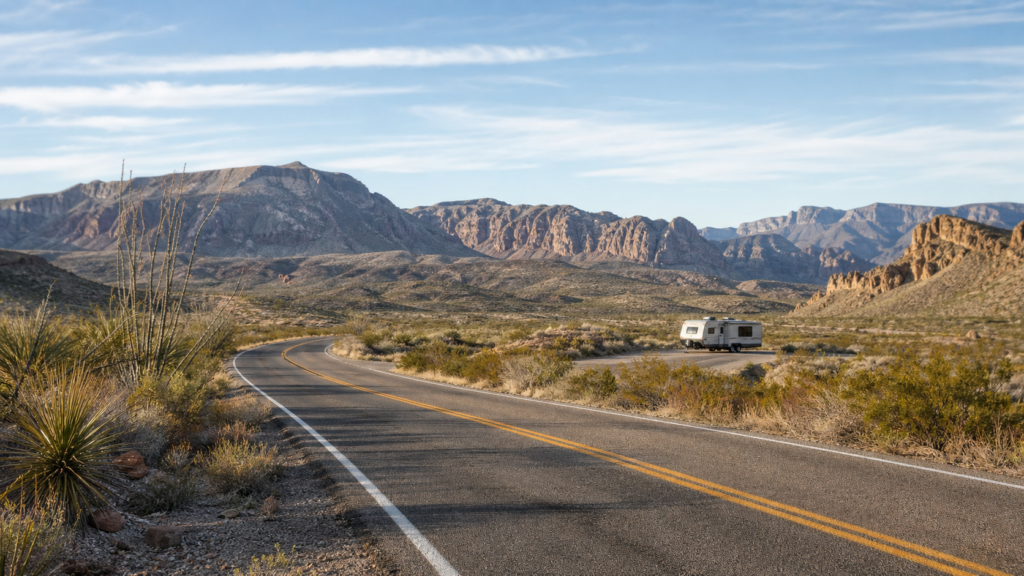
Big Bend RV Trip Planner: Campgrounds, Chisos Basin Access, Desert Routes and Big-Rig Cautions.
Whether traveling to the Big Bend, to and from Chisos Basin, or along desert routes, this is a Big Bend RV Trip Planner for campgrounds, desert routes and big-rig cautions.
One of the best RV trips in Texas, Big Bend is not a park I would drive into with my motorhome and “figure it out!” once I arrived. As the map suggests, it’s easy: drive down through West Texas, stop at a campground, and experience the desert, the river, perhaps the Chisos Mountains. When it comes to an RV, the real plan begins earlier than that.
This Big Bend RV trip planner is centered on the things you need to decide before even getting on the road: where the rig will all fit, which roads are reasonable, if Chisos Basin will work with your setup, how much heat you are taking on, or how much distance, and what back up plan will keep the trip from getting stressful. Big Bend is a reward for the patient traveler of an RV. It does not tolerate a vague plan.
If you are new to measuring a route around the RV instead of around a car, start with RoadReviewer’s RV-safe route planning guide. The philosophy at Big Bend is that it’s a place where campground first, scenery second is the correct way to go.
Is Big Bend National Park RV Friendly?
Yes, Big Bend National Park is RV friendly, but it will require conservative planning. The easiest are campervans, truck campers, small Class C motorhomes and shorter trailers. Even long fifth wheels, heavy travel-trailers, and big Class A coaches can still make a great trip, but it requires a more specific plan for campground fits, when to arrive, fuel, water, and roads.
Whether an RV can fit inside the park isn’t the key. The critical factor is whether your particular RV can fit into the campground, loop road, pullout, grade and parking area you’re considering.
RoadReviewer’s mantra is to pick the legal, feasible accommodation before the drive to the scenic spot. After the rig is leveled, tanks are handled, and water is topped off, and the condition of the day is checked, the park opens up. When you try to explore Big Bend from the driver’s seat of an oversized rig where there’s no backup plan, the same landscape can look a lot less generous.
Why Big Bend Needs RV-Specific Planning
Distance, heat, water and fuel margins in the desert.
Big Bend is “out of the way,” even within the national park. Services aren’t just around the corner, internal park drives may be long, heat affects people, pets, tires, batteries, refrigerators and generators. This is not a gateway town that is as crowded as it can possibly be, where every mistake is easily corrected.
Re-establish the fundamentals: refuel, fill propane tanks (if any), groceries, drinking water, holding tanks, tire pressure, and battery charge before entering the park. If dry camping, be familiar with your actual water consumption, rather than brochure water tank capacity. If using air conditioning, come clean about hookups, generator rules, generator condition, fuel supply and if it can keep up with the desert heat.
As with all of our other desert road trips, we give Big Bend the same treatment as we do our Death Valley RV trip planner: we add a margin for error in case we need it. The right desert plan is mundane until it’s needed for saving the day.
Cell service, tire stress and late-arrival risk
Avoid using a live data connection as the basis for this trip. Grab maps, campground and other confirmations, NPS alerts and reservation information offline before you get outside of cell service. Print or screen print anything you might need at a locked gate, a kiosk or a dark campground loop.
But, Big Bend demands more from tires than an estimate of the typical mileage would indicate. Stress is caused by long hot approaches, loaded rigs, rough edges of pavement, slow internal driving. Check pressure, inspect sidewalls, confirm torque if recently changed a wheel, and do not travel so late that the first time you check a campsite is with a flashlight.
A generic navigation application might select a line that is appropriate for a pickup or sedan. It can’t tell you how long your combination is, what your rear overhang is, how hot you are, or if you can back your trailer out of a bad situation. When it comes to daylight in Big Bend, it isn’t a privilege. This is part of the route plan.
Best Time to Visit Big Bend in an RV
Fall, winter and spring are the RV season
The best time of year to visit Big Bend in an RV is typically the fall, winter and spring months as they are cooler seasons. Those months can be a lot easier in terms of hiking, dry camping, generator use, pet safety and tire management. While cool weather doesn’t negate the need for planning, it does provide rig and driver with more space to work.
Demand for popular campgrounds, chilly nights and holiday stress can all be issues in winter. Spring can be a busy season with unpredictable weather changes. Though fall can be great, it is important to do a check for service details and conditions. What is the point is that one month is not perfect. What it means is that cooler temps provide a larger window for RV travelers to operate.
Summer heat strategy
Summer Big Bend RV camping is a different story. When it comes to heat, it can be intense, and if the cooling plan goes wrong, an RV can become unsafe in no time. Pets are particularly susceptible. Shade, hookups, generator hours or a campground breeze will not make up for this.
If you have to do summer, try a basecamp with good hookups outside the park, make days shorter for sightseeing, start your days early, bring more water than you think you need, and leave time in the day to adjust or cut your day short if the situation is too much for you to handle. Never rely on persisting in heat as a way to make a desert trip.
Road-condition checks, flash floods and storms
Although it is desert, storms matter in Big Bend. Washes can be flowing, dirt roads can be washed out, and distant roads can become a recovery issue. Please consult official Big Bend road conditions and alerts prior to driving dirt, remote or low-water roads. It’s the same basecamp-first logic that we use when plotting a trip in the Capitol Reef RV trip planner: don’t use a dirt road because it may be short on a map.
Big Bend RV Camping and Basecamp Planning
Rio Grande Village RV Park: full hook-up within the Park
There is only one in-park full-hookup, Rio Grande Village RV Park. According to NPS, it is an Aramark-run RV park with full hookups, a max length of 38 feet and 25 locations. It’s the first option that many people choose when they want to go Big Bend National Park RV camping with electric, water, and sewer facilities rather than a complete dry-camping experience.
Tackle it as a site fit and not merely a booking. Before your booking, check out the operator’s information, hookup status, maximum RV length, arrival directions and any site restrictions. To use a full-hookup label does not necessarily mean that every long motorhome, fifth wheel, tow vehicle and slide arrangement will fit comfortably.
Reservations and dry-camping checks for Rio Grande Village Campground
Rio Grande Village Campground is a plan of another type. NPS states that it is open all year and requires reservations, and has no first-come-first-served camping. There are no hookups and Recreation.gov advises that generators are allowed in some sites during generator hours, which are currently 8:00 a.m. to 8:00 p.m.
You can find some great starting points for your search, such as Rio Grande Village campground RV length, but the real answer will be on the current official campground and reservation pages. Before you make that big decision, consider the site with the RV, trailer, and tow vehicle if you tow; measure the RV, trailer, and consider the tow vehicle.
Chisos Basin Campground: small-rig-only planning
There’s a campground in Chisos Basin which always makes me want to be a different place. It’s beautiful, cooler and central but the road to the basin is narrow and winding and isn’t the first place that bigger motorhomes or longer trailer combinations would go. NPS says trailers over 20 feet and RVs over 24 feet are not recommended due to the narrow, winding road and small, unlevel campsites; Recreation.gov details are even stricter on some pages/sites, with trailer limits around 19 to 20 feet and motorhomes 24 feet.
When you’re checking out Chisos Basin campground’s RV length, don’t search for the largest number which makes your rig appear feasible. Search for the safest official language, up to date reservation notes, road cautions and real world driving. For many RV travelers, it is better to camp elsewhere and use a tow vehicle, campervan or smaller vehicle if conditions and access permit to visit Chisos Basin. Additionally, before publication, and before traveling, please update existing Chisos Basin access notices, as NPS posted an April 1, 2026 update saying the previously planned Chisos Basin closures will not take place.
Cottonwood Campground: service and seasonal restrictions
Cottonwood can be a quieter west-side style, but it still needs status checks at the present time. Current NPS information says that Cottonwood is closed for the summer season and will reopen Nov. 1 with reservations required up to 14 days in advance, no first-come first-served camping, and no use of generators.
Not the campground that I would leave until I got there. If Cottonwood is the perfect fit for your route, plan a west-side trip and have a legal backup outside the park.
Terlingua, Study Butte, Marathon and surrounding RV parks: camping outside of the park
RV camping near Big Bend National Park is a smarter way to travel for many travelers, than making them fit an in-park site. Terlingua RV parks, Study Butte area camping, Marathon area camping and other nearby private parks will provide hookups, easier maneuvering, laundry, groceries, dump access, later arrival time and a better heat plan.
The outside basecamp is particularly convenient for heavy vehicles, late arrivals, summer visits, vehicles requiring secure power and those who require a tow vehicle or smaller vehicle for sightseeing. The compromise is drive time to the park, and don’t assume that an outside basecamp is “right next door.” Decide on the side of the park you wish to explore, then pick the basecamp that will facilitate that.
Big Bend RV length restrictions and fit checks
RV length, trailer length and the total combination length
Length restrictions at Big Bend RV are only beneficial when the RV manufacturer and the campground’s or road rule’s unit of measurement is the same. RV length, trailer length and combination length are NOT the same measurements.
A 30′ motorhome isn’t a parking issue of a 30′ travel trailer and pickup. The fifth wheel can track differently than a bumper pull trailer. Tow points can be to the side, nose or tail of the RV. When space is limited, slides, awnings, rear ladders, bike racks, spare tire carriers, and cargo trays all come into play.
What to verify before booking
When you make your Big Bend RV campground reservation, check:
- True RV length, trailer length and overall length of combination
- Site length and if it includes tow vehicle space
- Back-in or pull-through design
- Slide clearance, trees, posts, slope and pad surface (as listed)
- The tightness of loop-road and turning room
- Do not exceed the generator limit and adhere to the quiet hour policy
- availability of water, dump, hookups and fill-stations
- deadline for arrival, instructions for the gate, and daylight access.
- Alerts, closures, fire restrictions and road conditions in place
When in doubt, go with the more conservative site or an outside basecamp. Winning an argument with a campground loop is not a good idea in Big Bend.
RV-Safe Routes Into and Around Big Bend
Marathon / US-385 approach
A popular north-side RV route to the Big Bend National Park is via Marathon and US-385. Marathon is a natural place to recharge fuel, food and schedule before the final drive south. Don’t use the final stretch as a short jauntiness. Daylight, water and fuel margin still required in the drive into the park.
This will be effective when your initial base is close to Panther Junction, Rio Grande Village or eastern side of the park. It also maintains the orderly arrival: fuel first, empty miles, daylight, check out what’s happening before entering, then proceed to camp.
Terlingua / Study Butte approach
The Terlingua and Study Butte side would be most suitable for west side basecampers, for Santa Elena Canyon plans, for outside camping in any RV park, and for those that wish greater services than an in park dry camp setup. Often the more convenient option for large vehicles requiring connections and a known course of action.
The error would be to think that having a base on the west side is a disadvantage in making the park small. Big Bend is still big. Plan each day of sightseeing off of the base you selected not the center of the map.
Rio Grande Village and Panther Junction routing
Many park drives end at Panther Junction. While Rio Grande Village is further east, it can be a handy place to stay, but each pretty place still has to be balanced against parking and heat, as well as road time and getting back to camp.
When parked, keep the RV parked whenever possible. If you have a tow vehicle or smaller vehicle or campervan use it for day trips. If you have only the motorhome to use, book an early start time, make fewer stops and don’t schedule more than one parking test on a sweltering afternoon.
Caution Chisos Basin Road
The Chisos Basin Road needs to be adjudicated separately. Don’t use it as a road for a big rig or long trailer. Assume it’s a small-rig or smaller-vehicle route unless it is clearly indicated by current official guidance and your driving rig.
This is the reason that you brought the tow vehicle in the event you have one. Do not go unless you have asked yourself if that’s worth the maneuvering risk for your rig on that day with the road and traffic conditions.
Roads and Areas Standard RVs should Treat Carefully
Primitive and high clearance roads are not RV shortcuts
Big Bend primitive dirt roads and standard RVs typically don’t go together, except for the word “avoid” in the same sentence; in fact, Old Ore Road and Black Gap Road are designated as extremely rough and suitable only for rugged vehicles, not cars, minivans, or RVs. Depending on the route and conditions, roads like Old Maverick Road, River Road, Black Gap Road, Glenn Springs Road and other backcountry roads could require dirt roads, washboard, clearance, rough surfaces, wash crossings and/or four wheel drive.
These roads are not to be used as scenic shortcuts for a standard rental RV, Class A, fifth wheel, long travel trailer or low clearance camper. Always read the current language before any dirt-road plan and if in any doubt do not venture off tarmac or arrange a separate backcountry-type vehicle experience.
Santa Elena Canyon, Boquillas Canyon and trailhead parking reality
High-value parking at Santa Elena Canyon and Boquillas Canyon are still on the RV plan. With a smaller vehicle these days make for easier times, particularly when dealings with busy periods. When touring from the RV, arrive early, don’t have a long stop list and don’t be afraid to by-pass a full or awkward parking area.
Page’s philosophy for the better Big Bend trip for RV travelers is not to see every canyon in one day, but rather to pick the canyon that fits this day’s basecamp, heat, traffic and vehicle.
Border-area and Boquillas crossing considerations
Please check the official days/hours, required documentation, and any operating alerts for the Boquillas Crossing area before publication and prior to traveling. According to the current NPS notice, the Boquillas Crossing Port of Entry will be open Fridays through Mondays from 9:00 a.m. to 4:00 p.m. and visitors must have a valid passport book or passport card (Enhanced Driver’s Licenses will not be accepted). Conditions and access details can be different and this is not something to take from a discussion in an old forum post.
Practical 2-4 day Big Bend RV Itinerary
Day 1: Arrive, set rig, check conditions
Keep Day 1 light. Come in during the daylight hours, check-in, level, hook up or establish the dry-camp procedure, check generator policy, find water/dump location, and check alerts. Fill up drinking water and fuel before needed. Take a short drive or walk in the area to enjoy the scenery if there’s time. Don’t plan for a long cross park evening, as your first one.
Day 2: Panther Junction, Rio Grande Village and some picturesque places
Have a controlled park day on Day 2. Starting from a central, or east-side, location, rotate around Panther Junction, Rio Grande Village, river vistas, visitor information, and some realistic locations. Do not over rig. Don’t make the day a series of congested parking lots.
In the event you are in a big RV, the very best stop could be the one that you don’t coerce. Give yourself time to get back to camp before the fatigue and heat build up.
Day 3: sights on the west side (Chisos Basin) in a smaller vehicle
Day 3 will be a day for deciding on Chisos Basin sights or west-side sights. With a tow vehicle or smaller vehicle, Chisos Basin is much more feasible to consider, as of now, access and parking conditions. If you only have a larger motorhome or long trailer combination, select the one that fits the rig not the postcard.
West side folks can concentrate on Santa Elena Canyon, overlooks and Terlingua-area logistics. Once again, use the car you’re riding in as the basis for the day.
Day 4: Buffer day or exit to the larger Southwest/Texas
Day 4 is a buffer day or clean exit day. Apply it in case of weather delays, laundry, dump, shopping, gas, or even if you need to leave early or an overlook. If you’re taking a Southwest loop, Big Bend is where RoadReviewer’s pacing suggestions from our Grand Canyon RV trip planner are relevant: space between big landscapes. If you’re traveling to Texas for a longer classic road trip, then the Route 66 RV trip planner is the obvious next planning destination.
Common Big Bend RV planning mistakes
These are the most likely RVing mistakes in the Big Bend:
- Booking in advance without asking for total rig length, just RV length
- The overdevelopment of Chisos Basin as a typical big-rig campground
- Getting tired from a long drive from West Texas
- Making it easy to assume hookups, water, dump, fuel or cell service will be easy.
- Using primitive roads with a normal sized RV
- Heat, pets, tires and internal distances underestimated
- Allowing a non-specific navigation application to select the route.
- Attempting to view both sides of the park in the incorrect basecamp in one hasty day
- Ignoring the actual performance of the tank, battery and generator
It is not to say that Big Bend is a bad destination for RVs, but none of these errors are a bad sign. They say Big Bend is a place that’s meant to be treated with respect.
Big Bend RV Planning Checklist
Prior to locking the trip, check:
- Measured height, width, RV length, trailer length and overall combination length
- Campground fit, site type, tow-vehicle space, slide clearance
- Water/Dump, Fuel, Propane, Groceries and Generator Plan
- Official NPS Alerts and Big Bend road conditions
- Pet-safety and cooling strategy, weather and heat
- Dirt-road and primitive-road if any dirt road is under consideration
- Reservation information and offline maps downloaded
- Backup overnight plan outside the park
- Plan for arrival that will ensure you are at the camp before dark falls.
- A smaller-vehicle plan for Chisos Basin, canyon parking and heavily used trailheads (if possible)
FAQ
Can you take an RV to Big Bend National Park?
Yes. Big Bend is accessible to RVs, and many camp in or near the park. It’s all about the match between your rig and the campground, road, season, and basecamp. Smaller rigs provide more maneuverability. The bigger the RV, the more conservative the planning.
What’s the best RV campground in Big Bend?
Your particular rig and travel style will determine the best campground. The Rio Grande Village RV Park is the only full hookup in park RV campground and the maximum listed length is 38 feet. Dry-camping plans can be worked out at Rio Grande Village Campground. Chisos Basin is better thought of as small rig territory, where the official guidelines or recommendations are about 20 feet travel trailers and 24 feet motorhomes. For large rigs, hookups, heat and services, you may want to consider studying outside of parks near Terlingua, Study Butte and Marathon.
Are there full-hookup RV campsites at Big Bend?
Big Bend offers full-hookup RV camping at in-park RV campground Rio Grande Village RV Park, which is operated by Aramark. NPS has a 25 full-hookup sites and a maximum length of 38 feet, but site fit, rules, and current details should still be checked prior to making reservations.
Are large RVs allowed to drive to Chisos Basin?
Chisos Basin is not a “go to” destination for large RVs and long trailers. Road is narrow, steep and winding; official Chisos Basin RV restrictions and/or recommendations should be carefully read before publishing and before traveling. The current NPS/Recreation.gov guidance is to steer travelers away from trailers around 20 ft and motorhomes longer than 24 ft, with some Recreation.gov details listing 19 ft for trailers. There are many travelers who get better results with a smaller car.
What is the best time to RV camp in Big Bend?
Typically, the window is fall, winter, and spring. However, in the summer months a much more robust heat strategy is needed, particularly for pets, dry campers, and travelers without the benefit of hook-up facilities.
Is it safe to travel through the Big Bend primitive roads in RVs?
Primitive roads are not normally suitable for standard RVs. According to current NPS alerts, primitive dirt roads are not accessible for motorhomes and are accessible only with high clearance true 4WD. Do not consider any dirt road unless you’ve checked the official road conditions for Big Bend.
Should large rigs stay in Big Bend or outside near Terlingua?
Many large rigs prefer to stay out of the park near Terlingua, Study Butte, Marathon or other local RV parks, where hookups, free maneuvering room, services and late arrival are more easily available. It is still possible to use in-park camping for the right rig and the right location, though this needs to be checked prior to booking.
Without a doubt, Big Bend is worth the drive in an RV. Go with the flow of the rig. Pick a basecamp, look at conditions, and plan each day with sufficient water, fuel, daylight and patience to experience the desert on its terms.