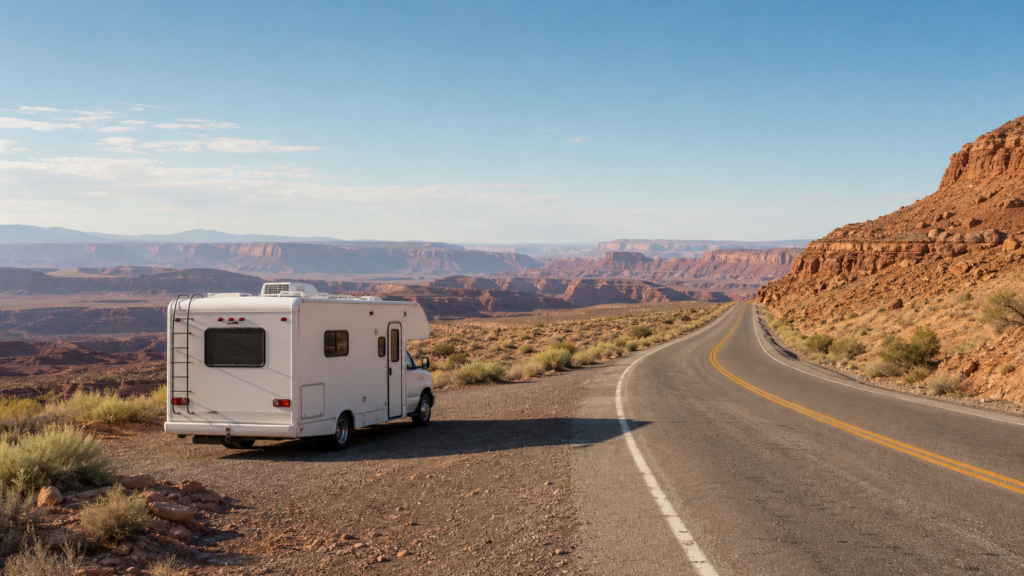
Canyonlands National Park RV Trip Planner: Island in the Sky, Needles, Moab Basecamps, Parking and RV-Safe Routes
The Canyonlands National Park RV Trip Planner is designed to help you plan the best RV trip to Canyonlands National Park, Utah.
From a parking spot in Moab, Canyonlands can look like a breeze. The area can seem like a single, uninterrupted red rock loop, with Arches just nearby, Island in the Sky down the road. That map can lie to you in an RV.
Canyonlands is not one connected drive-through park. A wide open desert park, separate districts, restricted large vehicles, dry camping, no gas at park, hot, and back country roads are not on a normal "RV Route". This canyonlands rv trip planner is designed around the logical choices that come first: what district to visit, where to stay in your RV, what paved roads are worth driving on and when to opt for an outside basecamp instead of an RV.
Before you start creating the Canyonlands segment of the route, review RoadReviewer’s RV-safe route planning checklist to get a handle on your loaded height, width, and weight, as well as your loaded length.
Why Canyonlands Needs RV-Specific Planning
The worst thing you can do in Canyonlands is plan around a single Canyonlands loop. There are two front-country districts: Island in the Sky and The Needles. The Maze and White Rim are considered to be backcountry contexts. No single paved in-park road runs between all of the major areas for an easy sightseeing day.
It’s important because RV planning is not as forgiving as car planning. You need to decide:
- Which district you are visiting.
- If an RV is in the park or if it is in a basecamp.
- If you are over 25 feet.
- Fuel, water, groceries, dump access, propane and battery charging.
- If your route is supported by current NPS road conditions.
- What you will do if a lot is full, or changes the weather.
The logistics of boring in Canyonlands is the trip. Solve those early and the park is much more enjoyable.
Quick Answer: Can You Visit Canyonlands in an RV?
Absolutely, you can camp in an RV at Canyonlands, but there are a few key considerations to keep in mind with regard to size, district, season and road conditions. Smaller rigs are more flexible. Conservative parking strategies are needed for larger class A motorhomes, fifth wheels, and long truck trailer setups, and should heavily consider using Moab or Monticello or another outside basecamp.
Best Fit: Campervans, Small Class C Motorhomes, and Short Trailers
Canyonlands is the best place for campervans, truck campers, small Class C motorhomes and short trailers. They are easier to park, easier to turn around and easier to handle when the viewpoint is busy. Still, it’s best to get off to an early start, have water on hand, and never venture a regular RV onto an unpaved road or backcountry road simply because the map application has drawn a line.
Large Class A Motorhomes, Fifth Wheels and Long Towed Setups
If you are more than 25 feet long, set your day to the standard large vehicle guidance. Currently, NPS indicates that vehicles longer than 25 feet have limited parking/access areas in Island in the Sky and The Needles. Avoid standing in roadways for clearance, using vegetation for parking, or assuming that a pullout will do because it appeared to be OK in satellite mode.
In many cases, the best way to move an RV is to simply park outside the park and, if you have a tow vehicle, not to park the motorhome or trailer in a tight overlook.
Understand the Canyonlands Districts Before You Route the Trip
Island in the Sky is the best Canyonlands district to stay in an RV for the first time. It’s a perfect complement to a Moab basecamp, paved access through US 191 and UT 313, and big overlooks like Grand View Point and Green River Overlook.
Island in the Sky is also the easiest district to team up with Arches, Dead Horse Point State Park, groceries, fuel, dump stations outside the park and repair support. This is the place in which to begin a short Canyonlands National Park RV trip.
Please use the most current NPS guidance prior to travel for Island in the Sky RV parking. Currently, vehicles more than 25ft long are advised to visit only limited areas (such as visitor center, Shafer Canyon Overlook, Grand View Point and the Green River Overlook) and may find it difficult in other areas.
The Needles Are Designed for Longer and More Distant Trips
The Needles is not a short side road off Island in the Sky, but a separate trip. Excellent for RV travelers who wish to visit Canyonlands quieter and more remote, but will need more time and planning.
Fit is also a concern with needles district RV camping. At the present time NPS provides no dump station, no showers, no electricity, and no RV hookups at The Needles Campground and the max combined vehicle/trailer size is 28 feet. Check the campground page on the website and the campground itself before you book, particularly if you are towing.
The Maze and White Rim Are Not Typical RV Touring Destinations
White Rim Road RV searches are extremely confusing. White Rim, The Maze, Shafer Trail, Elephant Hill, Mineral Bottom, etc. are backcountry/high clearance 4WD planning topics – do not use for RV scenic drives. Low range, self-rescue equipment, extra water and extra fuel are all essentials to which NPS road-condition guidance keeps referring to the backcountry drivers – particularly the high-clearance 4WD vehicles. It is not the place for a typical RV.
Best RV Basecamp Strategy for Canyonlands
Moab Basecamp for Island in the Sky, Arches, and Services
For the majority of RVers, Moab is the default. Access to Island in the Sky, Arches, Dead Horse Point, fuel, groceries, laundry, restaurants, dump stations outside the park and private RV parks with hookups. This is typically the easiest place to operate from when visiting Canyonlands and Arches with your RV.
RoadReviewer’s Arches National Park RV trip planner works the same way as Moab: park in the RV spot and then use the smallest vehicle for busy days at the park.
The Needles-Area Basecamp Is Located at Monticello
When it comes to The Needles, traveling from Moab may not be the best route, since a base in the south or east might be better. Camping at Monticello or the Needles area can help ease the strain of the day, but in both cases, it is still important to verify the access, services, roads and rig fit for current camping conditions.
It’s not the question of whether or not you can technically drive there, it’s the question of whether or not it’s still a good RV day after heat, parking, fuel and the return drive.
In-Park Camping vs. Outside RV Parks
Canyonlands National Park RV campsites are dry, restricted, and for those who are familiar with their tank, battery, water usage, generator regulations and heat policies. In RV parks, the winner is typically outside hookups, dumping, laundry, showering, shade, groceries, pets and food.
Location is yours when camping in park. Camp out and you have room to spare. Choose the one that your rig requires.
When searching for Canyonlands RV Parks and Campgrounds, you should consider the following factors:
Island in the Sky / Willow Flat Campground
Willow Flat, which is known as the Island in the Sky campground, is small and dry. Before arriving at Willow Flat campground RV accommodations, check current NPS information – season, availability, RV size, RV fees, water and RV generator rules, and alerts. Avoid going on a hookup or dump station hunt.
The Needles Campground
If you have a setup that fits and can do dry camping, then the Needles Campground can work. The Needles campground RV length detail is important because NPS currently states 28 feet is the maximum combined length of vehicle and trailer. Test the real life arrangement (cargo boxes, bike racks, hitch gear, etc. mounted behind bumper, tow vehicle, trailer).
What Makes Big Rigs Fit Outside the Park?
The larger the RV, the better the Canyonlands trip outside the park. Hookups support battery and air-conditioning plans. Dump access resets tanks. Pets and refrigerators appreciate shade. Food, fuel, propane and repair services keep small problems small. The same desert-basecamp mentality is reflected in RoadReviewer’s Grand Canyon RV trip planner.
RV-Safe Routes Into Canyonlands
Moab to Island in the Sky via US 191 and UT 313
The regular Canyonlands RV route from Moab to Island in the Sky also goes through the roads of US 191 and UT 313. This is the first paved access route one should consider in planning to do RVs in Moab. At the end of camp review road alerts, fuel, water, wind, heat and return. There are no food or lodging or gas facilities within Canyonlands.
US 191 and UT 211 to The Needles
The Needles approach is via US 191 and UT 211. Use it like an extra drive and not as an add-on. If you are in the vicinity of Moab, plan for the entire out and back day. If you are camping near The Needles make sure you arrive with daylight and your dry-camping systems ready.
Avoid Driving on Unpaved Roads as Shortcuts to Get to Your Destination
Be careful not to have a car GPS direct your RV onto backcountry roads. Unless you are instructed otherwise by current official guidance for your exact vehicle setup, do not assume that the standard RV can be used on one of these types of roads. It’s the same conservative thinking that RoadReviewer uses in its Zion RV trip planner.
Parking and Oversize Vehicle Strategy
In the case of larger vehicles, Canyonlands RV parking isn’t a frill, but a part of the plan.
The current NPS guidance for vehicles more than 25 feet long at Island in the Sky suggests limited areas including the visitor center, Shafer Canyon Overlook, Grand View Point and Green River Overlook. If you are planning on the construction of the Grand View Point stop being your RV parking location, check the announced construction closure on weekdays for late summer 2026 travel. Currently, at The Needles, vehicles over 25 feet are permitted on the paved scenic drive and may park in certain areas including the visitor center, Big Spring Canyon Overlook, Pothole Point, Stone Storehouse, or the Slickrock trailhead.
This guidance does not secure a space. It helps you to construct the day. Come early, place the most important stop for parking at the start, have a backup plan in mind and pass if parking lot is full. Avoid obstructing or blocking traffic, or waiting in the road.
A Practical 2- to 4-Day Canyonlands RV Itinerary
Day 1: Arrive, Set Up Basecamp, and Confirm Conditions
Put the RV before the scenes you want to see. Fuel up, handle tanks, fill water if necessary, check weather, save offline maps and confirm NPS road conditions. When dry camping, arrive with extra battery, propane, water, food and tank.
Day 2: Island in the Sky Scenic Drive and Overlooks
Island in the Sky is the primary Canyonlands day for most people who are new to RV travel. Early departure from Moab, paved roads, and planning for stops that are best suited to your vehicle and current NPS guidance. Use a tow vehicle, if available. If the motorhome is the only means of transportation, then shorten the stop list.
Day 3: Arches, Dead Horse Point, or Moab Service Day
Everything from a good third day to Arches, Dead Horse Point, laundry, groceries, a dump station, to a shaded rest day are all good third day choices. The ideal Canyonlands and Arches RV tour is not about a list of all the iconic attractions, but about parking, heat and services.
If you want an even longer western road trip, you’ll want to check out the Route 66 RV trip planner by RoadReviewer. It’s best to plan for service days on big road trips.
Day 4: The Needles Only If the Route and Rig Fit
Unless time and set up allow, make The Needles an option. It should be put on a route plan and not as a leftover from a hasty day in Moab.
What Are the Common RV Mistakes to Avoid?
- Assuming Canyonlands has one loop road connected.
- Attempting a trip to Island in the Sky and The Needles in one RV day.
- Driving a rig on roads that are not intended to accommodate it.
- Going down the road with the car GPS that is not the right fit.
- Trying to treat White Rim Road as a regular RV road trip.
- Reservations made in-park without verification of site length, hookups, water, generator restrictions, reservation restrictions and dump rules.
- Waiting in the park for fuel, groceries, water, propane, pets, or tanks.
- Ignoring heat, wind and sun exposure as well as lack of cell service.
The solution is easy: park the RV where it will fit in the district, get there early and avoid using backcountry roads on a standard RV plan.
Quick Canyonlands RV Planning Checklist
The following is a quick checklist of what to consider when planning your RV trip to Canyonlands National Park.
Prior to the trip, confirm:
- Loaded RV height, width, weight and total length.
- District choice: Island in the Sky or The Needles, or both if time permits.
- Choice of campground or basecamp.
- Alerts, road conditions and campground information for current times.
- Oversize-vehicle parking plan if over 25 feet total length.
- Water, fuel, dump, groceries, propane, battery, and generator plan.
- Plan for heat, shade and pet.
- Backup maps, route.
- Turn around time that allows you to return with daylight hours remaining in the day.
If the checklist seems constraining, reduce the itinerary. Canyonlands is better off with one district day than two rush days.
FAQ
Is an RV Allowed on the Roads of Canyonlands National Park?
Yes, on appropriate paved front-country roads, but access and parking is subject to district, length of vehicles, crowding, and current NPS guidance.
The Best District for RV Travellers in Canyonlands Is What?
For most RV travelers, Island in the Sky is the ideal first district to experience, thanks to its proximity to Moab, paved access, major overlooks, and services outside the park.
Can RVs Camp in Canyonlands National Park?
Yes, if the campground and site are the correct type for the rig. Expect dry camping. RV hookups are not available at any of the Canyonlands campgrounds and there is no dump station within Canyonlands.
How Long Is an RV That Can Park at Needles Campground?
The current NPS vehicle size limit in The Needles Campground is a combined 28 feet of vehicle and trailer length. Please check the campground page and specific site before making a booking.
Is Island in the Sky Actually Suitable for RVs?
Yes, particularly for small rigs and early comers. Existing guidelines for oversize parking of larger vehicles should be followed.
Is There RV Access on White Rim Road?
There are no standard RVs to be used on White Rim Road. Plan it as a high clearance 4WD backcountry route, familiarize yourself with the conditions and obtain permits, as well as recovery kit/gear preparation.
Should Arches and Canyonlands Be on the Same RV Tour?
Yes. If each park is used on a different day and the RV service plan is arranged prior to the parks, they function well together from a basecamp in Moab.
How Many Days Would You Need for Canyonlands RV Trip?
Two days are required for arrival and Island in the Sky. Three to four days allows for Arches, Dead Horse Point, service buffer or The Needles if the route and rig allows.
Final RoadReviewer Advice
When you’re moving out of your RV at Canyonlands, you should select the district first, then the trip. The most convenient first trip from Moab is to Island in the Sky. Needles is a plan that is independent and far away. White Rim, The Maze and other backcountry roads are not appropriate RV travel roads.
Do not run the rig on inappropriate unpaved roads unless the appropriate backcountry vehicle and current official guidance is available. Fuel, water, dump access, groceries, hookups, and shade are the domain of the service base, namely Moab, Monticello, or some other service base. Canyonlands is fun in an RV, but requires one to plan like the desert wants to.