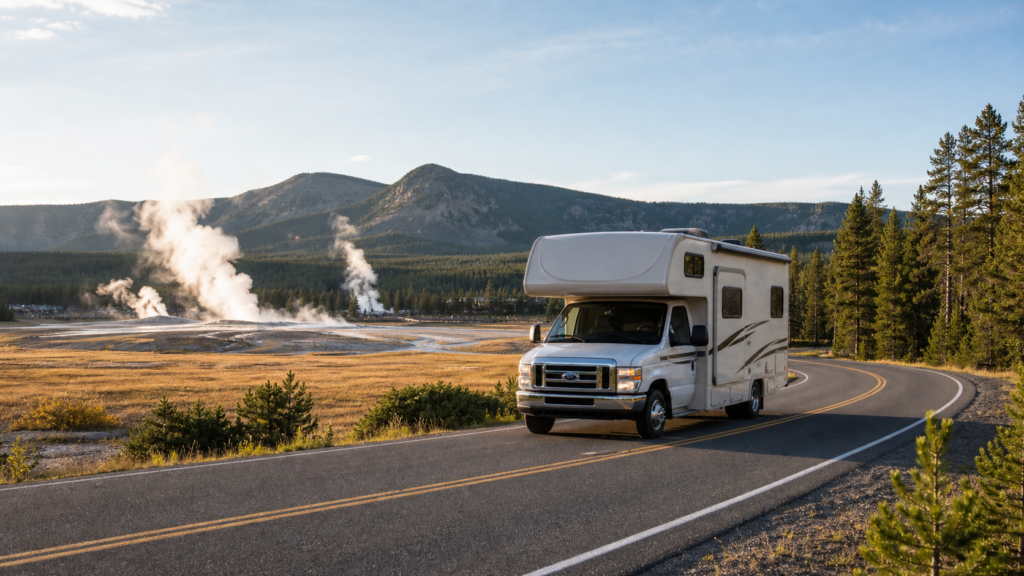
Yellowstone RV Trip Planner: Campgrounds, Road Closures, and RV-Safe Park Routing
Planning a trip in a RV to and from Yellowstone can be challenging due to snowfall and road closures. Snow and road closure can make Yellowstone RV trip planning tricky.
Yellowstone is easy to map. The roads are large circles, the well-known stops are well-known names, and the entrances appear to provide you with multiple entry points. The same map has more respect in an RV.
This Yellowstone RV Trip Planner focuses on the things that matter the most when you choose to bring your RV, campervan, travel trailer, fifth wheel or truck camper to Yellowstone: where you want to camp, whether the road is open, where you want to get in, where you plan to purchase fuel, where you plan your groceries, where you plan to dump tanks, where you would like to park, and how far you want to be from a legal overnight location when the day gets long.
Yellowstone is certainly a possibility in an RV. It’s not a park where I would let a car GPS, a loose reservation plan or a late arrival make the decisions.
Why Yellowstone Needs RV-Specific Planning
Large, seasonal, congested and service-limited are the characteristics of Yellowstone. Car route is not the same as a Yellowstone RV route.
The park links Mammoth, Norris, Madison, Old Faithful, West Thumb, Grant Village, Lake, Canyon, Tower-Roosevelt, Lamar Valley and five entrances. It can feel easy, and then get stretched out due to wildlife traffic, road construction, full parking lots, cold weather or slow campground arrival.
Don’t start planning the trip until you have answered the questions about the RV:
- What is the sum of your height, width, and total combined length when you are packed up?
- Can your campground site accommodate the RV plus tow vehicle, trailer or toad?
- Are the Yellowstone park roads you need open on your dates?
- Where will you be able to legally get fuel, dump, fill water, and get groceries?
- What’s your shorter backup plan if the weather, the fatigue, or closures alter the day?
If you haven’t built that workflow then begin with RoadReviewer’s guide to RV-safe route planning. Yellowstone is a rewarder of the same traits: measure first, confirm from official sources, and come with daylight left.
Quick Answer: Can You Visit Yellowstone in an RV?
An RV is an option for visiting Yellowstone.
Yes, it is possible to travel to Yellowstone in an RV. Reservations, season, rig size, and comfort level of driver determine easy or challenging RV camping in Yellowstone National Park.
Best Fit: Campervans, Small Class C Motorhomes, and Short Trailers
Typically, campervans, Class B RVs, small Class C motorhomes, truck campers and short trailers are the most flexible. They are able to accommodate more campsites and are more maneuverable in stopping at fueling stations, and they are less stressful in busy day-use spots.
Extra Caution: Large Class A Motorhomes, Fifth Wheels, and Long Towed Setups
There is a need to make reservations for large Class A motorhomes, fifth wheels, long travel trailers, and motorhomes with cars a little earlier and to be a little more conservative in their routing. There are limited long sites available and busy parking areas or tight campground loops can make the day challenging.
The key number is "total combined length". Count the tow vehicle, trailer, towed car, bike rack, cargo tray and anything else that alters the actual footprint.
Understand Yellowstone Park Roads Before You Build the Trip
When planning a trip to Yellowstone Park, it is important to understand the road conditions. It’s important to know the road conditions before heading out on any trip to Yellowstone Park.
The Grand Loop Road is the spine of most Yellowstone trips but isn’t a regular highway loop. The speeds are not that high, the stops are delayed, and traffic may be delayed for a period of time by wildlife or construction.
Seasonal Road Openings and Closures Matter
Routes involve closure of roads in Yellowstone. According to current NPS guidance, the only park road generally open year-round to regular vehicles is the route from the North Entrance at Gardiner, Montana, through the park to Cooke City, Montana, via Tower Junction, weather permitting. From early November through late April, most park roads are closed to regular vehicles; some limited oversnow travel is available during the winter months.
NPS provides projected regular-vehicle dates by segment for 2026 and all dates may change. Review the official road status page of Yellowstone before embarking on the journey and each travel morning. Your RV day changes with any pass, entrance, and/or construction zone change.
Do Not Let a Car GPS Choose RV Shortcuts
A car GPS does not always take the most convenient route. A car GPS doesn’t always take the most convenient route.
A generic navigation app doesn’t know your true length, height, turning radius, campground check-in time or your comfort with taking a narrow detour. Official NPS Road Status, State DOT outside the park, Campground Directions, Satellite View and RV-enabled routing should all be part of the plan.
Just like RoadReviewer’s Blue Ridge Parkway RV trip planner and Going-to-the-Sun Road RV trip planner, a popular road still needs to fit the rig.
Best Yellowstone Entrances for RV Travelers
The best places to get into the Yellowstone depend on the RV trip. There are five entry points for RV travelers, and the best one changes with the route.
For RV visitors, there is no one "right" way to enter Yellowstone. Select the entrance based on the basecamp, first park day, road status and approach route.
West Entrance: Best for West Yellowstone Services and Old Faithful Access
The West Entrance is convenient because West Yellowstone offers fueling, groceries, private RV parks, restaurants and services close to the gate. For Madison, Norris, Old Faithful, and the geyser basin corridor, west Yellowstone RV camping is a good choice.
North Entrance: Gardiner, Mammoth, and Year-Round Access
The North Entrance features Gardiner, Mammoth and Year Round Access. The North Entrance has Gardiner, Mammoth and Year Round Access.
The North Entrance at Gardiner is appropriate for Mammoth Hot Springs, the northern range and shoulder season planning. Gardiner Montana RV parks come in handy when you wish for services beyond the park and access to the northern corridor.
East Entrance: Cody Approach and Mountain Driving Considerations
If coming from the East you will need to take the Cody Approach and Mountain Driving considerations.
The East Entrance is the route to Yellowstone from Cody and the Sylvan Pass side of the park. It can be useful but be mindful of road conditions, grade and current weather conditions before committing a heavy rig, particularly early or late in the season.
South Entrance: Grand Teton Connection
The South Entrance makes sense as a Grand Teton to Yellowstone RV route. Schedule the two parks as a connected trip rather than a rushed add-on. This can be done in a few nights in each area, rather than moving the RV every day.
Northeast Entrance: Scenic but Not Always the Simplest RV Strategy
While the Northeast entrance is scenic, it isn’t always the simplest RV strategy.
The Northeast Entrance is helpful for Lamar Valley and to other destinations such as Cooke City, the Chief Joseph Scenic Byway and the Beartooth Highway. Take precautions when checking out seasonal conditions, mountain roads and services.
Yellowstone Campgrounds for RVs: What to Check Before Booking
When planning a trip to Yellowstone Campgrounds for RVs, there are several things to take note of.
Make Yellowstone RV camping reservations early. According to the current NPS campground page, there are 11 campgrounds, and more than 2,000 established campsites, with reservations required in advance except for Mammoth Campground’s first-come, first-served period from October 15 through April 1. However, just because it is a campground doesn’t mean it will be a good place for your RV.
Confirm Total Combined Length, Not Just Trailer Length
Not only trailer length, but also the total combined length should be confirmed.
Do measure the entire footprint you will take into the campground before making your booking. If it’s a travel trailer or fifth wheel, add the truck. If the motorhome is towing a car, add the toad! Add rear cargo carriers, bike racks.
Afterwards, look at the official campground page, the reservation site, generator guidelines, hookups, water, dump station, arrival instructions and approach road.
Fishing Bridge RV Park: Best Known In-Park RV Option
Fishing Bridge RV Park is the most popular in-park RV lodging.
Fishing Bridge RV Park is the most popular in-park RV, which is linked with full hookups and hard-sided RVs. The current NPS campground guidance lists Fishing Bridge as the only campground in Yellowstone that has water, sewer and electrical hookups and states that it is reserved for hard-sided vehicles only.
So, Fishing Bridge is a research hotspot, not a certainty. Check up on current dates, rules, type of site fit, length fit, and reservations.
Other In-Park Campgrounds Can Work, but Long Sites Are Limited
Although not all in park campgrounds can work, Long Sites are limited.
In some cases, depending on site availability and current rules, the following areas can accommodate some RVs: Bridge Bay, Canyon, Grant Village, Madison, Mammoth, Indian Creek, Lewis Lake, Slough Creek and Tower Fall. The NPS table also provides maximum RV-plus-vehicle length for each campground, but RV length information for each campground in Yellowstone should be updated before booking and before published.
When Outside-the-Park RV Parks Are the Better Choice
However, when outside-the-park RV parks are the better option.
Private RV parks off the park may be superior when it comes to bigger rigs, hookups, laundry, wider turns, fuel, groceries, and easy access. These gateway areas, such as West Yellowstone, Gardiner, Cody, Island Park and others, can make sense. A basecamp for the rig will often beat trying to cram the rig into every scenic mile, as RoadReviewer’s Pacific Coast Highway RV trip planner demonstrates.
A Practical Yellowstone RV Route Strategy
Construct the route around your rig, not attractions.
Basecamp Strategy: West Side, North Side, or South/Teton Approach
The two basecamp options are either from the west side or from the north side and/or south side and/or the Teton Approach.
A west-side base is suitable for the geyser basins, Norris, Old Faithful, and Madison. Base located on the north side is good for Mammoth and Lamar Valley. If you’re traveling throughout Wyoming and your Yellowstone National Park RV trip is on the south side or Grand Teton, it’s okay. The RVs that make the journey around the loop are the ones that have two basecamps that are better than one aggressive one.
Avoid Overloading One Day With the Full Park Loop
Don’t try to fit too much in on one day.
Most visitors do not have the time or budget to experience Old Faithful, Grand Prismatic, Canyon, Mammoth, Lamar Valley and Yellowstone Lake in a single day of their RV tour. Slowdowns occur in traffic, parking, construction and thermal-area stops.
Build Every Driving Day With a Turnaround Time
To create an every driving day is a turnaround time.
Place a time limit on your time away from camp. If the day is going long, discontinue sights and preserve the return.
Sample Yellowstone RV Itinerary Options
3-Day Yellowstone RV Trip: Choose One Side of the Park
This is a 3-day RV trip on one side of the Yellowstone Park. This is a 3-day side-by-side RV tour of Yellowstone Park.
Select one base for 3 days. From West Yellowstone or Madison, target Old Faithful, Midway Geyser Basin, Norris and perhaps Canyon, if time permits. From Gardiner or Mammoth look to Mammoth, Lamar Valley, and a northern-road plan.
5-Day Yellowstone RV Trip: West/North Loop With Buffer Time
Takes the West/North Loop route through Yellowstone with a buffer zone. This 5-Day Yellowstone RV Trip includes the West/North Loop with buffer time.
There’s a better balance to a 5-day trip with the RV in Yellowstone. Use west-side base for Old Faithful, Grand Prismatic, Madison and Norris. Then use a north side base or controlled longer day for Mammoth and Lamar or Hayden Valley. Maintain one partial buffer day for laundry, groceries, dump station, fuel, weather delays, or delays.
7-Day Yellowstone and Grand Teton RV Trip
You don’t need to make each day the moving day between Yellowstone and Grand Teton, as there are seven days available for you. Two nights near Grand Teton and three to four nights in or near Yellowstone for one basecamp change.
Fuel, Groceries, Dump Stations and Service Planning
Fuel, Groceries, Dump Stations and Service Planning.
It’s not the site for common sense at the last minute in Yellowstone. Check potable water, dump sites, stock groceries before long days at the park, and fuel before remote sections. Use an extra fuel allowance than the mileage estimate shows as there may be wildlife traffic, detours or full parking that adds miles and idle time.
Satellite-check fuel stops for canopy height, pump spacing, driveway slope, exit angle, and if you can leave without backing up for larger rigs. Current checking is also required at the Yellowstone RV dump stations, and NPS points out that dump stations (when available) can be closed if the temperature falls below freezing.
Best Time of Year for a Yellowstone RV Trip
When is the best time of year to go to Yellowstone on an RV? What is the best time of the year to visit Yellowstone in an RV?
Late Spring: Beautiful, but Road and Campground Status Still Matter
It’s not too late, beautiful, but still: Road and Campground Status Matters.
Late spring is great, but so are snow, staged road openings, cold nights, and limited services.
Summer: Peak Access, Peak Crowds
Summer is the most accessible time and pressure. Reserve early, camp early, and take short trips to Yellowstone campgrounds.
Fall: Strong RV Window With Weather Risk
Fall may be one of the best times to visit in an RV, as crowds are fewer and temperatures are cooler, but services might be curtailed and roads may close early.
Winter: Mostly Not a Standard RV Park-Road Trip
A winter RV road trip is generally not a typical RV park and road trip. Winter RV road trips are usually not your traditional RV park and road trips.
Winter is not an ordinary Yellowstone loop road RV season. Most interior roads are shut to regular vehicles, so only plan winter RV travel around a very specific northern-corridor strategy.
Yellowstone RV Safety Checklist
This is the Yellowstone RV Safety Checklist.
- Measure actual loaded RV height, width and total combined length.
- Make sure to check NPS road status before trip and every morning traveling.
- Verify Campground Reservation, Site length, Generator Guidelines, hookups, water, dump station, and arrival directions.
- Store offline maps and campground reservations.
- Fuel-up before going into remote areas.
- If necessary, select a legal overnight back up outside the park.
- Don’t camp in pullouts, parking areas, picnic areas or outside a designated campground.
- Avoid blocking traffic when planning wildlife viewing stops.
- Try not to drive at night within the park.
- Have an alternate route if weather, fatigue, construction or closures force a change of route.
Common Mistakes RVers Make in Yellowstone
There are some common errors that RVs make in Yellowstone. There are some common blunders that RVs make in the Yellowstone area.
Booking a Site Without Checking Combined Length
The length of your trailer doesn’t equal the length of your footprint. Before booking, please measure the complete truck and trailer or motorhome and toad length.
Treating Yellowstone Like a One-Day Drive-Through
Don’t think of Yellowstone as a day drive-through; the park is just too big and too slow. You can run out miles but you won’t have a lot of room to play.
Assuming In-Park Camping Means Hookups
In-Park Camping means hookups, doesn’t it? Does in-park camping mean hookups?
Services vary widely. Fishing Bridge is the primary in-park hookup, but other campgrounds offer different facilities and opportunities and have different seasons.
Waiting Until Inside the Park to Solve Fuel, Food, or Dump Stations
Fuel, food, or dump stations must be planned before the inside part of the park day. Fuel, food or dump stations should be planned before the park day.
Plan logistics in advance of park day. Things that take longer in an RV than in a car include fuel, groceries, propane, water, laundry and dump station needs.
Ignoring Road Status Because the Map Looks Open
When the map displays an open road, you may be tempted to press through it. If the map shows an open road, you might feel like going through it.
Yellowstone road closures make a huge difference to the trip. Old blog post and cached maps are not the authority, the official NPS road status page is.
FAQ
Can you drive an RV through Yellowstone National Park?
Yes, you can drive an RV through Yellowstone National Park. Yes, you can drive RV’s through Yellowstone National Park.
Yes. An RV can be driven through Yellowstone when roads are open to cars and motorhomes, but it depends on the campground fit, road status, weather, parking, and rig size.
What is the best RV entrance to Yellowstone?
Which is the best RV entrance to Yellowstone?
It will depend on your basecamp and route. The West Entrance is frequently useful for access to Old Faithful and West Yellowstone services. The North Entrance can be helpful for Gardiner, Mammoth and shoulder season planning. The South Entrance makes sense for the connections to the Grand Tetons.
Which Yellowstone campground is best for RVs?
What is the most suitable campground for RVs in Yellowstone?
Fishing Bridge RV Park is the most famous in-park RV accommodation, due to its hookups, but availability, rules, existing dates and rig fit should be confirmed.
Are there RV length restrictions in Yellowstone campgrounds?
Is there a maximum length for RVs at Yellowstone campgrounds?
Yes. Yellowstone RV length limits are different for each campground and site. See combined length (not RV length) and confirm official campground and reservation information before making a reservation.
Can you sleep in an RV in a Yellowstone parking lot or pullout?
Is it possible to sleep in an RV in a parking lot or pullout in Yellowstone?
NPS prohibits overnight vehicle parking or car camping on pullouts, parking areas, picnic grounds or anywhere in Yellowstone National Park except in a designated campground.
How many days do you need for a Yellowstone RV trip?
How many days you spend in your RV at Yellowstone depends on the schedule you have and what you want to see during your time.
Allow at least 3 days for one side of the park, 5 days for a more balanced Yellowstone journey and 7 days or more for a combination of Yellowstone and Grand Teton or multiple base camps.
Final RoadReviewer Advice
Avoid attempting to drive through Yellowstone on a single overloaded RV loop. Design the trip around campground fit, official road status, short driving days and leave options and daylight.
Right Yellowstone RV travel tips aren’t complicated: check first, drive carefully, and allow your RV to dictate the trip size. Check out the other RV route planning guides on Browse RoadReviewer’s Routes hub and Routes category.