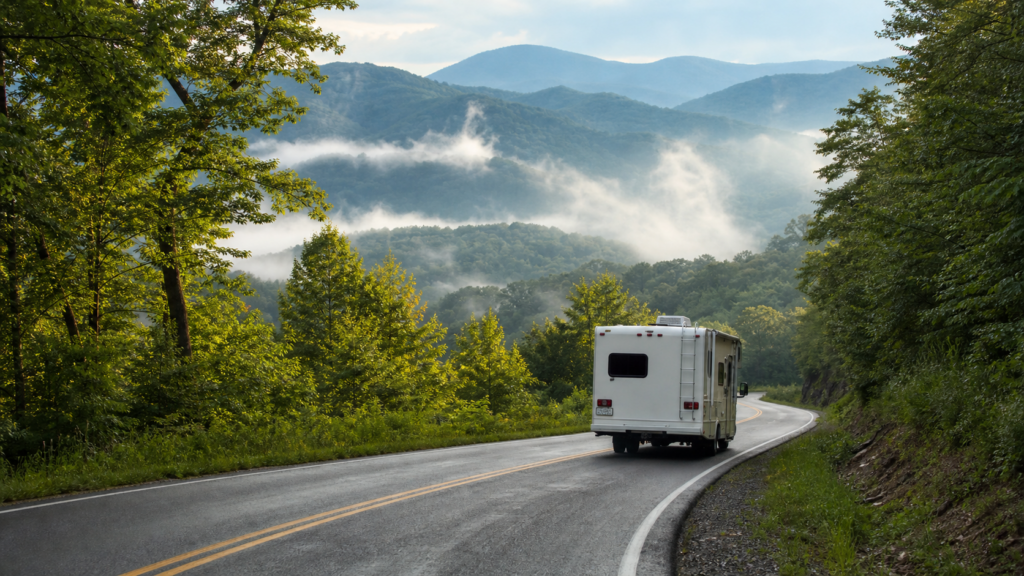
Great Smoky Mountains RV Trip Planner | Campgrounds & Roads
The perfect Great Smoky Mountains RV trip planner begins with the rig, not the post card image. If you’re mindful of the time and plan accordingly, the Smokies can be one of the most RV-friendly national park trips in the East, but it’s not the kind of trip I’d hand over to my car GPS to make the major decisions when traveling in a motorhome, fifth wheel, or travel trailer or camper van.
The park is located "between" Tennessee and North Carolina, and has active gateways such as Gatlinburg, Pigeon Forge, Townsend, Cherokee, and Bryson City leading to narrow valleys, steep grades, wildlife traffic and campgrounds that do not cater to every modern RV size. A passenger-car itinerary can go anywhere anytime and bounce back from a poor turn. Any RV itinerary must address site fit, daylight, legal parking, dump and water planning and a route that takes into account the height, length, weight and driver comfort of your RV.
If you haven’t finished developing your general route planning, use RoadReviewer’s RV-safe route planning guide first and then use this Smoky Mountains RV route plan to give your trip the necessary contours.
Great Smoky Mountains is a place that demands special planning for RVs.
Planning a car trip doesn’t necessarily translate to an RV trip.
The Smokies are a place for slower travel – but not for rushing RV travel. The tail swing of a compact car isn’t a major concern when it darts into a small overlook, turns at a narrow trailhead or idles through Gatlinburg traffic. There’s a different set of issues with a 31-foot Class C, or a long Class A, or a pickup with a travel trailer.
As you are getting ready for RV camping in the Great Smoky Mountains, jot these numbers down:
- True height with rooftop gear included
- Motorhome length or Trailer length
- Length of toad/tow vehicle combination.
- Width with mirrors
- Loaded weight, which is not the brochure weight.
- Mountain roads with fuel range.
Those numbers determine what campground sites are attainable, if a road feels comfortable, and if it is advisable to move the RV each day.
The park is open all year round, but there are still changes.
Primary park roads like Newfound Gap Road / US 441, Little River Road, and Cades Cove Loop Road are normally considered year-round roads as weather conditions dictate. That last phrase is crucial. A clean plan can turn turbid in an instant due to snow, ice, downed trees or storm repairs, wildfire risk, construction or congestion.
I would make sure prior to travel day that NPS roads were open for RV camping on Great Smoky Mountains National Park trips (not just before I left home). When you book the road may look OK, but it can be closed or restricted when you arrive.
Plan the trip based on the size of the rig, the fit of the campground, and the daylight.
A popular tip for the best Smoky Mountains RV trip is that it’s not necessarily the most stops it’s the best. It’s the one where you make it to the site in daylight, don’t get into any drama, pull in the RV when the road narrows and have a backup place to stay overnight that’s not in the park.
This is particularly true during leaf season, holiday weeks and summer weekends. People in crowds make everything slower. If you have a short drive in the nature area, it might end up being a long crawl! Take additional time with each move.
Yes, you can visit Great Smoky Mountains with an RV.
Yes, you can take an RV to Great Smoky Mountains, but it’s going to depend on the size of the RV.
Campervans, Class B, smaller Class C motorhomes and shorter trailers are best suited.
Campervans, Class B rigs, shorter Class C motorhomes and compact travel trailers make the easiest fit of Great Smoky Mountains RV campgrounds and scenic roads. These rigs are still a bit trickier to route but are easier to park, easier to turn and less stressful to drive on narrow approaches.
Special precautions – big Class A motorhome, long fifth wheel, truck/trailer units.
If a large class A motorhome, long fifth wheel or long truck/trailer combination is required, a more conservative plan is needed. You can go, but it doesn’t mean you should. It implies that you should not improvise, check the dimensions of the campgrounds, and base on gateway-town roads when roads become tight.
If you’re looking for a larger rig, then the smarter RV safe route to Great Smoky Mountains might be one of the private RV parks in Townsend, Pigeon Forge, Gatlinburg, Cherokee or Bryson City with a tow vehicle to use for daily sightseeing purposes.
The option to park for a full day or even week at a gateway-town base is a godsend for a vacationer.
Park once if you’ve got a long rig, your driver is unskilled at mountain driving, or your family is more interested in hiking and sightseeing than moving camp. The ideal basecamp minimizes the chance for late night camping, packed trailheads, tight turns.
Great Smoky Mountains RV Campgrounds: Things to Take into account before Reserving a Campground.
Don’t pick just the campgrounds that are near the attraction you see online but are not suitable for your actual RV and route. Most frontcountry camping in the park is dry camping and is popular, convenient and scenic.
Cades Cove Campground is best for getting to Cades Cove and west side of the park.
Cades Cove Campground RV planning is best for a trip around Cades Cove, Townsend, Little River Road and the west side of the park. Although convenient, there are still some things to check out before you book: site length, generator hours, quiet hours, dump station and potable water, and one-RV-per-site rule.
When you arrive early and are patient, Cades Cove RV camping can make for an excellent experience. It’s not as entertaining when attempting to "squeeze" a lengthy rig into a busy day-use pattern during rush hour.
On the North Carolina side, Smokemont Campground would be best for access via US 441.
Smokemont Campground RV visitors typically select it on the Cherokee side and Oconaluftee side of the park. A solid foundation for the North Carolina side, and a solid foundation for a well-planned Newfound Gap Road RV day, as long as you can fit in your site and the weather cooperates.
Smokemont is also helpful for a split-stay trip or if you don’t wish to go back over the park on a daily basis.
Elkmont Campground: excellent location, but check the length of the site very carefully.
The property is a desirable location for Elkmont Campground RV planning with excellent access to Little River Road, Sugarlands area, and west-central park. The “caution” is site fit. Be sure to book by campground name. Make sure that the length, access angle, parking pad, and length of tow vehicle/trailer (if applying) is listed for the particular site.
Look Rock Campground: Foothills Parkway base, with uncommon hook-up facilities at certain sites.
The Look Rock Campground can be a convenient Foothills Parkway staging area, particularly for those seeking a more secluded west-side experience. Additionally, NPS currently has a listing of ten sites equipped with electric and water connections, which is not typical in the park. Please check the hookup information for the site before making a booking as hookup availability may vary from one site to another, and from season to season or maintenance schedules.
Cosby, Deep Creek and other considerations for the season’s campground.
Seasonal campgrounds, such as Cosby and Deep Creek, can be a good choice for smaller rigs and those who prefer more secluded areas of the Smokies. They need to be the same discipline: operating dates, length of the site, approach roads, dump stations, potable water, generator hours, and location for sightseeing.
Verify length of site, rules, hours of generator, dump stations, water and parking tag
Before you make reservations for any Great Smoky Mountains RV campground, check Recreation.gov and NPS websites for specifics:
- Site length and driveway type, if known, exactly.
- If you and/or your tow vehicle and trailer will fit on the site
- One-RV-per-site rules
- Generator hours / quiet hours
- Potable water sources and dump stations are marked.
- Shower expectations outside of the park
- Parking tag rules for parking off-site of campgrounds.
- Firewood rules
Remember, when you see RV site, it is not your RV site, in a National Park.
Avoid some of the roads that have been designated as restricted!
The Newfound Gap Road / US 441 is a scenic, useful but mountain-driving serious road.
People travel the RV way on Newfound Gap Road, but it’s not something to be taken lightly. Elevation change, curves, grades, changes of weather and heavy traffic are part of US 441, the primary road within the park between Gatlinburg and Cherokee. I wouldn’t necessarily take it as a guaranteed path for all rigs.
It could be a sensible scenic crossing for a smaller motorhome or camper van in good weather. If you have a long 5th wheel or the driver doesn’t like to drive downhill, you might be better off camping on one side, touring locally, and then using the wider outside roads to get around the park as necessary.
Little River Road: a beautiful road, but it’s narrow enough that patience is required.
Little River Road is a classic Smokies drive, although NPS cautions drivers on trailers, RVs and buses to be careful on the section between the Townsend entrance and Elkmont. Be prepared for tight roads, sharp turns, traffic and distracted drivers. If you are blocking up faster traffic, use pullouts; and don’t force a stop on the roadside if the parking area isn’t designed for that type of rig.
The traffic and timing issues as well as the practicality of RVs on the Cades Cove Loop Road.
Grade is not the major issue on the Cades Cove RV route; it’s more about timing, congestion and patience. This loop is scenic and historic but watch out for wildlife that can cause you to drag behind. The primary concerns for RVs are if the loop is open for vehicles that day, if they will be able to park legally, and if the driver will be comfortable driving a vehicle slowly with limited opportunities for escape.
The loop might be feasible if you’re at Cades Cove Campground and have a smaller RV. I would definitely highly prefer a tow vehicle or a smaller runabout or early/late plan on a long rig.
Highways on which the use of RVs, trailers, or buses is prohibited or strongly discouraged.
Not all Smokies roads are accessible to all RVs. Several secondary roads are designated in the official NPS guidance and have restrictions or cautions that, in some areas, prohibit trailers, RVs, buses, motorhomes longer than a specified length or towed combinations. These include Roaring Fork Motor Nature Trail, Rich Mountain Road, Heintooga Ridge Road, Balsam Mountain Road, Greenbrier past the ranger station and other narrow and/or seasonal roads.
Keep in mind when it comes to RVs driving down a road: if it is secondary, narrow, gravel, one-way, steep or a motor nature trail, check it out first.
Before every travel day, RV travelers should verify road conditions at the NPS website.
There is too much weather and congestion variation in the Smokies to check once a week. Before moving the rig, check NPS alerts, seasonal road schedules and current road conditions. If it doesn’t seem like a good day, park the RV and opt for a less risky option.
Best RV Basecamp Strategy by Entrance
Townsend will provide practical access to Cades Cove from the west side, and quieter staging.
Townsend TN RV camping is quite often the quietest west-side approach. It is also close to the entrance to Cades Cove without being forced into the busiest Gatlinburg daily route. Townsend is the sensible starting point for many RV travelers for a day at Cades Cove, Little River Road, Foothills Parkway and for more leisurely family cruising.
Services, private RV parks, and crowd trade-offs at Gatlinburg / Pigeon Forge.
Gatlinburg RV parks and camping are near restaurants, supplies, attractions, repair services, and the Sugarlands entrance. In exchange, they have to accept traffic. If you are going to be staying here, then book short driving times and do not expect to be able to move quickly through the town during rush hour.
On the North Carolina side, Cherokee is a base for Oconaluftee and Smokemont.
Cherokee NC RV camping is suitable for Oconaluftee, Smokemont, south side of Newfound Gap Road and potential connection to Blue Ridge Parkway. It’s a good choice for a day trip that you want the NC side to be more than.
Bryson City/Deep Creek: the more relaxed southern side route for smaller rigs.
Bryson City and Deep Creek are good for travellers seeking a quieter base on the southern side, particularly if in a smaller rig. This side works well in conjunction with a slower Smokies trek, though scan the approach and don’t take for granted that every mountain road traversing the neighborhood is RV friendly.
When you need to use a tow vehicle or shuttle local plan to leave the RV parked
When it comes to parking, if the area you are visiting is congested or has limited parking, or if you know of a problem with congestion, leave your RV. Tow vehicle, local shuttle or smaller day plan. The same “park once” philosophy that is effective in other overcrowded national parks, such as RoadReviewer’s Zion RV trip planning, applies.
A planning strategy has been developed for the Cades Cove RV.
Driving the loop in an RV?
Sometimes, yes. Always, no. Campervans or compact Class C’s have a better argument than a long motorhome or trailer. Even in that case, I would only take the loop when it’s open to motor vehicles, the weather is fine, parking is reasonable, and you don’t mind going slow.
When towing, carefully consider whether or not to take the trailer around the loop. I don’t want extra length on a busy Cades Cove Loop Road for no apparent reason unless the rules allow for it.
Vehicle-free Wednesdays and why timing matters
NPS has May 6 to September 30, 2026, listed as Cades Cove vehicle-free Wednesdays. Even that plan should be verified near the time of publication and then again before traveling. The loop is for walking and biking on vehicle-free days and oversized parking is limited. Never head an RV up/down at Cades Cove on Wednesday during that season without a plan.
Parking tags, wildlife traffic, and realistic loop timing.
Great Smoky Mountains National Park is not a typical entrance fee park. Vehicles must have parking tags if parked longer than 15 minutes unless a valid exception exists, and parking tags do not guarantee parking spots.
That means for Cades Cove to not simply ‘show up’ but to come early or later in the day, to have wildlife interruptions, to always park legally, and to have water, snacks and patience.
When Cades Cove is too crowded for your rig, there are safer alternatives available.
If Cades Cove appears to be too busy, move the day. Take a walk at a rest day on Foothills Parkway, a Townsend-based rest day, a visitor center stop, or a short hike from a parking area that will accommodate your vehicle. Only a missed loop is better than putting a long RV in a bad traffic situation.
Here’s a practical 3-day Smoky Mountains RV itinerary that you can use.
Arriving and setting camp, and keeping the first drive short.
Arrive during daylight hours; fuel outside park; check in; level rig; and determine dump/water needs. Stay light on sightseeing: Sugarlands, Oconaluftee, Townsend or a local sightseeing lookout based on base. Cades Cove and Newfound Gap Road are not the best course for a late afternoon activity after a long day of traveling.
Another early starting day for Cades Cove or the west side scenic day.
If staying at Townsend or Cades Cove, opt to use Day 2 at Cades Cove with an early start, a vehicle-free-day check and a parking tag plan. If the loop is too full or impractical for your rig, proceed on Little River Road with care, Foothills Parkway or a plan on the westside of the river.
Day 3: A day of Newfound Gap / Oconaluftee or a route on the N.C. side.
Day 3 is reserved for Newfound Gap Road / US 441 when weather, roads and drivers align. Smaller rigs can cross and explore Oconaluftee. This might be a better option for larger rigs in that they can remain on the side they want and tour with a tow vehicle.
A 5- to 7-Day Smokies RV Route
Consider adding Blue Ridge Parkway after determining rig comfort and road conditions.
The Smokies go hand in hand with the Blue Ridge Parkway RV trip planner, but don’t add it randomly. Parkway driving includes overlook, grades, curves, tunnels and weather exposure. It looks great in the appropriate rig and speed. It is not a quick-fix.
Avoid back-tracking and stay on the path to success by splitting your night between Tennessee and North Carolina.
Most of the time a strong 5- to 7-day Smoky Mountains RV tour will utilize two bases: Townsend or Gatlinburg/Pigeon Forge in Tennessee and Cherokee or Bryson City on the North Carolina side. This helps to minimize backtracking each day and aligns each sightseeing day to the closest entrance.
Incorporate laundry, dump, grocery, weather and rest buffers.
Service days should be planned for trips that are longer in duration. Empty dump tanks before they get to be a problem. When available, refill potable water. Purchase food outside of the park. Allow for rain, fog, traffic and a day when everybody needs to get off the road!
Traveling to the Great Smoky Mountains by RV? Follow the checklist below to make sure you’re prepared:
Before you depart, check this out:
- Obtain the true height, width, motorhome length, trailer length, total combined length and loaded weight.
- Check all campground locations on Recreation.gov and on current NPS Web pages.
- Monitor NPS alerts, seasonal road timetables and road closures.
- Check if parking tag is required and buy/print if necessary.
- Check dump stations, potable water, generator hours, quiet hours, and hookup status.
- Use fuel outside the park as in-park fuel services are limited.
- Save off-line maps and campground confirmation.
- Schedule backups for legal overnight stays.
- Do not take car-GPS shortcuts on mountain roads.
- Make the first and last travel days short.
Common Great Smoky Mountains RV Planning Mistakes
Typically, a national park road is an easy RV road.
The streets within national parks can be narrow, old, scenic, and crowded. Don’t think of them as guarantees but as roads that need to be prepared.
Reservations are made prior to determining the actual length of the site and vehicle regulations.
A campground might be RV friendly, but the particular area might not accommodate your RV. Look at the site, not just the campground.
Don’t try to do a tour of Cades Cove at the wrong time of day!
Cades Cove is sometimes quiet and sometimes excruciatingly slow. Timing is key – particularly for RVs.
Most of the in-park camping is dry camping and you need to plan for that.
Make plans for tanks, batteries, use of generators and showers. For those who require full hookups, private RV parks might be more suitable than those within the park.
Letting a car GPS choose the mountain route
A car GPS has no idea how high, how long, how swinging, how comfortable your car’s brakes are, and how you drive into a campsite. Verify each route off the main corridor.
FAQ
Which is the best Great Smoky Mountains campground for RVs?
Not every campground is best for every RV. Cades Cove is good on the west side, Smokemont is good on the NC side, Elkmont is a central location and Look Rock might be useful if you have hookup-equipped sites on Foothills Parkway. The ideal option is the campground that has a specific site that will accommodate your rig and align with your route.
Is it possible to drive through Cades Cove?
Depending on the time of year, if Cades Cove is open for motor vehicles, you might be able to drive through it with your RV, but it would not be something I would do without careful consideration, especially for larger rigs and trailers. Always find out about vehicle-free days, parking regulations, traffic conditions and predictions.
Do Great Smoky Mountains National Park campgrounds have hookups?
The majority of frontcountry camping in the parks should be treated as "dry camping". NPS now indicates that electric and water connections are available at some of the Look Rock locations, but limited 5-amp electric outlets are available at some other campgrounds, strictly for medical equipment only. Always check your location before making a reservation.
Yes, RVing is allowed on Newfound Gap Road.
Some RV travelers are able to travel on Newfound Gap Road, but the definition of “safe” is dependent on the size of the rig, the skill of the driver, the weather, traffic, and the condition of the road. A smaller rig in good shape doesn’t have the same risk profile as a long fifth wheel or large motorhome.
Is it necessary to reserve any Smoky Mountains RV camping?
Make reservations at in-park frontcountry campgrounds via Recreation.gov and check rules prior to traveling. During the busy seasons, popular RV sites can come and go just as fast.
So, where can a big RV park near Great Smoky Mountains?
Large RVs perform best at private RV parks in gateway communities like Townsend, Pigeon Forge, Gatlinburg, Cherokee, and Bryson City. A gateway base allows for use of a tow vehicle or smaller local transportation for narrow park roads and busier sightseeing locations.
It’s a wrap: The Smokies pay off the RV traveler who plans on the safe side.
A good Smoky Mountains RV trip isn’t necessarily about how much you can fit in a day. It’s based on the rig you’re driving, the camping site you’re at, the road conditions when you’re moving out and the patience to park the RV.
Measure first. Book carefully. Check official conditions. Arrive in daylight. Keep backup copies outside the park. If you do, then Great Smoky Mountains can turn into a hands-on and memorable RV vacation rather than a mountain-road guessing game.