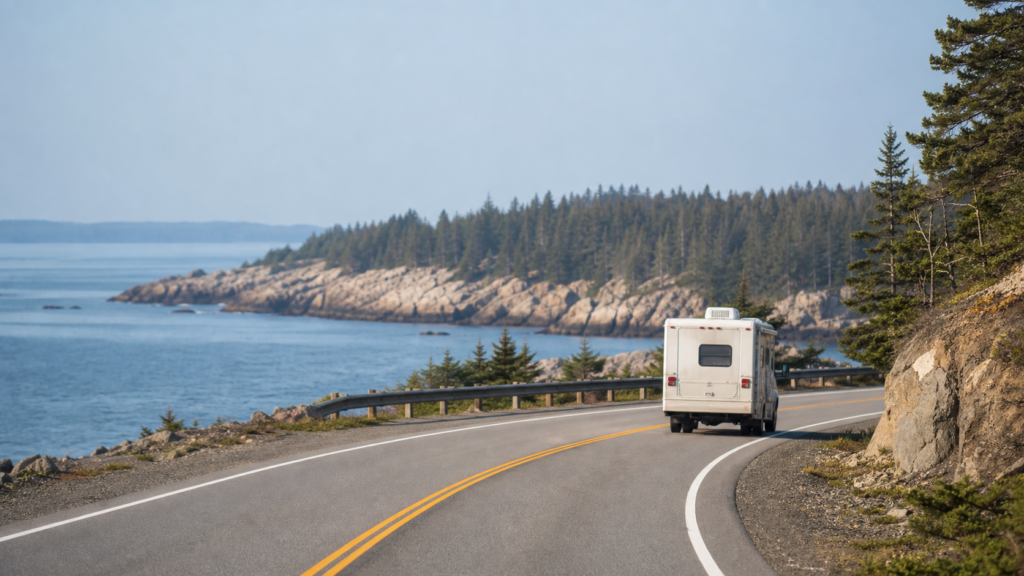
Acadia RV Trip Planner | Campgrounds, Roads & RV Tips
It’s easy to get the wrong idea of how big or small Acadia is on a map until you attempt to navigate an RV through the heat of July. Low clearances, narrow village streets, historic park roads, small lot sizes on the trailheads, and scenic drives were not built for modern motorhome and long truck and trailer use on Mount Desert Island. It doesn’t mean RV camping at Acadia National Park is a bad idea, however. It has a code of conduct, and that’s that if you’re coming to Acadia, you are coming as a tourist, but you’re not coming as a tourist runabout.
This Acadia RV trip planner is written as if I were planning the trip for my family, and measures the RV first, reserve the campground in line with the way I want to explore, checks all restricted roads ahead of the trip day, and has a smaller transportation plan ready for Bar Harbor, Cadillac Mountain and the busiest ocean-side spots. If you already have our RV-safe route planning checklist, Acadia is just the place for that additional homework.
Planning means tackling the size, road and crowd constraints necessary to make Acadia an RV friendly trip.
Acadia is RV friendly because the park offers campgrounds that can accommodate RV guests, some nearby private parks and sufficient transportation facilities to make a hassle-free visit. Not RV friendly as in the quality of having the ability to drive anywhere a car can go.
Not all RV travel plans are appropriate for every RV.
The typical car trip involves: starting in Bar Harbor, driving down Park Loop Road, stopping at Sand Beach, visiting Thunder Hole, driving to Jordan Pond, and seeing the sunrise or sunset at Cadillac Mountain. But in a compact SUV, that’s acceptable. That could become a stressful day of missed turns and full lots if it’s a 31′ Class C, a truck camper hanging off the back, or a travel trailer that isn’t hooked up since it’s later in the day to check in.
When planning a route at Acadia, think vehicle before viewpoints. Some roads in the park have height restrictions and some lots restrict parking of RVs and trailers and Cadillac Summit Road has its own rules which can prevent an RV or trailer from parking even if the driver has a reservation.
Before booking, it is essential to be aware of the three numbers of planning.
Before you reserve a campsite or rely on a mapping app, make a note of these numbers:
- Total height (Air conditioners, satellite domes, roof racks and vent covers included).
- The overall length of the vehicle when bike racks, cargo trays, hitch attachments, etc. and a spare tire are attached.
- Combination length when towing (from front bumper of truck to back of trailer).
The final number is the one which many first-time Acadia visitors misjudge. An RV-friendly site may be listed on a campground, but it does not necessarily take into account the angle of the driveway, trees, site pad, tow vehicle parking, or the turn into the loop. That’s why we recommend that you RV in Acadia just as we do for our Yosemite RV trip planner: RV allowed does not mean your exact setup fits comfortably.
When a campervan or small Class C is on a very different trip than a long fifth wheel.
Driving a campervan through Acadia National Park is not the same as having a travel trailer or fifth wheel. When posted rules allow this, more standard parking areas may be used for a Class B or small Class C. A large trailer or fifth wheel should be considered a campground to campground vehicle. Explore, un-hitch, and stabilize using tow vehicles, bikes, shuttles, taxis or on foot.
Yes, you can visit Acadia National Park in an RV.
You can certainly go to Acadia in a RV, but the ideal trip is typically developed on a basecamp basis.
The answer is yes; however, some roads and parking lots are not suitable for RVs.
There are two primary campground areas of Mount Desert Island and an additional campground area at Schoodic Woods on the Schoodic Peninsula. That will give the RV traveler a few viable bases. It’s not nearly enough that you’re coming close to Acadia, it’s that you think the rig should be used for ALL in-park errands.
Park Loop Road is handy but there are some sections where you may have to be careful about the height of your vehicle and also some congested pullouts. Cadillac Summit Road is NOT an RV/Trailer Friendly Road. Oversized vehicle restrictions exist on several popular areas, such as Sand Beach, Jordan Pond South, Bubble Pond and parts of the Schoodic area; these should be reviewed in accordance with the current guidelines provided by NPS before driving.
Traveling in an RV is an excellent way to explore Mount Desert Island and Schoodic Peninsula.
Smaller rigs make the most comfortable Mount Desert Island RV camping experience, as they don’t take up as much space as larger models, which include campervans, truck campers, short Class C motorhomes and compact trailers that fit and don’t overcrowd their reserved camping spot. There are also larger motorhomes and fifth wheels that can be used to make a great Acadia trip, but they will require more discipline. Choose a base, get there outside of peak traffic if possible and do not drive around in the park with the full rig all in one go.
Schoodic Peninsula RV camping is less hectic. The location on the mainland is further from Bar Harbor, but provides a quieter Acadia rhythm, and may be a good choice for those who prefer space over nightlife.
I sometimes wonder why bigger rigs don’t use a basecamp approach rather than drive around the park every day to see what happens.
The basecamp philosophy is to park the RV once, and then move people around, rather than the house. We would apply the same reasoning to the Great Smoky Mountains RV trip planner, where no, we don’t want to drive all day long because of the crowd and the lack of parking.
In Acadia, that involves making shopping trips, disposing of garbage at dump-stations, picking up shuttles, hiking to the next site, walking on tides, and finding a meal in Bar Harbor based on the campground where you are staying. Riding a large rig through village traffic as infrequently as possible makes the trip better.
Which Base will You book at Acadia National Park RV Campgrounds?
Not only which campground is available, but which campground is the best for your RV trip depends on what type of trip you are planning.
Best for east Mount Desert Island and Park Loop Road access.
Blackwoods Campground is the quintessential east side Acadia base camp. It will bring you near Bar Harbor, Ocean Drive side of Park Loop Road, Sand Beach, Thunder Hole, Otter Point and many of the park’s most popular first-visit sites. Blackwoods is convenient if your plan is designed around having to get up early on Mount Desert Island and if you have a rig suitable to the site you reserved.
The price is crowd pressure. Many visitors park on East Mount Desert Island, and it fills up early in the summer. Don’t treat Blackwoods as the opportunity to "go big" in transportation, rather as a starting point for smaller transportation.
Seawall Campground is the quieter west side base closer to the coast.
Seawall Campground is located on the west side of Mount Desert Island where it is less busy. It’s ideal for guests seeking a more relaxed base for coastal exploration, convenient access to the “quiet side” of villages and a bit further from the busiest road in Bar Harbor. If you can schedule one day for exploring west and one day for a timed outing to the Park Loop Road, you will find a Seawall Campground RV plan to work well.
Don’t book Seawall because it seems it would be quieter. Always confirm site length, road approach, generator rules and services before commitment. There are no hookups at Blackwoods and Seawall, but there is a dump station at both; sites with electric and electric-and-water hookups at Schoodic Woods.
Schoodic Woods Campground is located on the mainland and has a more relaxed and less touristy atmosphere.
The park’s mainland RV base on the Schoodic Peninsula is the Schoodic Woods Campground. It is pulled out of the Bar Harbor orbit at the point. A Schoodic Woods Campground RV stay allows you to enjoy rocky coastline, biking and a less hectic version of Acadia.
The compromise was to sacrifice distance from Mount Desert Island. If you are looking for Cadillac Mountain sunrise attempts and dinners in Bar Harbor everyday, schoodic will seem far. If you desire breathing room, and a safer foundation for a bigger rig, then it might be the better choice.
Duck Harbor is not a typical RV choice for a lot of reasons.
Duck Harbor is not an RV Park – it’s a boat access site on Isle au Haut. Look for Blackwoods, Seawall, Schoodic Woods and private RV parks off park for normal Acadia National Park RV camping.
When booking a site, what are the things to check?
Prior to booking any Acadia campground reservations, check:
- Exact length of site and if tow vehicle space is included.
- Site surface, Back in or pull through layout, driveway grade.
- Generator hours and quiet hour rules.
- Potable water and access to dump stations, and whether connection is possible.
- Current reservation release dates and seasonal operating dates.
NPS currently sends campers to book reservations on Recreation.gov. 90 percent of campsites for Blackwoods, Seawall and Schoodic Woods are sold 6 months before arrival, on the first of each month at 10 am EST with the remaining 10 percent sold 14 days before arrival. Campsites may be available for same-day online reservations.
Along with its beauty and utility, it’s not a party zone, either, for RVs.
One of the attractions of Acadia is Park Loop Road. It’s likewise the place where poor RV planning becomes readily apparent.
Park Loop Road is a great asset for RV travelers and at the same time a place where it is quite limiting.
Park Loop Road serves as a convenient route to connect scenic stops, trailheads, picnic areas and coastline on the right-sized vehicle. In larger rigs, it’s a road that should be taken with caution. Sections are one-way, parking usually fills up early and this road was designed for historic landscape use, not for large cars.
If your Acadia RV routefinder is just a car-GPS route, take a breath and verify the park regulations first.
In Acadia, low bridges and one way streets are common and height is important.
In the current guidance on the NPS oversized vehicle list, low-clearance issues on Park Loop Road are identified as historic bridge clearances and some closures. That is why it’s important to know the actual roof height. A motorhome that’s about 12 feet on paper could be more if you include the accessories.
This is the same attitude we have on the Blue Ridge Parkway RV trip planner: Roadways that are beautiful can also be quite difficult.
Traffic is allowed at certain parking lots, such as Sand Beach or Jordan Pond and Bubble Pond to accommodate RV plans when they require careful consideration.
Some of the lots that are most popular to live on in Acadia are not RV locations. Existing NPS oversized-vehicle information includes Sand Beach parking lots, Jordan Pond South Parking Lot, Bubble Pond Parking Lot, and portions of the Schoodic road system. Those names will be red flags for your plan. If you need a big rig to park at one of them during the day, then rebuild the day.
There are a number of reasons why road signage and official NPS restrictions come before any app.
Traffic and distance uses navigation apps are helpful. They are not the final decision makers on RV access. Even on the App’s shortest route, stick to the posted signs and instructions at the campgrounds and follow current NPS alerts in Acadia.
Cadillac Mountain and Cadillac Summit Road: What RV Travelers Need to Know
Cadillac Mountain is a destination on the bucket list. Cadillac Summit Road is NOT an RV shortcut.
There are a number of reasons why RVs and trailers should not be planned for Cadillac Summit Road:
Presently, NPS regulations prohibit the use of recreational vehicles or trailers on Cadillac Summit Road, and require that vehicles be less than 21 feet long, including any attachments like bike racks or hitch gear. The existence of a valid reservation doesn’t change that rule. When the vehicles go over the limit, even if you had reserved a spot, you may not be able to get in.
Cadillac Summit Road is like one of our popular restricted scenic roads in our Going-to-the-Sun Road RV trip planner—the solution can be a different vehicle, a different route, or a different experience.
This section discusses vehicle reservations, entrance passes and why a reservation does not solve vehicle size limits.
Cadillac Mountain vehicle reservations are in addition to the park entrance pass. According to NPS, the 2026 reservation season on Cadillac Summit Road will be May 20 – October 25, 2026. The vehicle reservations are $6 and available online via Recreation.gov, with 70 percent sold two days early starting at 10 am ET, and 30 percent sold 90 days out.
The important planning element is stable: a time slot is assigned to an eligible vehicle at the time of the reservation. It doesn’t count as an oversized RV.
Better Cadillac Mountain strategies: tow vehicle, smaller runabout, shuttle/taxi planning, or hiking options.
The safest Cadillac option is to not use the RV and instead use a proper passenger car. If you’re not driving, then take a taxi or another local form of transportation, if available. The NPS does not currently provide information on the use of the Cadillac by the Island Explorer bus system, so do not plan your trip around a shuttle that may not run to Cadillac.
If conditions, fitness, daylight and weather are right, strong hikers should consider trail options. It is a HIKING PLAN, not an RV PARKING PLAN.
Determine sunrise without moving the RV!
The popularity of the sunrise on Cadillac is based on the drama, which is not easy. When traveling, make sure to have a reservation, entrance pass, vehicle size compliance, an offline confirmation code, warm layers, and a backup plan. You may have trouble accessing your cell phone, and you don’t want to find out that your bike rack makes your car too long to fit in the parking lot.
Schoodic Peninsula RV Strategy
The portion of Acadia that RVers should consider more seriously is Schoodic.
An Acadia RV may choose Schoodic Woods as a base.
Schoodic Woods offers RVs a park campground on the mainland side of Acadia, away from the heavy traffic on Mount Desert Island. It is particularly appealing for the larger rigs, bikers traveling the Acadia shoreline, and families seeking the Acadia coastline without the constant problem of Bar Harbor congestion.
You should avoid travel on some roads on Schoodic if you have an over-sized vehicle.
Oversized-vehicle restrictions are currently recommended by NPS for Schoodic Head Road and sections of Schoodic Loop Road and Arey Cove Road. But that doesn’t mean Schoodic is out of the question. It implies that you need to put the rig where it rightfully belongs, and dig around on the peninsula in a smaller rig, bike or on foot.
Once the rig is in the parking lot, how to explore Schoodic safely.
Slow down, bike or walk and park early while enjoying the tide-aware coastline stops on Schoodic. Do not park the RV in the restricted areas, avoid parking on the shoulders and do not block an emergency access point for a photo stop. The best way to do Schoodic is to not try to “cover” it, but to let the peninsula set the pace.
In Bar Harbor, on Mount Desert Island, traffic and RV parking is a reality.
When your campground or private RV park has convenient access to town to RV camping in Bar Harbor, you will find it very convenient. That’s another story when it comes to driving an RV in Bar Harbor.
While Bar Harbor is convenient, it’s not necessarily RV-simple.
Bar Harbor can be a very uncomfortable place when you’re traveling in a large RV on village streets and walking, on restaurant streets, with cruise ship passengers, delivery vehicles and on those narrow streets where you can’t get wide enough. If you are staying out of town near Trenton, Ellsworth or any other private RV park, schedule your trips to Bar Harbor in advance, rather than "just driving in."
Campground basecamps are used to reach the Island Explorer via bike, taxi or tow.
An Island Explorer Acadia RV strategy is useful when there are seasonal routes in operation and these routes lead to your campground or destination. For 2026, Island Explorer notes limited service in the spring from May 20 to June 22; in summer from June 23 to August 16; and in fall from August 17 to October 12; check to confirm the actual path. Buses, bikes, taxis and tow vehicles all have the same objective: to park the RV in a legal, comfortable parking location. Much like our Zion RV trip planning suggestions, the best oversized-vehicle trip is one that isn’t moving the oversized vehicle.
The timing rules for summer, fall foliage, weekends and cruise-ship/crowd days are provided.
If you’re looking for the best summer and fall colors, be prepared for the first parking plan to fall short. Play early, don’t wander around in the hot part of the day and leave one stop flexible per day. A greater margin is warranted on weekends or days when there is heavy crowding. Acadia is stunning in all weather, so a foggy morning or a rainy afternoon may be the best day for now if you are ready.
A practical 3-Day Itinerary for visiting the Acadia RV.
This Acadia National Park RV itinerary does not mean you are required to stick your rig into rough environs.
On Day 1, come and settle the rig and stick to the first short drive.
Come early, if possible. Take a quick walk or do a sunset drive in a smaller vehicle, confirm the RV hookups or dump sites, check the next day’s road alerts, and set the RV. Don’t do your first Acadia run on a Park Loop Road with an unfamiliar campground exit.
Click here to read some tips on selecting the right size vehicle for Day 2: Park Loop Road / Ocean Drive.
Drive the smallest legal size car. Early start times for Ocean Drive and Sand Beach area viewpoints where possible, timing at Thunder Hole, Otter Point, and planning at Jordan Pond. If you have the RV, it’s big, target legal pullouts and avoid lots where there are restrictions or crowding, as the plan is weak.
The Schoodic peninsula or westside Mount Desert Island, without having to overdrive the RV!
Pick a less stressful day. Based out of this point on Mount Desert, head west or take a longer trip with the appropriate vehicle on the Schoodic outing. Stay local, take in the peninsula rather than the commute.
A 5- to 7-Day Acadia RV Route
As time goes on, Acadia is more about choosing good weather windows, and less about checking boxes.
If the time permits divide it between Mount Desert Island and Schoodic.
It may be a good idea to split it up: Blackwoods or Seawall for Mount Desert Island, and Schoodic Woods for the mainland side. It’s not easy to move these campgrounds, but it also eliminates the need for numerous long drives and it can bring two different personalities to the trip.
Include wash buffers, groceries, weather, dump stations and slow traffic.
When every day of the RV trip is full, then it will not go the distance. Include a day of low-mileage, such as shopping, laundry, tanks, propane, repairs, or just plain rest. The weather conditions along the coast of Maine can turn a hike or scenic drive into a mood swing in an instant, and a buffer day can give you the opportunity to place a hike or scenic drive in the better window.
If you’re near Bar Harbor, Trenton, Ellsworth or a private RV park, it’s best to stay outside the park.
If you’re staying with a larger rig or full hookups, have kids with needs, or just failed to book a spot in the park, private RV parks just outside of Acadia can be the perfect solution. The downside is getting to and from work every day. Planning ahead, use RV-safe planning tools to map out the route before booking; know where you will park the RV before you reach Bar Harbor, Park Loop Road, and any shuttle stops to avoid parking in shoddy conditions.
Common Acadia RV Planning Mistakes
Stay away from these and your travel becomes a breeze.
A campground is booked before the specific site is confirmed for its suitability.
Please do not book a camping site based on the name of the campground. Measure the length of the site, pad layout, vehicle limits, surface, slope, and vehicle parking for slides and if the slides open without turning the site into a puzzle.
As long as vehicle reservations are allowed on Cadillac Mountain, RV use will be permitted.
They do not. The Cadillac plan only includes a reservation and an entrance pass. Eligibility for vehicles still applies.
Clean up roads with low clearance and/or oversized-vehicle restrictions by letting Google Maps determine which roads are suitable.
Don’t use mapping apps as a rule, it’s a tool. Compare park notifications, NPS oversized-vehicle pages to campground directions and signs.
Attempting to park large rigs at the full lot occupancy at crowded trailheads and beach lots.
A day that hinges on parking a big RV at a famous small parking area at 11 AM is a weak day. Get it started earlier, use smaller transportation or choose another destination.
Bar Harbor traffic and peak season delays were underestimated.
There’s Bar Harbor and it’s not an RV town. Determine transportation plans, shopping plans and walking on the waterfront.
Use this checklist to ensure your RV vacation is safer.
Follow this checklist prior to leaving and again on the evening of each in-park driving day!
Record measurements and rig data to.
- Height including any roof accessories.
- Total length including racks, hitches and cargo.
- Overall length when towed.
- Width with mirrors.
- Reducing stress and stress response in confined areas.
Reserve/pass items to confirm:
- Reservation and site number for camps, arrival rules.
- Park entrance pass.
- If driving an approved vehicle, Cadillac Summit Road reservation.
- Reservation confirmation off-line.
- Current Campground Operating Season and Services.
The road and parking restrictions for each travel day must be checked.
- Restrictions and closures on Park Loop Road.
- Road restrictions for Cadillac Summit Road vehicles.
- Restrictions include: Sand Beach, Jordan Pond South, Bubble Pond and Schoodic restrictions.
- Temporary construction, weather and road notifications.
- Route status and seasonal service for Island Explorer.
In case of bad weather, crowds, or when the parking lot is full, they have backup plans in place.
Be prepared for another hike, quiet side drive, Schoodic day, Bar Harbor walk, campground rest afternoon. In Acadia, flexibility isn’t a compromise. This is what makes the journey fun!
FAQ
Can an RV use Park Loop Road in Acadia?
Depending on the size of your RV, the area of the road, existing restrictions and parking plan. Please check the NPS oversized vehicle guidelines before traveling Park Loop Road with your RV as it has areas with height restrictions and one way traffic.
Can RVs be parked on Cadillac Summit Road?
The current NPS guidance prohibits recreational vehicles, including trailers, on Cadillac Summit Road and vehicles longer than 21 feet (including attachments). A Cadillac Mountain vehicle reservation does not take the place of the size rule.
Which is the best Acadia campground for RVs?
Blackwoods is ideal for anyone going to the east end of Mount Desert Island, Seawall is ideal for those favoring a quieter life on the west side, and Schoodic Woods is a solid base for those on the mainland, albeit a quiet one. This will depend on your rig size, site availability, and how you intend to get the rig to the site.
Are there hookups at Acadia campgrounds?
Schoodic Woods has water and electric hookups. There are no hookups at Blackwoods or Seawall, although there is a dump station at each. Always check Recreation.gov for details on your particular establishment, such as generator policies and available services.
Are reservations required for Acadia Campgrounds?
Yes. The campground system for Acadia’s National Park Service (NPS) campgrounds is not by campground office or in person, but only by booking online through Recreation.gov. For Blackwoods, Seawall and Schoodic Woods, 90% of sites are released 6 months in advance and 10% of sites are released 14 days ahead on a rolling basis.
Is Bar Harbor RV-friendly?
While accessible to large rigs, Bar Harbor is not an easy place to park your rig or park in town for an overnight stay. Typically, it’s more effective to have a campground basecamp, a smaller car, bike, taxi or seasonal shuttle option.
Are the larger RVs better suited for Schoodic Woods?
Schoodic Woods can be a better fit for RV travelers who want a quieter mainland base, but larger rigs still need to verify exact site fit and avoid Schoodic roads where oversized vehicles are restricted.