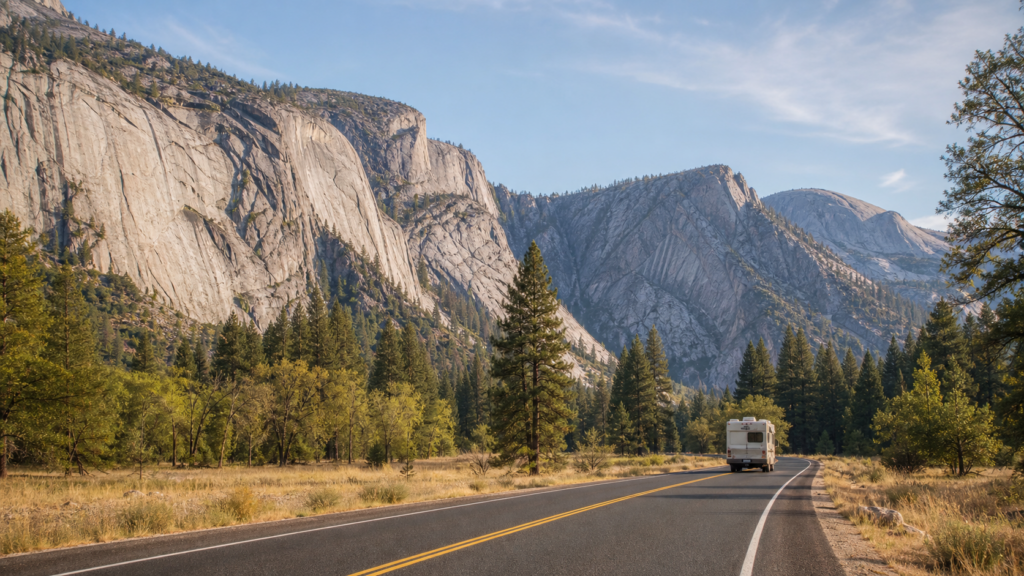
Yosemite RV Trip Planner | Campgrounds & RV Route Tips
Yosemite isn’t a park where I would load the travel trailer up and say, “figure it out.” Views are huge, and the space for an RV is at a premium: crowded valley parking spaces, back-in campsites, steep grades, tunnels, seasonal roads, shuttle logistics, visitors stopping anywhere because El Capitan just materialized through the windshield.
This is a Yosemite RV trip planner, focusing on what works in an RV, Yosemite RV camping, RV campground fits, Yosemite RV length restrictions, RV road limits, and parking strategy, and a realistic itinerary. Be sure to record your true size, RV length, trailer length, total combination length, width (including mirrors), loaded weight, fuel range and if you have a tow vehicle before you book. If it is a new process, use the RV-safe route planning guide from RoadReviewer.
Why Yosemite Needs RV-Specific Planning
Planning is essential for Yosemite when it comes to RV use.
On a map of California, the Yosemite is shown to be straightforward: Highway 41 from Fresno, Tioga Road from the east (when it’s open), Highway 140 from Merced, and Highway 120 from the west. That’s sufficient in a car. Upstairs, in a motorhome, fifth wheel, campervan, truck camper or trailer it is just the beginning.
Most main roads in the park are open to most RVs, but not all side roads, campground loops, turnouts, and parking lots. Yosemite Valley is crowded and cramped. Larger RVs and trailers face limits on Glacier Point Road. There are short-vehicle restrictions on Mariposa Grove Road and Hetch Hetchy Road. The road up to Tioga Road is also seasonal and requires some serious mountain driving sense, particularly when towing from the Lee Vining side.
The best Yosemite National Park RV trip is conservative: arrive in daylight, reserve a site that is compatible with your RV, park the RV, if possible, and shuttle, bike (where allowed), walk, tour, or tow the RV for the rest of your trip.
Quick Answer: Can You Visit Yosemite in an RV?
Yes, you can camp in a large motorhome or camper in Yosemite.
Yes, but only if your campground, route, parking plan and season are compatible with your rig. It is common to camp in an RV in the Yosemite National Park and most Yosemite campgrounds there permit some RVs or trailers. The problem is that Yosemite isn’t an RV resort. The current National Park Service campground guidelines state that there are no electric, water or sewer service connections in any of the Yosemite campgrounds. There are not many dump stations, generator hours are limited and reservations are required during much of the main season.
The smaller of the campers, such as small campervans, Class B rigs, truck campers and compact trailers offer the most flexibility. A 35- to 40-foot motor home or a long trailer works as well, but the list of sites begins to dwindle rather fast. Note that if you are not spending the night in the park, you will require a certain amount of discipline to find a large-RV spot in Yosemite – the RV parking in the park is limited and fills up by late morning during peak times.
Yosemite RV Length Limits and Campground Rules to Know First
Before you hit the road to Yosemite, here are some RV length limits and campground rules to know first.
First and foremost, the Yosemite campground RV length rule is RV length and trailer length are different. The campgrounds information for Yosemite says that many campgrounds have varying limits, due to the back in angle, loop roads, and turning radius.
The current NPS guidelines will allow for RV and trailer lengths of up to 40 feet and 35 feet respectively in Yosemite Valley, but only a few sites will accommodate those longer rigs. There are many more that accommodate RVs up to 35 feet and trailers up to 24 feet. The actual Yosemite RV size limit issue is that there may be a class of RV’s that you are interested in using in Yosemite, but the RV you found online isn’t.
When making Yosemite RV reservations, verify:
- Open dates for current campgrounds and rules for campground reservations
- Individual site RV length and trailer length
- Whether the tow vehicle requires the same pad to be placed on as the vehicle being towed.
- The quiet hours, no-hookup, and generator hours limitations.
- Dump station status, potable water, and food storage rules.
- Recreation.gov site alerts and equipment type restrictions
Please don’t book the marginal site if they have booked there online. If there is no other camp site available, this may be because your rig is too large.
Best Yosemite Campgrounds for RVs
Upper Pines: best year-round valley base for medium rigs
The Upper Pines section of the valley is ideal for medium rigs all year round.
Upper Pines is a sure bet for a dependable Yosemite Valley RV camping alternative as it is open year-round and near shuttle stops, Curry Village, trail access and valley services. Today, reservations to Upper Pines are opened 5 months in advance, on the 15th, and the maximum length is 35 feet for RVs and 24 feet for trailers. It is dry camp, so be prepared for battery, water, tank and generator windows.
Lower Pines and North Pines: best limited longer-site options
These areas offer the best longer site options that are limited.
Lower Pines and North Pines are seasonally operated valley campgrounds, one of the longest listed RV/trailer capacities. The current NPS guidance is for a maximum of 40′ for RVs and 35′ for trailers, but few sites accommodate the longest rigs. If you are looking for a valley base for a larger motorhome or trailer, these can be the best Yosemite campground for RVing.
Wawona, Crane Flat, Hodgdon Meadow, and Tuolumne Meadows
The following four areas are located in the south and west/high-country areas: Wawona, Crane Flat, Hodgdon Meadow, and Tuolumne Meadows.
Wawona may serve Route 41, Oakhurst, Mariposa Grove, and travelers linking to Yosemite and Sequoia and/or Kings Canyon. The westside approaches to Highway 120 could be served by Crane Flat and Hodgdon Meadow. High country camping is available at Tuolumne Meadows at Tioga Road, but is subject to the opening up of the road, the availability of snowpack, and campsite availability.
If you’re travelling and need hookups, or you have a larger rig, then it might be better to use private RV parks outside the park. Choose between El Portal, Midpines, Mariposa, Groveland, Oakhurst, Bass Lake, Lee Vining or Mammoth Lakes along the way.
Yosemite Road Restrictions RV Travelers Must Check
Wawona Road, Big Oak Flat Road and El Portal Road
The Wawona Road, Big Oak Flat Road and El Portal Road are the roads where vehicle limits need to be checked.
The NPS vehicle-restriction policy currently reads: Wawona Road and Big Oak Flat Road have a maximum length of 45 feet for one vehicle, and “Taller rigs should read carefully” is noted under the tunnel height category. El Portal Road has maximums for single, combination and towed vehicles and NPS notes the outside of the park road on Highway 140 between El Portal and Mariposa has maximums for vehicles up to 45 feet long, including the total length of the combination.
Although Highway 140 is currently the most conservative western RV route to Yosemite, the road condition, rockfall work, traffic, weather, fire, smoke and chain requirements still play a role with Highway 140.
Tioga Road RV planning
It is an amazing RV trip, but only in certain seasons. Tioga Road closes typically around the time of November and is usually reopened in late spring or early summer based on snow and plowing. The east side from Lee Vining, is steep and winding; the NPS states that there is an 8-mile stretch that rises approximately 2,500 feet, and parts of it are as steep as 8 percent.
Know your tow rating, brake controller, transmission heat up/down characteristics and comfort level when towing. Never run a car at the speed of a car. Take advantage of pull outs, climb slowly, descend in a low gear and always have a break down plan.
Glacier Point, Mariposa Grove, and Hetch Hetchy
The Glacier Point Road RV restrictions are not readily apparent. Beyond the Sentinel Dome trailhead/parking area, the current NPS guidance is to keep the maximum limit to 30 feet for individual vehicle parking and no trailers are permitted.
When using Mariposa Grove RV parking, be sure to arrange around the Mariposa Grove Welcome Plaza and shuttle as appropriate. The current NPS guidance specifies that Mariposa Grove Road is limited to a maximum of 25 feet and there are no trailers. The current guidance for Hetch Hetchy Road RV restrictions is a maximum length of 25 feet, and a width of 8 feet (mirror to mirror), and is open only from sunrise to sunset.
Best Entrance and Basecamp Strategy for Yosemite RV Trips
If the most conservative west side approach is desired and the most easy YARTS backup, take the Highway 140 route through Merced, Mariposa and El Portal. Take Highway 41 to Wawona, Oakhurst, Bass Lake, Fresno and Sequoia/Kings Canyon. Take Highway 120 west to Groveland, Big Oak Flat and Bay Area/northern California. Only use Tioga Pass when the road is passable, weather is holding, and setup of the rig makes sense.
When using the map to connect Yosemite to other national parks, don’t be overwhelmed. The same planning, which is “rig first” first, rules also apply to RoadReviewer’s Yellowstone RV trip planner, Grand Canyon RV trip planner, and Zion RV trip planner.
Yosemite RV Parking and Getting Around
According to NPS guidance, RV, trailer and oversized parking is limited at Yosemite, particularly during the summer months. Larger Class A and B vehicles will be parking at Curry Village parking, or Yosemite Falls parking west of Yosemite Valley Lodge. For smaller Class C RVs, use day-use parking at Yosemite Village or the space west of Yosemite Valley Lodge, if available.
There are few RV sites off the valley, including Mariposa Grove Welcome Plaza, select RV parking stops along Glacier Point Road for shorter RVs and Tioga Road sites such as Olmsted Point and Tuolumne Meadows. The idea is quite simple in practice:
- Arrive early.
- Park once.
- Ride the Yosemite shuttles, if available.
- If you’re staying outside the park, but not camping within Yosemite, use YARTS.
- If traffic or parking conditions change on the day, have legal overnight backup.
YARTS runs all year long on the Highway 140 corridor and seasonally on other corridors on the approach to Yosemite, but please check the schedules and alerts before structuring your day around YARTS.
A Practical Yosemite RV Itinerary
Day 1: Camp: Arrive on Day 1 and leave the rig at camp.
Select the entrance that is appropriate to your base. Check in, level the RV, pack the food storage, verify generator windows and locate the closest shuttle drop off. Keep it simple: Lower Yosemite Fall, Cook’s Meadow, Sentinel Bridge, or a short walk in the valley.
Day 2: Yosemite Valley without moving the RV
Utilize the shuttle and feet to travel. Highlight Yosemite Village, Yosemite Falls views, El Capitan views, Merced River corridor, and one realistic trail/viewpoint plan. If parking outside the park, see the early bird catches the worm; catch YARTS early.
Day 3: Choose one side trip.
Depending on your rig and season, select Glacier Point, Wawona/Mariposa Grove, or Tioga Road. A smaller car is recommended for Glacier Point. Certainly the welcome plaza and shuttle are the most effective for Mariposa Grove. This is not an addition to a mountain driving day, but a stand-alone day on Tioga Road.
Day 4: The 4th day is a buffer day or a clean exit day.
The last day is for weather, water and dump station logistics and/or an early departure to: Lake Tahoe, Highway 395, Sequoia, and/or coast. If the coast is next, check out RoadReviewer’s Pacific Coast Highway RV trip planner.
RV-Safe Route Planning Checklist for Yosemite
Just before you lock your Yosemite RV itinerary, check:
- True height, width, RV length, trailer length, and total combination length
- Loaded weight, tow rating, brake setup, and engine/transmission cooling confidence
- Campground reservations, site length, equipment type, open dates, and rules of arrival
- No hookup plan for batteries, water, tanks, refrigeration, heat or medical equipment.
- Readily available dump stations and generator hours for your season.
- The current condition of NPS roads, construction, traffic, fire/smoke, weather and chain conditions.
- Restrictions are in place for Glacier Point Road, Mariposa Grove Road, Hetch Hetchy Road, Tioga Road, Wawona Road, Big Oak Flat Road and El Portal Road.
- If outside-park transit is being used, YARTS schedules the trip.
- Legal backup overnight option outside the park.
When answering questions about GVWR, payload and total combined weight, make sure you read RV weight ratings explained from RoadReviewer first.
Common Yosemite RV Planning Mistakes
Booking before checking the exact site
This is the same way that many people book a bed and breakfast.
It isn’t just about “RVs Allowed”. Review the individual site length, equipment type, pad notes and Recreation.gov alerts.
Simply comparing length of trailer and length of motorhome is a mistake.
Cautious maneuvering is required for Yosemite with a travel trailer. It’s more difficult to park a 24-foot trailer than a 24-foot RV.
Assuming valley parking will solve itself
Oversized spaces can fill up quick. If you don’t camp in Yosemite, then YARTS or a very early arrival can save the day.
Forgetting Yosemite has no campsite hookups
Yosemite motorhome camping is primarily dry camping within the park. Size generator windows, plan water, power, tanks, food storage.
Avoid towing over Tioga Pass without a cushion.
While many trailers make it across Tioga, it’s not all about grade, heat, braking, altitude, traffic and experience.
FAQ
So, which is the best Yosemite campground for RVs?
For access into the valley, Upper Pines is the reliable year round medium rigging option and Lower Pines and North Pines offer a couple of longer seasonal options. If you are camping with a large RV or hookup, then an outside private RV park is a good choice.
Do Yosemite RV campgrounds have hookups?
No, Yosemite camping sites have no electric, water or sewer facilities. Some locations have limited and seasonal dump stations.
What are the primary length limits for RVs in Yosemite?
There are maximums on RV and trailer sizes in Yosemite Valley (up to 40 feet RV; 35 feet trailer), but very few of these are available. There are many more that accommodate RVs and trailers up to 35/24 feet.
Is there a restriction on driving an RV on Tioga Road?
Yes, when Tioga Road is open, it is a seasoned mountain drive. When going towing from the east side, be prepared for a very steep climb from Lee Vining to Tioga Pass, and check road conditions, weather, smoke, and tow set up.
Is there a possibility to visit Mariposa Grove by RV?
Yes, but the NPS guidance currently states that Mariposa Grove Road is limited to 25 feet and that no trailers are to be used. Most visitors park at the welcome plaza and then take the shuttle service.
Do I need Yosemite RV reservations?
At the main season time of year, yes if camping in the park. The NPS advises RV and trailer campers to make reservations in advance from April through October, and campgrounds can book up from spring through fall.
Conclusion: Yosemite Rewards the RV Traveler Who Plans Conservatively
In conclusion, the RV traveler who plans conservatively is rewarded with the pleasure of staying in Yosemite.
Yosemite is good for the RV, but not for the margin. Choose the door you need to rig, rather than one a car map recommends. Reserve campsite by the length of the actual equipment. Consider Tioga Road, Glacier Point Road, Mariposa Grove and Hetch Hetchy as individual restriction checks. Park in the valley if possible, use shuttles, YARTS, tow car or boots for the smaller tasks.
That’s where a logistics issue in Yosemite becomes the trip which you wanted: coffee under the pines, a dry-camp that is functional, granite walls above the windshield, and a route plan that makes the stressful parts boring.