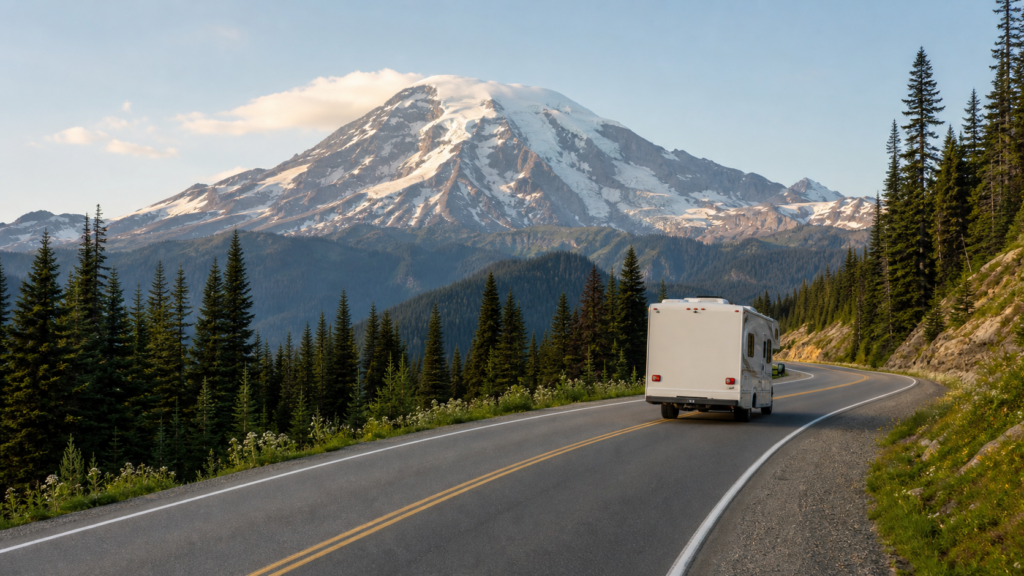
Mount Rainier RV Trip Planner: Campgrounds, Paradise and Sunrise Access, Road Status, and RV-Safe Routes
Maintains a list of campgrounds, access to Paradise, access to Sunrise, road conditions and RV-Safe routes for Mount Rainier.
There are parks where the mountain seems like it’s just a stone’s throw away, the map seems like it’s just a stone’s throw away, and the RV day can get complicated too fast. Roads are in the main corridors but then move onto real Cascade terrain. Parking fills early. When camping, the lengths are limited. There is a RV caution on Sunrise Road. Ohanapecosh is not open for 2026. White River is operating on a reduced level of facilities. Paradise can be attained, but not something I’d do at peak hour in a big rig.
This Mount Rainier RV trip planner was written how I would plan the park for my own setup: (1) Where to spend the night, (2) which entrance to take due to road conditions, (3) I would check out the Mount Rainier road status page the same day and determine if any of the roads would be closed to RVs, and (4) I would have a smaller-vehicle plan in place for Paradise and Sunrise. Before relying on a generic GPS line through the Cascades, check out RoadReviewer’s RV-safe route planning approach if you are new to mountain routing.
Is Mount Rainier National Park RV Friendly?
For those that can make the effort to be RV friendly, Mount Rainier can be a big-rig friendly park, but not in the casual sense. Camper vans, truck campers and shorter travel trailers work best. Longer Class A motorhomes, fifth wheels and truck/trailer combinations require a conservative approach to fit into campgrounds, parking pressures, steep grades, seasonal road openings, and leave the RV at camp options.
There is no one single road rule that is the main limitation in an RV. It’s the pile of minor conditions:
- In-park campgrounds do not have electric, water or sewer connections at individual sites.
- Cougar Rock (35′ RV, 27′ trailer), loop roads are tight.
- NPS notes that Ohanapecosh will be closed in 2026 for rehabilitation efforts.
- The White River limits are lower: 27′ for RVs and 18′ for trailers.
- Sunrise Road is steep, narrow, and twisting, so NPS does not recommend that RVs and vehicles with trailers longer than 25 feet LOA travel beyond the intersection at the White River Campground.
- Trailheads are frequently busy on summer weekends, at such places as Paradise, Sunrise and Longmire.
So, yes, it’s possible to camp at Mount Rainier National Park with an RV. The more pertinent question is: Should your particular rig sleep in the park, base outside the park, or park once and tour with a tow vehicle?
Mount Rainier RV Route Strategy by Entrance
There are several approach corridors to Mount Rainier and the ideal Mount Rainier RV route will vary based on basecamp, season, and rig size.
Nisqually Entrance RV Route
Many RV travelers use the Nisqually Entrance year round which is located on the southwest side. It links via Ashford and Longmire towards Paradise. This is typically the cleanest planning corridor if your destination is Cougar Rock Campground, Longmire or Paradise.
But that doesn’t mean that the day will be easy. The road from Longmire to Paradise is a mountain road and NPS indicates that weather or road conditions may close the road. The greater problem in the summer is traffic congestion. July and August are peak visitation times, says NPS, and parking and entrance are often difficult, sometimes requiring more than an hour on the busiest weekends and holidays in summer. In the case of RVs it’s best to get in early, not hit the hot spot of Paradise during the day, and not have as long a stop list as you would have with a car trip.
Stevens Canyon Road RV Strategy
The Stevens Canyon Road is open on the Paradise side on the southeast side of the park. It’s both scenic and useful, but should still be regarded as a mountain road with current status checks. At the time of this draft road status check on the NPS website, Stevens Canyon Road was open and had a tunnel height of 12 feet 6 inches.
The number of that tunnel is significant. Avoid using a brochure height. Be aware of what all equipment is installed on top of the RV such as air conditioners, antennas, solar panels, cargo, etc. and how high they are. If you’re running at the limit, select an alternate plan.
Chinook Pass and Cayuse Pass RV Route
Important east-side access for White River, Sunrise and Pacific Northwest RV road trip loops, SR 410 over Chinook Pass and SR 123 over Cayuse Pass. These passes are seasonal and weather dependent, so be sure to include WSDOT and NPS in your route check. WSDOT said that SR 410 Chinook Pass and SR 123 Cayuse Pass would reopen May 22, 2026, but always check pass status near time of travel.
For a Washington national park RV trip that connects Mount Rainier with Olympic, check out pacing against RoadReviewer’s Olympic National Park RV trip planner. Each park has its own campground and road restrictions with the parks being close enough for a good loop.
Carbon River and Mowich Lake Caveat
Don’t plan your Carbon River/Mowich Lake 2026 vacation around driving from SR 165. Currently, NPS does not allow public access to Carbon River and Mowich Lake from SR 165 due to the closed nature of the Fairfax Bridge and lack of alternate routes. Mowich Lake walk-in sites are not accessible by vehicle, pedestrian or bicycle traffic from SR 165, but are accessible from the Wonderland Trail with the proper wilderness permit.
Mount Rainier Campgrounds for RVs
While the RV campgrounds at Mount Rainier are lovely, they are not resort-style RV parks. Expect dry camping, shorter pads, forested loops, tight turns and limited services.
Cougar Rock Campground RV Length
Located on the southwest side near the Nisqually-Paradise corridor, Cougar Rock is the most useful in-park camper for many RV travelers. NPS maintains 179 separate sites, a standard late-May to late-September season, and makes reservations via Recreation.gov. The official table of campground size indicates that the maximum RV size is 35 feet and the maximum trailer size is 27 feet.
As a practical note, Recreation.gov states that motorhomes larger than 35 feet and trailers larger than 27 feet will not fit into the campground, and that the loop roads have sharp turns in which damage is likely if over-sized. Cougar Rock has no working dump station and no sewer, water or electric hookups.
If you are towards the max length, be sure to learn the exact location of the site and arrive during daylight hours. Listed maximum does not indicate that each site accommodates all RV shapes.
Ohanapecosh Campground RV Status
Ohanapecosh is normally one of the main southeast-side campgrounds, with NPS listing a maximum RV length of 32 feet and trailer length of 27 feet. The crucial issue for 2026, however, is closure. NPS currently reports that Ohanapecosh Campground will remain closed until November 2026 for rehabilitation.
NPS also states that the general public will be barred from the Ohanapecosh Developed Area during the project, including vehicle, pedestrian, bicycle, camping and restroom access, potable water, visitor center and day-use access.
That alters the complete east/southeast strategy. Please check the official NPS and Recreation.gov pages for changes before planning an Ohanapecosh Campground RV vacation in 2026. Camp outside the boundaries of the parks: RV camping near Mount Rainier, camping at Cougar Rock if travel time allows, and camping at White River if travel time and rig and dry camping facilities are suitable.
White River Campground RV Strategy
White River is located on the north-eastern side, close to the road to Sunrise. It is first come, first served only, and NPS currently states it is open July 1, Loops A and B only. At the time of drafting, both NPS and Recreation.gov warned that there is no water at White River Campground and that campers need to bring all water and supplies. Recreation.gov also mentions porta-potties as the available facility in the current alert.
The White River Campground RV limits are short, with RVs being 27 feet and trailers being 18 feet. There are no hookups. No dump station is available. No cell service or Wi-Fi is mentioned on Recreation.gov and clients are advised to download the Recreation.gov app prior to arrival to make payments.
White River is fantastic with the right little rig but don’t go there with a big rig and expect a traditional RV campground experience.
Length limits, hookups, dump stations and reservations apply to RVs.
The campground snapshot for the RV to check before booking and driving in:
| Campground | 2026 planning status | RV / trailer limits | Reservations and services |
|---|---|---|---|
| Cougar Rock | Open, with the last NPS campground status update on June 30, 2026 | RV 35 ft / trailer 27 ft | Reservations through Recreation.gov; no individual hookups; RV water fill closed and dump station closed |
| Ohanapecosh | NO PLANNED STAY UNLESS OFFICIAL CHANGE IN STATUS: Closed due to rehabilitation. | Normally RV 32 ft / trailer 27 ft | Closed for 2026 |
| White River | July 1: Loops A and B only (per NPS) | RV 27 ft / trailer 18 ft | No water under current alert; no hookups or dump; first-come-first-served |
| Mowich Lake | Primitive walk-in only | Tents only | NOT an RV campground; SR 165 access issue in 2026 |
The most important campground rule: No electricity, water or gray-water connections in any Mount Rainier campground. Overnight parking of vehicles outside of designated campgrounds is not allowed. If you are staying in a developed campground, you’re allowed a max of 14 consecutive days.
If you are running a bigger rig, it may be better to camp outside the park near Mount Rainier, where you can find more space. Check the site length, pull-through availability, 30 amp or 50 amp service, water, sewer/dump, and approach road length for total combination.
Paradise Access and RV Parking Strategy
Timing is an issue with Mount Rainier Paradise RV parking. Paradise is one of the most popular areas of the park, and access to it is via a mountain road which can be impacted by weather, snow, construction, congestion and parking restrictions.
My Paradise Road Mount Rainier RV strategy is:
- Visit the NPS Road Status/Alerts page prior to departure from camp.
- Get there early – preferably before the mid-mornings.
- Do not tow a trailer to Paradise without confirmation as to its location.
- Tow vehicle or smaller vehicle if available.
- Have a back-up plan that includes Longmire, Cougar Rock or another lower elevation stop.
- Never circle, block traffic or wait for a space in the roadway.
Worth the effort is paradise. It is also the location where a late-start, oversized RV day can fall apart. Instead, park the rig where it will fit, and then make a point of visiting Paradise in the morning or later in the day.
Although paved, parking, reservations, and times of the crowd all determine whether the day works out or not, as RoadReviewer does in the Yosemite RV trip planner:
Sunrise Road and White River Strategy
Sunrise is the highest road that can be driven in Mount Rainier National Park and is one of the best clear day vantage points in the Cascades. It’s also an area in which RV travelers must be restrained.
However, currently NPS advises that because of the steepness and narrowness of Sunrise Road, RVs and vehicles with trailers longer than 25 feet LOA should not travel beyond the intersection of the White River Campground. That’s the key Sunrise Road RV restrictions language for trip planning. NPS further states that there are no restrictions for unmodified motor coaches of standard length, however, I would consider parking and turning space as practical considerations.
Sunrise might work with an early start and a road check on the same day for those opting for the smaller class B or truck camper or small class C. If you hailed near the northeast side, left the trailer at camp, and drove a smaller vehicle if available, then you could avoid taking a long trailer, fifth wheel, or big Class A up Sunrise Road.
Sunrise Road was listed as open starting July 4, at the time of the road status page check for this draft. This is a seasonal road at a high elevation and FactChecker and editorial should confirm this status just prior to publication.
If you want to see how another high elevation road processed vehicle restrictions in their entire plan, read RoadReviewer’s Going-to-the-Sun Road RV trip planner.
Timed Entry, Fees, Road Status and 2026 Access Notes
There is actually a clear official answer now to the Mount Rainier timed entry 2026 question: NPS says no timed entry reservations will be required anywhere in Mount Rainier National Park in 2026. The fees page also states that the park will not consider timed entry reservations for any part of the park in 2026.
But that doesn’t mean that you can disregard planning. You still need:
- A valid entrance pass or appropriate federal pass.
- Reservations for campgrounds (if required).
- Mount Rainier Road Status for the day.
- Park notifications of closures, fire restrictions, development, weather and facility changes.
- Campfires, charcoal grills, and wood fires are prohibited; gas and propane stoves are permitted – As of this check, Recreation.gov campground alerts for Cougar Rock and White River are the same – campfire ban.
- When applicable, WSDOT pass checks for SR 410, SR 123, SR 706, Chinook Pass and Cayuse Pass.
- An alternate plan in case parking is full.
NPS also notes Mount Rainier has moved to cashless fee collection at entrances and campgrounds. If you don’t want the cash, see the official fees page to find out where partners are located upon arrival.
The Mount Rainier plan for 2026 is unique for travelers who have been through Rocky Mountain style entry windows in the past. RoadReviewer’s Rocky Mountain National Park RV trip planner can be helpful, but DO NOT carry over timed-entry assumptions from one park to another.
RV-Safe Driving Notes Around Mount Rainier
Driving an RV with care around Mount Rainier is well worth the effort. It’s a deterrent to speeding and careless driving.
Prior to entering the park, check:
- RV loaded height (roof equipment).
- Length overall (including hitch gear and rear racks).
- Trailer length and combined tow length.
- Brake condition and engine-braking strategy.
- Fuel range as services within the park are minimal.
- Water supply, particularly if coming to White River in 2026.
- Pass and weather conditions, and time till sun down.
Never allow a car app to take a side road or shortcut. Shorter can also refer to narrower, steeper, snowier, or less appropriate for your rig, in the Cascades. Always use official road status pages first, WSDOT second and RV-safe route planning tools as a sanity check.
NPS will require all vehicles, including four-wheel drive vehicles, to have tire chains in the park from November 1 to May 1 during the winter season. For the majority of people enjoying RV travel, winter Mount Rainier is a special excursion with the focus on Nisqually access to Longmire/Paradise and not a casual tour around the mountain.
Suggested 2-4 Day Mount Rainier RV Itinerary
Day 1: Arrive, Set the Rig, and Check Conditions
Arrive in daylight. If you are staying at Cougar Rock, check your Recreation.gov information, fit of the site, generator use, water plan and dump plan prior to your stay. Outside the park, spend the first evening refuelling, shopping, managing the tank and doing a road check.
Do not have a complicated first night. Rather than hauling a weary driver up a mountain road at dusk, a Longmire walk or a short viewpoint or an early bedtime is better.
Day 2: Paradise and Longmire
Take the smallest vehicle that will accommodate you, and set out early. If the road is clear and the weather allows, proceed via Paradise. If parking is already becoming a problem, try to change course to Longmire or Cougar Rock area trails, viewpoints, or a lower elevation, slower day. This is where it pays off for RV travelers to think of Paradise as a mission as opposed to a 24-hour parking bet.
Day 3: Stevens Canyon or East-Side Positioning
This can be a good scenic day trip between the south and east side of town if Stevens Canyon Road is open and your vehicle height does not exceed the official height of the tunnel. If Ohanapecosh is closed for 2026, don’t expect that campground to be your end. If you plan to travel around the mountain, look for an out of town base near Packwood or a known RV location.
Day 4: White River and Sunrise, If the Rig Fits
If roads are open, consider using early starts for White River and Sunrise for small rigs and travelers with tow vehicles. For larger rigs, NPS Sunrise Road indication: do not take long RV or trailer combinations past the White River Campground intersection. If the conditions are close to marginal, consider it a scenic day to the Northeast instead of a mission to get Sunrise.
Combine this pacing with RoadReviewer’s Yellowstone RV trip planner mentality: Schedule for closures, weather, parking, and campgrounds.
Common Mount Rainier RV Planning Mistakes
The most common errors I encounter are easily foreseeable:
- It is easy to assume there are easy roads at Mount Rainier, since they are paved; this is not the case.
- Reservations for a campground without paying attention to the precise RV and trailer limits.
- Planning for Ohanapecosh in 2026 despite the fact that NPS indicates that it is closed.
- Failing to read the NPS 25-foot LOA caution and taking a long trailer towards Sunrise.
- Parking at peak times at Paradise.
- Inside the park: anticipating hookups, showers or a dump station.
- Forgetting White River currently has no water under the 2026 alert.
- Treating Carbon River or Mowich Lake as normal RV access destinations in 2026.
- Taking the word of a generic GPS over the official WSDOT pass reports and condition of the roads.
The solution is simple: select the basecamp first, avoid putting the rig where it doesn’t belong, check-in on the same day, and let the mountain tell the story!
Mount Rainier RV Planning Checklist
Make sure you ask, before you leave:
- Length of the RV and of the trailer, height, width and loaded weight.
- Fit a campground at Cougar Rock, White River or an outside RV park.
- Status of closure in Ohanapecosh for 2026.
- No individual hookup in park campgrounds.
- Dump plan and potable-water plan prior to entering the park.
- Water/facility status for White River.
- Paradise parking timing and backup stops.
- Sunrise Road status and RV caution at White River.
- The Stevens Canyon Road status/tunnel height limit.
- Access status for Carbon River/Mowich.
- Status of WSDOT on SR 410, SR 123, SR 706, Chinook Pass and Cayuse Pass.
- All current NPS alerts, weather, fire restrictions and construction.
- Entrance fee/pass and cashless payment plan.
- Copied maps to use off line and downloaded Recreation.gov app when necessary.
If any of those items sound unsure, ease the journey. Four days of wishful routing is not as good as a two-day, clean trip to Mount Rainier.
FAQ
Can you take an RV to Mount Rainier National Park?
Yes, you can travel to Mount Rainier by RV, but this will depend on the size of your rig, the season, campground compatibility, and road conditions. Smaller rigs are more flexible. Long trailers, fifth wheels and larger motorhomes should take conservative routes and consider outside basecamps.
Are there any campgrounds for RVs with electricity at Mount Rainier National Park?
NPS reports that there is no electricity, water, or grey-water utility in any of the campgrounds of Mount Rainier. For hookups, showers, sewer, laundry or for easier big rig access, check out verified RV camping outside Mount Rainier.
What is the Cougar Rock Campground RV length?
Cougar Rock is listed by NPS as a max RV length of 35 feet and a max trailer length of 27 feet. Recreation.gov cautions motorhomes greater than 35 feet and trailers longer than 27 feet are no longer able to enter due to limited turns in the campground.
In 2026, will Ohanapecosh Campground be open for RV’s?
No, not as of the date of this draft (NPS campground page). Ohanapecosh Campground posted as closed for 2026 due to Campground Rehabilitation Project. Double check before posting or going anywhere.
What is the RV limit for White River Campground?
White River Campground has a size limit of 27′ for RVs and 18′ for trailers. It is currently a first come first served only, no hookups and has a no water alert for 2026 season (Loops A and B only).
Will there be timed entry reservations at Mount Rainier in 2026?
NPS says there will be no timed entry reservations in Mount Rainier National Park throughout 2026. The entrance fee or valid pass is still required and campground reservations are still required (where applicable).
Is it possible to drive to Paradise at Mount Rainier in an RV?
The Nisqually-Longmire-Paradise roadway is open for many RVs to use, but parking and road conditions are the constraints. I like tow vehicle or going early for bigger rigs.
Are there any Sunrise Road RV restrictions?
Due to the steep grade, narrow and winding road, NPS advises against travel—by RV or other vehicles with trailers longer than 25′ LOA—up Sunrise Road past the White River Campground intersection. This is an important RV caution in the park.
Is Stevens Canyon Road safe for RVs?
Stevens Canyon Road can come in handy when open, but RV travelers need to check on road status and height restrictions. A 12-foot-6-inch note for Stevens Canyon Road, stating the height of the tunnel, appeared on the NPS road status page checked for this draft.
So, what’s the best Mount Rainier trip idea for an RV?
Most RV travelers will find a 2-4-day schedule is ideal: arrive and rig up, then visit Paradise early (Road/Height Check, if available), then visit White River/Sunrise with a smaller vehicle or short rig. Be flexible every day, for weather, closures, parking.