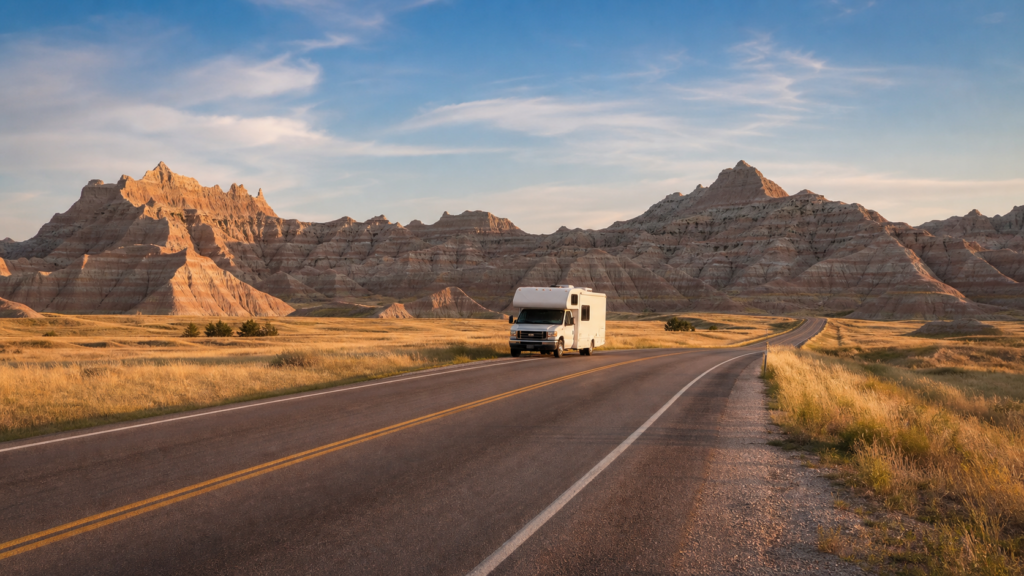
The Badlands National Park RV Trip Planner will help you plan a trip to this park, including campgrounds, the loop road, Sage Creek, and Big-Rig cautions.
From the interstate, Badlands National Park could seem like an easy park to visit. I-90 is just north of the park, Wall is near, the paved Badlands Loop Road has two clean access points and the main viewpoints are along the road that many RVs drive each season. That’s true, but it’s not the complete truth.
Even if you are driving a motorhome, fifth wheel, travel trailer, class B van, a truck camper or tow vehicle, the same old rules of campground fit, road surface, wind, heat, storms, water, dump access, and being able to safely enter and exit the campgrounds you want to camp at still apply. The park is conveniently located. It’s not a location for a generic GPS, a late arrival or a vague campground plan to decide for you.
This Badlands RV trip planner focuses on the practical questions of where to camp, how to navigate Badlands Loop Road in an RV, why Sage Creek isn’t a typical backup for larger rigs, why Wall or Interior is better, and how to tie in Badlands with a longer trip in South Dakota, the Black Hills, Route 66, Yellowstone or Grand Teton. For those still in the process of creating the larger route, use this guide along with RoadReviewer’s RV-safe route planning guide prior to planning travel days.
Yes, Badlands National Park is RV friendly!
Here are some answers for motorhomes, camper vans, travel trailers and fifth wheels.
Yes, Badlands can be RV friendly, if you use the paved roads, campgrounds and basecamps, and take it easy on unpaved roads. Badlands Loop Road is paved, Cedar Pass Campground is the primary developed in-park campground for RV’s and the surrounding area of Wall, Interior and the greater Black Hills area provides additional options for RV travelers outside of basecamp.
The caveat is, “RV friendly” doesn’t necessarily mean “all RVs fit everywhere.” The camper van or short Class C is more flexible than the 40-foot Class A towing a car or a long 5th wheel. RVs over 18 feet are not allowed at Sage Creek Campground. Sage Creek Rim Road is an unsealed road. Heat and prairie wind have an impact in the summer. Pullouts can be full or slanted, depending on the shape and size of the long trailer.
Although there are no RV length restrictions on all of the paved miles in the Badlands National Park, there are a couple of crucial moments that need to be considered: campsite fit, geometry of the pullout, Sage Creek limit, parking for a tow vehicle, or any unpaved-road decision.
Though Badlands may seem like a cakewalk on a map, it requires RV-specific planning.
The simple geography of the park lures the visitor to underplan. Exit 131 toward the Northeast Entrance is a popular spot from I-90 west, and Exit 110 near Wall and the Pinnacles Entrance is a popular spot from I-90 east. The Badlands Loop Road (State Highway 240) takes you on a scenic trip through the North Unit.
While that simplicity is helpful, it can also obscure aspects that are important for an RV day. You must still know where you are going to stay, if your site is able to accommodate the entire setup, where you will dump, where you will refill water, if the weather is changing, and if your planned stops are able to accommodate your rig. It is in the Badlands that a bad plan is likely to be the result of a series of small assumptions, not of one big blip.
When big rigs need to basecamp outside the park rather than attempting to make every stop
If Cedar Pass availability is an issue, if hookups are a concern, if pets are to be kept cool, or if you want to tour the park in a smaller vehicle, a larger motorhome, fifth wheel and long travel-trailer combination may be interested in an outside basecamp. Wall, Interior or a private campground near the edge of the park are better ways to RV camping near Badlands National Park.
When considering the driving of big rigs, the intelligent question is not “Can I technically drive there?” Is it “Can I get there, park up legally, exit safely, sleep fine and get away without incident? When the answer becomes less clear, stop the RV and lighten up.
Badlands doesn’t have an RV-Specific Plan.
Badlands Loop Road is paved, scenic, and a real RV driving day.
While not as challenging a road trip as a high mountain pass, Badlands Loop Road RV travel will warrant respect. It’s a paved road and is frequently used by RVs, but still has a scenic feel, views, wildlife slowdowns, exposed shoulders, grades, and drivers that stop short for views or bighorn sheep.
Unless your rig, daylight, campground time and the weather are all in favor, don’t plan the loop as a short interstate exit. The scenic drive itself can be the highlight of the day, especially if you take the time to stop and take pictures, and visit a visitor centre at a safe speed.
Extreme heat, wind, thunderstorms and open fields cause driving.
Weather in Badlands is included in the trip itinerary. Dry camping can be uncomfortable during the summer heat and can be tough on pets, tires, refrigerators, and marginal cooling systems. Towing can be a strain with the wind. Thunderstorms can rapidly develop over open prairie and produce heavy rain, lightning, hail, slippery surfaces and sudden gusts.
Campgrounds should be secured so that wind can not blow in while you are gone. Awnings and mats, chairs, grills, and loose equipment should not be left out haphazardly. I also like to be proactive and check the tire pressure, battery, water level, and refrigerator performance before a trip to Badlands, not after something has started acting up.
The cost of fuel, water, dump, groceries and service margins are limited.
Badlands is in the vicinity of towns, but it is not a full-service RV corridor within the park. Make sure you arrive with your fuel loaded, fresh water arranged, waste tanks emptied, groceries on board, and an offline map saved. Cedar Pass is campground serviced for verification purposes only, you should not rely on the availability of water, dump or power without consulting the latest official information.
Hence, I build my Badlands RV route from the overnight plan outwards. After campground, dump, water and next fuel, it becomes easier to choose a scenic stop.
Wall & Interior are helpful, but they’re better in the park day when they aren’t emergency fixes. Use Badlands as a rejuvenation stop on the way to the Black Hills, Yellowstone, or the northern Rockies rather than as a beginning point the following day when supplies are low.
Wildlife – no stopping other than where the rig can safely enter and exit.
Wildlife viewing can be great at Badlands, but drivers of RVs must be disciplined. Never park in the lane. Never feel compelled to go onto a soft shoulder because of a picture. Never pull long trailers in tight overlook without sight of the exit. If the pullout feels cramped or is set at an awkward angle, ignore it and take the next pullout.
Selective RV days in Badlands. Not all overlook is necessary. You must have the correct ones for your rig, confidence and the traffic ahead of you.
Best Time to Visit Badlands in an RV
Spring – cooler temperatures, storms, mud and changing road conditions.
Spring is a great time to visit Badlands National Park by RV because the weather is not as extreme as the midsummer, there are fewer crowds and the landscape can be green. The compromise is that there is some variation. Unpaved roads and campground comfort may be impacted by rain, mud, wind and late cold snaps.
Spring is the time when road conditions are critical – if Sage Creek Rim Road is in your plan. Even if an unpaved road appears innocuous on a dry map, it may be the wrong spot for a trailer when it rains.
Summer with heat and the crowds and pets and tire pressure and early-start strategy.
Summer is the season of the year when RV habits are the most important and the busiest season of the year. Planning ahead and getting started early (before the heat hikes up), keeping pets out of the car, bringing plenty of water, and not letting the midday turn into a parking search with a big rig. If air conditioning is needed, check your power plan prior to booking.
When booking a Badlands RV camping with hookups or electrical service, don’t expect a complete hookup RV resort. Electric and non-electric site categories are available at Cedar Pass on Recreation.gov, but sewer and water at every site should not be assumed – check the current listing for the exact site. Larger rigs and pet owners may prefer using private parks outside the park during the summer.
Fall – excellent RV season; shorter days and wind dies down.
Fall is a good time of year for Badlands. Often after the heat of summer the days are more pleasant, the lighting is great, and the park is less crowded. Concerns for planning include less daylight, campground season information and wind.
Still like daylight falls in fall. Backing into a wide open campground or private RV park may seem straightforward until it gets dark, you are fatigued, you have gusts, and a cold front is rolling in.
Winter means closures, snow and ice — and why this is not a casual RV loop season.
Winter Badlands is a beautiful, yet not a casual RV loop season. When it’s snowy, icy, closed, and wind chill, a simple drive can become a real safety decision. Before sending a motorhome or trailer down the road, consult the official park alerts, South Dakota road conditions, and the forecast.
If winter are part of a repositioning effort make a back up plan for the night outside the park and be ready to cut out the loop.
Badlands RV Camping and Basecamp Options Are Available.
Cedar Pass Campground: In-park RV campground near Ben Reifel Visitor Center.
The first step in Cedar Pass Campground RV planning is its location. Located close to the Badlands scenery, and the Ben Reifel Visitor Center, it is the most convenient in-park base for many RV travelers. It would be my first place to look if I were to go to the campgrounds for a typical Badlands National Park campgrounds RV plan.
According to current official pages, Cedar Pass is a 96 site campground located near Ben Reifel Visitor Center, offering level sites, scenic views, Recreation.gov reservation information to confirm and limited winter use. Recreation.gov also mentions that the Badlands can have sudden heavy winds and storms, so it isn’t like I can give you a lot of information about that unless you’re leaving out an awning or using a light canopy for shade.
Things to check before booking Cedar Pass: length of site, electric, generator regulations, fire regulations, dump/water and tow vehicle fit.
Reserve a specific site, NOT the campground name. Prior to booking Cedar Pass, check:
Total usable site length for RV, tow vehicle, hitch, rear carrier and slide clearance.
- (Electric or Non-electric) Site category.
Quiet hours and generator restrictions. Fire restrictions, cooking rules. Availability and current condition of dump stations. Access to potable water and if you need to arrive full or not.
- If one RV with tow vehicle will comply with the site rules.
- Check-in, check out, and late arrival guidelines.
Same approach as I use in RoadReviewer guides such as the Death Valley RV trip planner and the Big Bend RV trip planner: a campground-first approach.
At Sage Creek Campground, you aren’t likely to find a “normal” RV fall-back. The campground is primitive, free, first come first served.
There is a great misunderstanding about Sage Creek Campground. While it may sound like a good backup option since it is free and first-come-first-served, for many RV travelers it isn’t a backup at all. Primitive and is on Sage Creek Rim Road, there is no water. Generators are not permitted and facilities are more primitive than a developed RV park.
If you are using a small van or compact configuration, Sage Creek could be a conscious decision. So it shouldn’t be the “we will just go there if Cedar Pass is full” answer if you are a big sized RV.
Due to limited room, Sage Creek RVs have a limit of 18 feet. Any rig longer than this is not permitted.
The most important length limit at Sage Creek Campground is one set by the NPS itself: Motorhomes, pull-behind trailers and other recreational vehicles over 18 feet long are not permitted at Sage Creek. Do not bend the rules to your benefit. If the entire traveling package exceeds the length of the trailer box, do not compare against the trailer box size only.
If you are over the limit, create another plan. An outside RV park (Wall, Interior, Cedar Pass, or other) is a safer and cleaner option.
Badlands/White River KOA, Interior, Wall, and other outside basecamps
Basecamps outside are not “second rate” choices. Often they’re the better solution for Badlands National Park big rig RV travel. There are a number of different RV park Badlands locations that are good for travelers turning on to I-90, or entering from the Pinnacles side and visiting Wall Drug. Interior should be satisfactory for Cedar Pass and the east/southeast side of the park. Effortless maneuvering, laundry, showers, a pet cooling plan, and easier maneuvering are all available in private parks throughout the area.
Ask questions about the length of the site, availability of a pull-through, amperage, road access, late check-in, water pressure, dump access, pet policy and if the tow vehicle will fit without crowding when comparing RV camping near Badlands National Park.
If it comes to this, then an outside RV park will be the better big-rig choice.
When you require a dependable electric hookup, more space, later arrival, laundry/reset day, or a smaller vehicle to tour, select an external RV park. This is particularly true if Badlands is one of multiple stops in either a loop to Yellowstone RV trip planner, Grand Teton RV trip planner or Rocky Mountain National Park RV trip planner.
RV-Safe Routes Into Badlands National Park
The west/north approach to I-90/Wall is a common approach.
Most RVers have an I-90 / Wall approach. Exit 110 of Wall goes to the Pinnacles Entrance and the west side of Badlands Loop Road. This is a great choice when you’re staying close to Wall, are coming from Rapid City or are traveling between the Black Hills.
The main benefit of a large rig is services. Fuel, food and private RV parks are more accessible outside the park road.
Interior / Northeast Entrance approach: good for Cedar Pass and east side touring.
The Northeast Entrance near I-90 Exit 131 is utilized for those travelers entering from the east or traveling directly to Cedar Pass and the Ben Reifel Visitor Center area. Interior and Highway 377 are also significant if on approach from Highway 44 or if not in the park on the southeast side.
This can be the purest way to spend a Cedar Pass Campground RV vacation, but check the route before your last few miles. Don’t allow the phone to select a shortcut based on TIME.
The Badlands Loop Road / SD-240 is the ideal scenic road to drive on when visiting Badlands on an RV.
The main paved scenic route is Badlands Loop Road (SD-240). If you’re not rushing and want to stop and take a stroll on some of the short paths, or spend some time at the visitor center, I would schedule this activity as a leisurely half day in an RV. If it’s just a layover, it may be shorter, but that’s not the point.
Drive during the daylight hours, maintain moderate speeds, drive in lower gears as needed, and pass impatient vehicles (if legal and safe). Smooth braking, predictable pullout and no sudden turns are the key components in a Badlands Loop Road travel trailer day.
Sage Creek Rim Road is an unpaved road, a weather close road, a washboard hazard, and a careful rig judgment road.
When making Sage Creek Rim Road RV decisions, err on the side of caution. According to official NPS directions, it is a gravel road on the north side of the Badlands Wilderness Area, and is subject to possible closure during heavy rain or snow. That’s plenty of justification to look into present conditions prior to use with any RV, and ample justification for larger standard RVs not to see it as a scenic shortcut.
When it comes to towing or driving a long motorhome, washboard, dust, soft shoulders, bison slowdowns, weather conditions and limited turnaround options are all more important.
Here are a few classic RV roads and shortcuts to take with caution.
Be wary of roads with no pavement, shortcuts on maps, and high clearances roads. Conata Road, Sage Creek Rim Road and Sheep Mountain Table-type ideas are not same as remaining on paved SD-240. If the road is unpaved, weather dependent, high clearance or locally restricted, a standard RV should not be used for testing the wording.
Badlands Loop Road RV Strategy
With an RV, how much time should you allow for the loop?
When planning a Badlands RV day, plan for more than the amount of time it takes on the road, which can be indicated by a map app, but add several hours for experiencing the scenery. Throw in time for overlooks, the visitor centre, toilet breaks, traffic, wildlife, short walks and the fact that RV travel is slower when you’re picking your spots carefully.
When coming in, if you plan to drive the loop and go to another campground, keep the plan modest. Badlands is not a detour, it’s a destination.
Overlook not to enter: just because it is there, don’t enter every overlook!
Read each pullout carefully before you go into it. Check for sufficient length, a clear exit, and the opportunity to get back into the traffic flow. When towing, steer clear of pullouts where it may be necessary to back up with other vehicles behind the tow. There are numerous overlooks in Badlands, failing to catch a tight one is no fault.
It’s possible to park around the visitor center and Door, Window and Notch areas as well as Big Badlands Overlook.
The Door, Window, and Notch trail area, the Big Badlands Overlook, and the Ben Reifel Visitor Center may all be of interest, but crowded RVs are a different experience. Be sure to get to the popular trailheads early. If the lot is full or is in an awkward location, go back later or use a smaller vehicle if one is available.
The visitor center area is also a good place to reset yourselves: restrooms, current information, water questions, weather checks, and a decision whether or not you still have the rig for the rest of the day.
How a tow vehicle or a smaller runabout can make the trip easier.
Taking a car or owning a smaller vehicle really helps if you are towing a car, make it much easier to deal with Badlands. Use the smaller vehicle for overlooks, Wall, Interior, Minuteman Missile National Historic Site, sunrise/sunset and trailhead stops; park RV at Cedar Pass or an outside basecamp.
That’s no exaggeration. It can make all the difference between a laid back day and a array of parking test.
Badlands RV Itinerary – practical 1-3 days.
1 day: I-90 access, Badlands Loop Road, Cedar Pass area and legal overnight plan.
For 1 Day, Keep It Simple! Take I-90 in and follow Badlands Loop Road during daylight hours, park at select prime overlooks, tour Ben Reifel Visitor Center, and plan an approved legal overnight stay before dark. It could be Cedar Pass, a private RV park, located near Wall and Interior, or the destination you have planned for later on your trip.
Treat Sage Creek as a backup only if you are under the limit, the road is appropriate and primitive camping is something that you really desire.
This is a one main loop day plus sunrise/sunset, visitor center, and short trails.
After 2 days, it’s a better trip. The first day is spent arriving, setting up camp and doing the visitor centre or a quick sunset stop. Explore on the second day, the main loop, early light, short walks, and selective overlooks. This pacing will also allow you wind, heat, crowd, or storm timing.
These are 3-day options and would include Badlands with Wall, Minuteman Missile, Black Hills positioning, or buffer day.
Three days allows Badlands to breathe. Include Wall, Minuteman Missile National Historic Site, a delay at sunrise or sunset, a buffer for the weather, or a positioning day for Black Hills. On the third day, dump, refill, fuel, restock and shorten the next drive if going west or south.
There are several ways to reach the park from Route 66 in New Mexico, from Yellowstone, from Grand Teton or from Black Hills.
Badlands is a natural connection to an extensive plains-to-mountains trail. It can be used in conjunction with a Black Hills basecamp, extended to Yellowstone and Grand Teton, or used as a northern complement to traditional long hauls in the Route 66 RV trip planner. The error is pursuing the falsehood of making all high-profile stops one-night drives.
Make the next area its own plan and use Badlands as a travel day, measured of course.
There are common RV planning mistakes to watch out for in common badlands.
It’s the usual errors:
Using Sage Creek as a campground for a large RV.
- Late arrivals without fuel, water and no guaranteed camp.
- Not anticipating exposure to heat, wind and storm conditions in the summer.
- Using dirt roads due to their apparent shortness on a map.
Attempting to pull over at all pullouts when towing a long trailer or motorhome.
- Assuming that a car GPS knows the length of the RV or is capable of turning inside the room, on the road or in a campground.
- Not looking carefully at the specific type of site and total set up length when booking Cedar Pass.
Failure to recall that pets are not allowed in many park areas and that pets must have a heat safe plan.
All are simple. These are fundamental RV rules. It is that discipline which is rewarded in Badlands with one of the most scenically unique drives in the Great Plains.
Planning a trip to Badlands? Make sure you have everything ready with this checklist!
Testing and site-fitting of rigs.
Just prior to departing, enter your actual loaded height, loaded width with mirrors, RV length, trailer length, combination length and turning comfort limits. Be sure to read the actual campsite, not the campground name.
Campgrounds reservation and current condition checking.
Check Cedar Pass reservation dates, Sage Creek regulations, private campground policies, fire restrictions, generator regulations, dump station availability, water sources and NPS alerts.
Fuel, water, dump, groceries and offline-map plan.
Come with fuel margin, fresh water, controlled waste tanks, groceries, propane, charged batteries and offline maps. Don’t rely on 100% cell coverage when making the final routing decision.
Weather, road status and checks for fire rules
Be sure to view the forecast and wind, thunderstorm potential, heat, winter road status, and current unpaved road conditions. Under prairie windy and dry conditions, fire rules are important.
The overnight backup plan is one that is near Wall, near Interior or near the Black Hills.
Before going into the park, have an overnight contingency plan. Part of the plan is a legal and realistic backup, not the failure of the plan.
FAQ
Is it possible to camp in an RV on Badlands Loop Road?
Yes. Badlands Loop Road has been paved and is frequently traveled by RV campers. Drive this during daylight hours, select pullout spots with care and don’t expect every vantage point to be suitable for a long trailer or large motorhome.
Which RV Campground is the best in Badlands National Park?
Cedar Pass Campground is the primary in-park developed RV campground and is typically the first stop when RV camping in Badlands National Park. The best site is the one that meets your specific setup and current service requirements.
Are Sage Creek Campground Big RVs welcome?
No for most big RV. Motorhomes, pull-behind trailers and other recreational vehicles over 18 feet long are not allowed at Sage Creek Campground as per official NPS guidance.
Does Cedar Pass Campground offer hookups?
Cedar Pass has the electric and non-electric site categories posted on Recreation.gov, but it is not a full-hookup RV resort. Please check for the following before making a reservation: exact location, electricity, water, sewer, dump, generator regulations and campground notices.
Travel time to drive Badlands Loop Road by an RV?
The basic drive can be as short as a map but a good RV visit will take a few hours, including time at overlooks, the visitor center, wildlife, traffic, and careful pullout selection. If you wish to enjoy it plan it as a half day scenic segment.
Is Badlands National Park an excellent choice for big rigs?
Badlands can be great for large vehicles, if used conservatively—paved roads, verified campground accommodations, out-of-the-way basecamp when necessary, early starts and no casual unpaved roadside shortcuts. Sage Creek and busier pullouts should be particularly avoided by big rigs.
When to RV Camp in Badlands?
Many people find midsummer to be the hottest time to camp in an RV, and spring or fall to be the better times of the year for camping. Cooling plan and early starts are good for summer. Road, weather and service checks are important during the winter.
For RVing in Badlands National Park, is it best to camp in the park or camp outside at Wall or Interior?
If the site is acceptable, you enjoy the location, and the campground services meet your needs, STAY INSIDE AT CAMPGROUNDS AT CEDAR PASS. If you need more hookups, space, late arrival, laundry, etc. or easier maneuvering of a big rig, stay outside near Wall, Interior, or the Black Hills.
The Bottom Line: Badlands is easily accessible but offers a conservative plan for RVing.
Badlands National Park is one of the more accessible national park RV stops in the Plains, but needs to be planned for in a real way. Access is easy along the paved loop road. Cedar Pass provides a very solid in-park foundation for many travelers. Wall and Interior provide big rigs and hookup-dependent travelers helpful options.
The danger lies in assuming that the entire park is like the interstate exit. There’s a limit on Sage Creek. Sage Creek Rim Road is a dirt road and subject to weather conditions. The day can change rapidly, due to heat, wind, storms and congested pullouts.
Know your rig, select your basecamp first, check conditions, drive on Badlands Loop Road with care, and avoid any stop that may be beyond your rig. Do so and an RV trip to Badlands National Park is what it ought to be: a practical, memorable South Dakota vacation itinerary centered around the rig you drive.