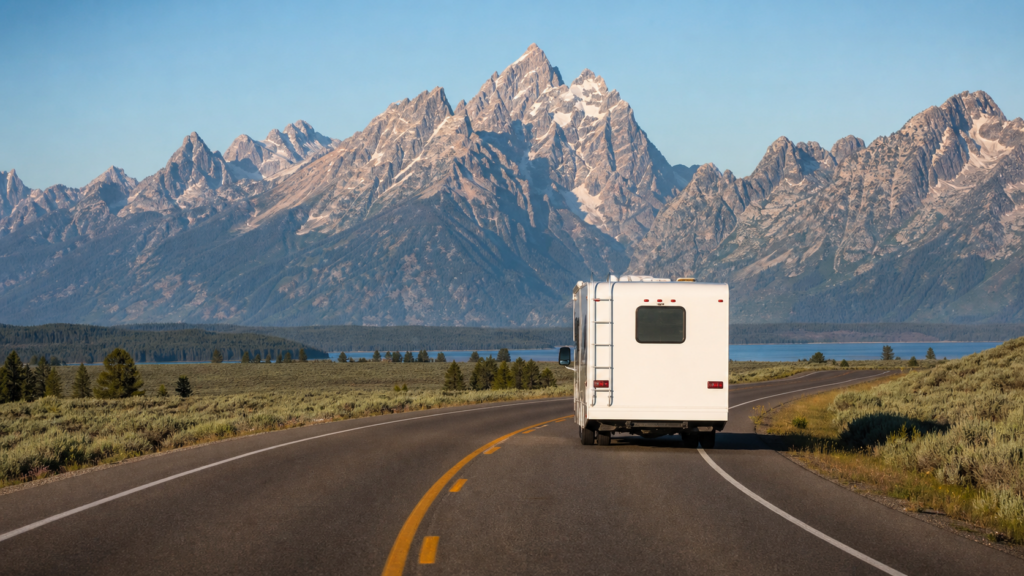
Grand Teton RV Trip Planner: Campgrounds, Parking, Road Restrictions, and RV-Safe Routes
On this page you will find a list of Campgrounds, Parking, Road Restrictions, and RV-Safe Routes for Grand Teton.
With a trip designed around rig size, reservation needs, legal roads, and practical parking, Grand Teton is RV friendly. This planner outlines how you can plan a basecamp, avoid Moose-Wilson moments, and make it all the way from the Tetons to Yellowstone without being swept up by a car-based trip plan taking over your RV day.
The Grand Teton RV Trip Planner features a map of the area, campgrounds, parking and road restrictions, and RV-Safe routes.
On a map, Grand Teton appears to be easy. Compared to Yellowstone the park is narrow, the main highway is easy to follow and the mountains are visible much of the driving time. It is that simplicity that leads to RV travelers being surprised.
With little thought, a car can slide from overlook to trailhead to overused lakeshore parking. A cleaner plan is required for a motorhome, fifth wheel, travel trailer, truck camper, or campervan. It is important to understand where the rig will be placed overnight, and which roads are legal and sensible, which ones may be tight for parking, and which may be better to park the RV at camp and take a smaller car or shuttle style plan for the more populated parts of the park.
This Grand Teton RV trip planner was written as I would try to plan the trip from the back of the rig – measure the rig first, book the campground that really fits, keep the scenic roads honest, and check live conditions before you roll. If you have not already done so, measure height, width, length, weight and total combined length first before selecting a route to Grand Teton via RoadReviewer’s guide to RV-safe route planning.
Yes, you can drive an RV in Grand Teton.
Yes, it’s possible to drive an RV in Grand Teton National Park, and many RV travelers do just that, all season long. The main park approaches (US 26/89/191), Teton Park Road when open, the Colter Bay/Jackson Lake area and campgrounds that indicate RV compatible sites are the parts of the park that are RV friendly.
What this does mean, however, is that not all roads, campgrounds, pullouts, trailheads or lakeshore parking lots are suitable for every rig. The same thing that I would do on Yosemite is that ‘legal access’ is different from ‘comfortable access’.
For the vast majority of RVers, the best Grand Teton strategy is:
- Please reserve a legal campsite or RV park in advance.
- Use the principal roads to move RVs.
- If your setup isn’t allowed, avoid restricted roads like Moose-Wilson Road.
- Arrive early or ride a smaller vehicle at Jenny Lake, String Lake, Taggart Lake and small trailheads.
- Plan the Yellowstone and Grand Teton RV trip as a complete one, rather than as two “rushed” day trips.
Grand Teton is better planned at a slower pace. While not vast, time can slip away quickly at the park with parking congestion, wildlife traffic, road work, and campground fit.
Grand Teton is an area where RV-specific planning is essential.
The Teton Range forms one of the finest windshield vistas in the West, but the practical aspects of the trip are less romantic. The park features seasonal roads, campgrounds, which are only open to reservations, popular day use facilities with limited parking, and at least one well-known road that has a no RV and no trailer policy.
Before you decide on a Grand Teton National Park RV vacation, jot down the numbers that count:
- Overall motorhome length or truck-and-trailer combined length
- Total height with A/C and antennas, solar equipment and roof storage
- Width including mirrors
- Gross vehicle weight and towing setup
- If it is possible to separate the tow vehicle or toad from the RV
- If you are looking for hookups, generator hours, dump station, or just a dry site.
Those details determine if you should book a Colter Bay RV Park rental, Gros Ventre Campground RV sites, a Signal Mountain Campground rental, Headwaters Campground RV Park rental, a rental outside of the park at Jackson Hole RV or a smaller dry camping option.
Grand Teton RV camping: when considering all the main options, what are the differences?
Before booking, information should be confirmed on the National Park Service, Recreation.gov and concessioner pages regarding all park campground details. Rules, seasons, construction, hookups and site types may be adjusted. Here is my priority list of the Grand Teton RV camping options:
Colter Bay RV Park
When it comes to travel in the Grand Teton area and needing full hookups as you travel, Colter Bay RV Park is the most likely solution. Close to Jackson Lake, close to Colter Bay Village services, marina close by, fuel close by, groceries close by, and close to the north end of the park road system.
According to the current planning guidance, Colter Bay RV Park offers a full hook-up RV park with pull through and back-in sites. Before booking your stay, the most important number to check is the total length. Pull through RV sites are up to 45 feet total length and back-in RV sites are up to 30 feet, but see the current site description and reservation page for the actual size of the site for your specific date and site type.
Best for: RVs that require hookups and a north-park base, and those looking for fewer compromises than a smaller dry campground while getting closer to the South Entrance to Yellowstone.
Look for: demand, site length restrictions, reservation times, and if your tow or toad will fit into the restrictions.
Gros Ventre Campground RV Sites
One of the most helpful campgrounds on the Grand Teton for RV travelers wishing to be closer to Moose, Mormon Row, Antelope Flats, Jackson, and the southern half of the park is the Gros Ventre Campground. While not as central to Jackson Lake, it’s certainly a great starting point for sunrise photo shoots, wildlife drives, and a Jackson Hole RV camping plan that will keep you near the park.
The regular campground information posted on the NPS website shows standard sites, some that have electric connections, and a length limit of 45 feet. Use that as a guideline and not a guarantee for all sites. The name of the campground is less important than the reservation page.
Best fit: South-side-based RVers and those who aren’t concerned with being at full-hookup sites.
Look out for: site specific fit, limited electric available, dump station information and the urge to take the RV off into every little trailhead from this very convenient location.
Signal Mountain Campground RV Length
One of the better central park locations is Signal Mountain Campground, located near Jackson Lake and Teton Park Road. It’s also a campground where size does count. The NPS has advised a 30-foot length limit to use of Signal Mountain Campground RVs.
That makes it a better choice for campervans, truck campers, smaller class C’s and smaller trailers than for larger fifth wheels or longer motor homes. If close to the limit, please check if the number is total length, vehicle length or site-specific fit before booking.
Ideal for: smaller RVs who prefer a central location and are willing to deal with more restrictions at campgrounds.
Listen for: "It is very short," "campground loop," "seasonal," and "We can squeeze in" vs. "We can comfortably set up."
Colter Bay Campground
Colter Bay Campground is located away from Colter Bay RV Park. That distinction matters. The RV park is the full-hookup site, the campground is a larger campground with standard and limited electric site types.
The current NPS guidance is to site 45-foot length limits at Colter Bay Campground, but the real question is site specific – will your RV, tow vehicle and any additional equipment fit the site without blocking the road or the vegetation?
Best fit: RVers who desire the Colter Bay area but do not need full hookups.
Be aware of: no full hookups in regular campground, reservations, generator restrictions and site size.
Lizard Creek Campground
Lizard Creek Campground is located on the north end of Jackson Lake and is suitable for smaller RV’s that have no hookups. It is not a full-hookup site and it should not be used as a large rig fallback for Colter Bay RV Park or Headwaters.
Lizard Creek is currently a 60-site standard campground with a 30-foot length limit on the current NPS campground tables, and the current reservation/concessioner guidance may vary in parking pad widths and trailer or RV size limits, as well as having a shorter 25-foot maximum length limit. Lizard Creek is a small-rig, site-specific option; check reservation page before booking.
Perfect for: Campervans, truck campers, short trailers and smaller motorhomes seeking a more quiet north-end Jackson Lake base.
Look out for: no hookups, smaller pads, size of the site, seasonal operation, and if it shows a lesser number on the reservation page for your dates.
Headwaters Campground RV Park
Headwaters Campground RV park at Flagg Ranch is located between Grand Teton and Yellowstone along the John D. Rockefeller, Jr. Memorial Parkway. This can be an extremely convenient location for a Yellowstone and Grand Teton RV trip.
Headwaters currently has full-hookup pull-through RV sites listed, and a 45-foot length limit. While it’s not ideal if you’re spending every day on Jenny Lake or Moose, it may be helpful if you’re travelling from one park to the other and you want to minimise the days that you have to move around.
Best fit: RVers doing Grand Teton and Yellowstone together, particularly those who want to have hookups and be close to the park-to-park route.
Look for: driving distance to Grand Teton sights in the south, status of the Yellowstone South Entrance, seasonal dates and availability of full hookup sites.
Jenny Lake Campground is NOT an RV campground.
Don’t expect Jenny Lake Campground to be a place for an RV. NPS campground tables currently state that Jenny Lake is tents only. Well, the Jenny Lake area is one of the most popular and most searched areas in the park and there is the tendency of mixing wanting to visit Jenny Lake with the need to camp there.
A better approach for RV enthusiasts is to park where the rig will fit and then make early plans to visit Jenny Lake or plan the day around realistic parking.
Grand Teton campgrounds do have length restrictions, and you can make campground reservations.
Grand Teton campground reservations are not something to be left to the last minute. The current guidance for camping in the NPS is that campgrounds are available for advance reservations only, and they are typically made a six months in advance via Recreation.gov.
When comparing numbers on the RVs at campgrounds at Grand Teton, keep in mind that that is a first filter. I also check:
- Back in or pull through location of site.
- If the tow vehicle is part of the limit or not
- If slide out is available and will not snag against trees or posts
- If you have a turning radius that fits on the road loop
- What kind of generators are permitted and when (excluding gas-powered generators)
- If full or electric-only hookups are available or if they do not exist
- If there are any dump stations available when you will be traveling
The most attractive campground in Grand Teton for RVs is not the most attractively described. It’s the one that fits your rig, your driving schedule, your time window and the area of the park you really want to see.
RV-Safe Roads in Grand Teton
If you are planning an RV-safe route with Grand Teton, remember to use the larger moves on the main roads only unless otherwise officially advised and your rig will fit.
US 26/89/191
US 26/89/191 is the primary RV road into the valley and runs through the southern and central portions of the valley from Jackson to Moose Junction to Moran Junction. From Moran, the actual park-to-park roadway follows US 89/191/287 north to the approach to Jackson Lake, Colter Bay, Flagg Ranch and the Yellowstone approach.
This is the road that I would employ for the majority of the heavy RV positioning. It’s also the cleaner option when the weather, the darkness or fatigue begins to close in on you.
Teton Park Road RV Use
Teton Park Road is the interior road, between Moose and the Jackson Lake Junction area, that provides access to the Jenny Lake, String Lake, Signal Mountain and several overlooks. In the off-season, it’s a big scenic drive and can be used for RVs that can handle conditions.
That doesn’t mean it is a typical parking road for all large rigs. Drive Teton Park Road during the day, and at a low speed, as a scenic drive. In a large Class A, long fifth wheel or truck & trailer, have a stopping point in mind before embarking. Some are easier overlooks/side roads than others.
Moose-Wilson Road RV Restrictions are in effect.
What RV drivers must do is slow down before even touching the steering wheel, and that’s on Moose-Wilson Road. According to the current NPS guidance, Moose-Wilson is slow, winding, partially unpaved, and closed to RVs and trailers (any vehicle over 280 inches or 23.3 feet in length). It also has periodic closures and construction-related delays.
When planning, I make the Moose-Wilson Road RV restrictions as follows: If you are an RV dweller, a tower, or near the length limit, don’t assume you belong there. Check the NPS road page for the latest restrictions and language prior to traveling. If you are not allowed to use your set up, take the main highway and go in the park via the legal RV friendly paths.
This is the type of road that a car GPS can lead to a bad choice for an RV. This is the same with all the other mountain parks like the routing errors RoadReviewer alerts you to in the Great Smoky Mountains RV trip planner and the clearance-and-grade attitude in the Blue Ridge Parkway RV trip planner.
Small Side Roads and Scenic Pullouts
There are a few other roads that need to be checked and common sense applied: Antelope Flats, Mormon Row, Schwabacher Landing and Signal Mountain Summit Road. Some can be narrow, rough, crowded or just not nice in a big rig, and some might be seasonal. Don’t try to test out a long trailer when a road is unpaved, one-lane, or has lots of passenger cars at sunrise.
Make use of the satellite view, official park websites, road conditions and recent park advice. If in any doubt, park the RV at the campground and drive the smaller vehicle.
This is a guide to Jenny Lake RV Parking and popular trailheads.
One of the largest planning pitfalls for Grand Teton is Jenny Lake RV parking. Jenny Lake is popular and it should be: boat shuttle access, Hidden Falls, Inspiration Point, lakeshore walking and classic Teton views. That’s reflected in the parking needs.
To avoid building the plan around being late morning and finding easy oversized parking do not drive a large motorhome or tow. This is what a good day becomes: circling, backing, stress and missed hikes.
An improved Jenny Lake plan:
- Be very early, particularly during busy time.
- If feasible, switch to a smaller vehicle when traveling in your RV.
- If you can’t park in the lot, have a place in mind to stop next.
- Avoid blockage of lane, side of road or area not intended for your vehicle.
- Check parking instructions prior to trip.
The same concept holds true at other small trailheads, such as Taggart Lake, Lupine Meadows, and String Lake. Grand Teton is a lot more fun without the RV serving as your 24/7 trailhead shuttle. RoadReviewer’s Acadia RV trip planner says as much in a different park: sometimes the best RV move is to park one time, and cease asking the rig to solve every crowded access problem.
Deciding on a Basecamp is a choice between building your camp in the north, central, south or outside the park.
Don’t just choose a basecamp because of the campground.
North-park base
Colter Bay and Headwaters are suitable for Jackson Lake, Oxbow Bend, Moran, the northern park area and Yellowstone connections. This is the more natural fit for travellers connecting the Grand Teton with Yellowstone.
Central base
For smaller rigs Signal Mountain is appealing as it brings you near the interior scenic corridor area. The compromise is size restrictions and availability.
South-park base
Gros Ventre area RV parks and Jackson area RV parks are good for Moose, Mormon Row, Antelope Flats, a first or last night in the valley and Jackson services.
Outside-the-park base
Outside the park, Jackson Hole RV camping may be a better option for larger RVs, services, and people who desire hookups, restaurants, access to repair services, and a larger private RV park setting. It is higher traffic and more driving at entry times to the park.
Yellowstone and Grand Teton RV Trip Planning
They are close enough together to be considered together, but not close enough to be considered close companions in an RV. Park features, time to entry points, road conditions in different months and year, and campground details can make a “quick hop” a longer trip than planned.
If you’re traveling to both parks, plan your trip using RoadReviewer’s Yellowstone RV trip planner and this guide. The sanest scheme is likely a single base of each one Grand Teton and a single base of each one Yellowstone, or a single base of each one Headwaters/Flagg Ranch as a bridge between.
If it were my first time traveling in an RV, I would definitely not camp every night. More time is spent moving days than they sound on a map: Break camp, dump, fill, fuel, drive, enter, park, check in, level, reconnect, and still attempt to enjoy the park. It’s a lot to demand at altitude, where the wildlife traffic and summer crowds are.
A 3-Day RV Itinerary for the Practical Grand Teton National Park.
Arrival, set-up and a scenic drive in a low stress manner.
Reach destination before dark falls. Make camp first, then pursue viewpoints. If possible, use the major scenic route driving without reservation to narrow parking spots. Oxbow Bend, Jackson Lake area or larger pullouts can be good first nights if it is your basecamp.
Early in the day on Day 2, both Jenny Lake and String Lake will be open.
Have this as your day to start early. Use a tow vehicle if available. Otherwise, only drive if you can fit your RV size and direction of parking guidance. Have an alternative to your stop, such as a different scenic pullout, a visitor center, or an alternative overlook that is not so busy.
On Day 3, we’ll be visiting Mormon Row, Moose, and taking a conservative exit plan.
Take the morning for Mormon Row, Antelope Flats or Moose area, depending on road/parking conditions. If towing or driving a large RV, remember to use extra caution on small side roads. Allow for fuel, dump, groceries and next campground.
A 5- to 7-Day Grand Teton and Yellowstone RV Route
If you are going to take a longer route, slow it down:
- Nights 1-2: Gros Ventre/Jackson/south-side base for access to Moose, Mormon Row and Jenny Lake.
- Nights 3-4: Colter Bay or Headwaters for Jackson Lake, Oxbow Bend, and a less hectic pace up north park.
- Nights 5-7: Yellowstone base based on reservation and entrance plans.
That path provides space to appreciate the weather, construction, and full parking, coupled with a day that doesn’t go according to plan, as well as laundry and dump station timing. Conditions at Grand Teton are at elevation and they can change in a flash, just as the less-precise-than-Max-RV mountain driving attitude of RoadReviewer’s Rocky Mountain National Park RV trip planner.
Common Grand Teton RV Mistakes
The same errors are repeated time and time again:
- Reservations for campgrounds without verifying the length of the campground.
- If Jenny Lake Campground is RV friendly.
- Using Moose-Wilson Road as a road and not a scenic route.
- Using large rigs to busy trailheads at busy times.
- Not allowing for the tow vehicle or toad in the total combined length.
- Designing a "big hunk of moving day" at Yellowstone and Grand Teton.
- Relying on a car GPS for park information instead of official park information.
- Going to campgrounds after dark and having to figure out how to fit in.
All these errors are simple. They occur when the Teton is not crowded, the road is not closed or the campsite is not too short.
Take your travel plans to Grand Teton with RV-Safe.
Before departure, confirm:
- Status of NPS roads and construction news
- Any current year construction advisory, such as the NPS 2026 advisory to plan ahead and be prepared for traffic delays if travelling during this construction period
- Campground fit and reservation, size, hookups, length of time
- Local regulations at your specific area of use
- Restrictions/Closures on Moose-Wilson Road
- Jenny Lake and String Lake parking expectations
- Gas locations that are convenient for RVs
- Potable water availability (dump station)
- Road conditions in the season, smoke, wildlife closures, weather conditions
- Campground or outside the park backup facility is available.
- If provided: a smaller vehicle plan to alleviate congestion on trail heads
That checklist isn’t busy work. It’s what makes a pleasant RV journey from a tight-turn problem.
FAQ
Does Grand Teton have an RV site?
Yes, Grand Teton can be RV friendly, provided you use the main roads, book a campground or RV park that is appropriate for your rig, and stay out of restricted areas and crowded areas that are better for passenger cars.
Which is the best Grand Teton campground for RVs?
Colter Bay RV Park and Headwaters Campground RV Park may be the best choices for hookups and RV convenience. Gros Ventre Campground and Colter Bay Campground can also accommodate many RVs. Your decision will depend on the length of your rig, hookup requirements, availability of reservations, and whether the base you want is north, south or connected to Yellowstone.
Is it possible to camp at Jenny Lake Campground?
According to current NPS guidance, Jenny Lake Campground is considered "tents only." Jenny Lake Campground is not recommended for RV camping Grand Teton National Park trips. Visit another campground, and use Jenny Lake as a day use stop.
How difficult is it to park at Jenny Lake?
It can be challenging to find a parking spot in Jenny Lake in peak season, particularly after early morning. Big rigs and big rigs on trailers should not take easy parking for granted. Go early, if possible use a smaller vehicle, and have a back-up plan.
What you can and can’t do on Moose-Wilson Road.
According to current NPS guidance, Moose-Wilson Road is closed to RVs and trailers, which includes vehicles larger than 280 inches (23.3 feet) in length. The road is also slow and winding, has partial surfaces and closures or delays. Check NPS road page before traveling.
Is it permitted to camp on Teton Park Road with an RV?
Many RV travellers use Teton Park Road during the normal open season, but there’s the size and parking judgment issue. Large rigs must make careful stops and not stop in small lots or side roads that are not adequate for the size of the rig.
Are there Grand Teton campgrounds that require reservations?
According to the latest NPS statement, the Grand Teton park has switched to “by advance reservation” campgrounds via Recreation.gov only; check dates and rules before they book.
How many days should I allow for a trip in an RV to the Grand Teton?
You can make three days a concentrated Grand Teton RV tour. Five-to-seven days is preferable if you are going to do Grand Teton and Yellowstone, if you are changing basecamps, and if you have a bigger rig that requires more set-up space and parking room.
Where to stay on a Yellowstone & Grand Teton RV trip?
One base in or near Grand Teton and one base in or near Yellowstone is a practical plan. Headwaters Campground RV Park can also serve as a "bridge" site between the parks. Don’t make every day a moving day.