The Rig
Winnebago Ekko
The All-Weather Adventure Van Tested
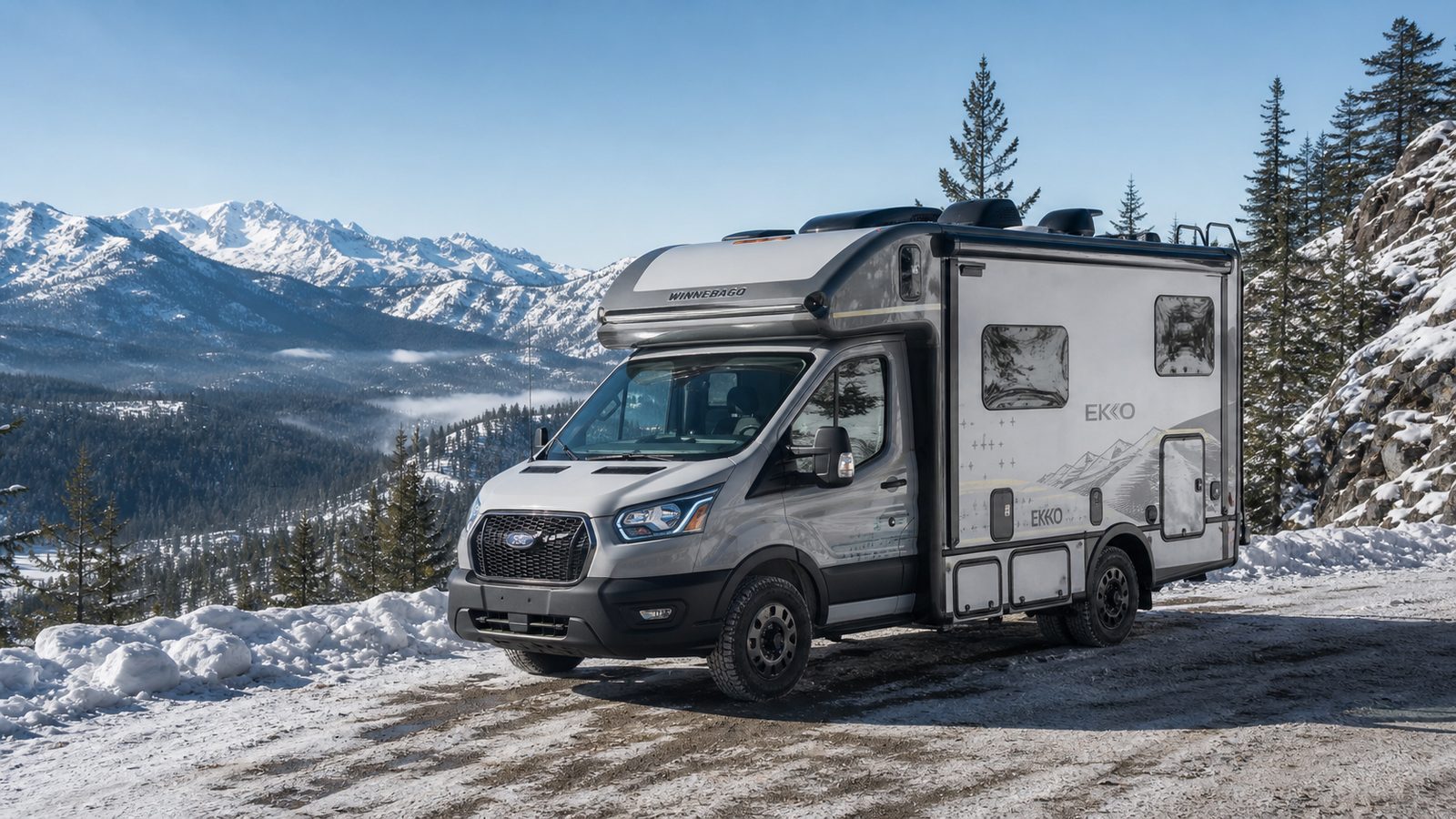
The Winnebago EKKO is one of those RVs that seems straightforward, but is not. Although it's a small Class C motorhome, it feels more like a camper van with a bit more cabin and storage and a little better off-grid potential. That is the primary cause folks proceed to discuss it. The EKKO won't try to be a big luxury coach and it's not simply a regular van with cabinets in it. It's nestled in the middle which is why it is the right choice for the right buyer. The 2026 EKKO is available in two sizes: the 22A on the Ford Transit AWD chassis and the 23B on the Mercedes-Benz Sprinter AWD chassis. While both models are smaller than a standard Class C, they are both designed to travel more than a standard weekend cruiser. The big question is if the EKKO is really comfortable enough to travel in, or is it just an adventure machine, with a good brochure and a high price tag.
What EKKO Is Truly Trying to Be
The concept behind the EKKO is very simple: combine the freedom of a camper van with some of the comfort of a small Class C coach. It's a fair description, although it sounds like marketing talk. A normal van is easy to maneuver and easy to park, but the space can become cramped quickly, especially during bad weather conditions. A normal Class C is bigger, but also broader, higher and more oriented towards campgrounds. The EKKO attempts to achieve a compromise. The 22A is 23 feet long and the 23B is 24 feet and 6 inches in length. The two are not small but they're still much more manageable than a large motorhome. The intention is not to provide you with the moving apartment. The aim is to provide you a small base camp that will have plenty of systems, plenty of storage and plenty of winter preparations so that travelling feels a little less precarious.
Chassis, Driving, Real World Size
Within the name EKKO, there are two personalities. The 22A chassis is based on the Ford Transit AWD platform powered by the 310 horsepower, 400 lb-ft 3.5L EcoBoost V6. The 23B is based on the Mercedes-Benz Sprinter AWD chassis equipped with the 2.0L twin turbo diesel fuel. That makes the 22A more familiar to those who know the Transit platform and the 23B more towards the Sprinter image and diesel economy and a bit more interior room. The 22A has a length of 23 feet, a width of 7 feet 2.5 inches, and a height of 10 feet 6 inches, and a GVWR of 11,000 pounds. The 23B is longer, at 24 ft 6 in, with an 11,030 lb GVWR. The key is that both are still within the realm of possibility. They can be used in town, are not the embarrassment of a large Class C on a mountain road, and can be parked. It's not a Subaru, it's still an RV. However one of the EKKO's great assets is the size.
Inside Space and Comfort of Everyday Life
The EKKO is more utilitarian than a fashion statement in its interior. It's not a bad thing, though. It is designed for people who really use gear, prepare basic meals, sleep through any weather, and have space for jackets, bikes, boots, tools and outside gear. The 22A is the smaller of the two, and its best feature is that it's efficient, yet it's not overly complex. The 23B provides a bit more living room, longer twin/flex beds and a more flexible front living area. The lounge in the Sprinter version offers multiple options including a work area, side sofas, dinette or additional sleeping area. This kind of flexibility is important as a small RV must make every square inch count. The EKKO won't be the coach that you purchase if you are looking for a big recliner, a giant bathroom, and residential separation between each zone. If you're looking for a compact cabin that is still usable, it is the kind of coach you will purchase.
The Bath Is Smart, but Not for Everyone
The most talked about feature of the EKKO is the bathroom. Winnebago's concept is based on a dry/wet bath system that features a pivoting wall that allows the toilet and storage to remain secure while the shower is in use. It's a neat idea, and one that uses space more efficiently than a traditional wet bath, where all of the items get wet. However, it's still a small RV bathroom. Don't mistake it for a full house setup. The EKKO is also equipped with a cassette style toilet that has a 5-gallon cassette. Some travelers enjoy this as it is straightforward, adaptable as well as does not call for the same routine at the dump-station as a black tank. Others don't like it because it isn't quite as traditional, and it requires more actual emptying. This is an area where the right answer is dependent on the way you travel. The cassette may make sense when you camp in national forests, trailheads and small sites. Normal RV campground routines may take some adjustment.
Water, Tanks and Camping Rhythm
For a small RV, the EKKO's performance on water is pretty impressive. The 22A has a 50g fresh water tank and a 51g gray tank listed. There are 50 gallons of fresh water and 51 gallons of gray water also mentioned in the 23B preview sheet. Those are good stats for such a small coach, and they're more important than many consumers realize. Many small adventure vehicles don't have much water, so you quickly need to plan your trip around refilling. The EKKO allows for greater airspace. Conserve, even if you have to shower, wash dishes and avoid hookups for several days. However, one of the advantages of the EKKO over a conventional camper van is its tank configuration. It allows you to move around with a little more of your normal rhythm rather than being in emergency mode with every gallon.
Power, Solar and Off the Grid
One of the biggest selling points is the EKKO's off grid capabilities. The 22A features lithium battery power, a pure sine wave inverter/charger, a second alternator to charge coach batteries while underway and solar charging. Winnebago also mentions in their current feature information that the EKKO is capable of having a 455 watt solar setup, and the 22A spec page specifies that it can be outfitted with a 220 watt flexible solar panel with the inclusion of the pop-top. The Sprinter 23B is advertised as having 520 watts of solar, a 320Ah Lithionics lithium battery bank and possible upgrade to 630Ah. This is an item that may vary depending on the floorplan and options, and a buyer should ensure this is accurate on the actual window sticker. However the overall direction is apparent. The EKKO offers a way of spending time off the hookup. It's not just about parking in an RV resort. It is well suited to trailheads, public lands, and shoulder season travel with solar, lithium, alternator charging and efficient appliances, to mention a few.
All-Season Design
It's not as though the all-season part is just a label stickered on the side. The Winnebago EKKO features a heated and enclosed water system, insulation on the roof, walls and floor and a heated rear gear garage. On the 23B, the company explicitly cautions buyers to continue to follow winter use and winterization guidelines, which is reasonable. Even a well-built RV does not make cold weather disappear. However, the EKKO holds up much better to cold nights and shoulder season travel than many rigs in this size range do. That's important if you enjoy mountain biking in spring, skiing vacations, desert nights in the winter, or camping when the chill sets in after dark falls. The EKKO is not intended to be a substitute for an Alaskan cabin. However, for real-life cold weather RV usage, it's more comfortable than a less-insulated van conversion.
Storage and Gear Garage
One area where the EKKO can demonstrate that it is more than just a van is storage. The 22A has 65.3 cubic feet of outside storage, while the 23B preview sheet states 64 cubic feet. However, it's no small amount of room for a little coach. One thing Winnebago takes great pride in is heated pass through gear garage, for good reason. Here, bikes, inflatable kayaks, camp chairs, recovery gear, wet boots and outdoor gear can truly reside. Many small RVs look great on paper, until you start to wonder where all of the trip gear is. The EKKO is the best response to the question. It's not infinite room and you still need to pack smart. However, many Class B vans do not provide this storage benefit.
Price and Value
This is where it becomes more difficult to explain the EKKO. The 2026 22A is priced by Winnebago at $215,551 and the 23B Sprinter version typically increases the price based on the equipment configuration. That's a lot of money for a small RV. Larger Class C coaches are available for purchase for a lower price. Also used vans, truck campers or travel trailers can be purchased at a very reduced price. But true competition is not on square footage per dollar on the EKKO. It's competing on water, storage, heated systems, compact size, AWD and off-grid capability. The EKKO will seem like a high price if you just want to have interior room. The value begins to make sense if you're interested in a coach that will last for several seasons, several roads, and less reliance on campgrounds. It's not a bargain, it's still a high dollar item.
What Could Be Better
The EKKO has its flaws. It is expensive and the interior may seem small if you're switching from a traditional motorhome. This cassette toilet will not be suitable for everyone. There are also some buyers who may prefer to have a completely customized van as they would like to have control over every cabinet, battery and appliance. As in all production RVs, a careful examination of build quality should be conducted prior to delivery. This involves door, seal, plumbing, electrical, cabinetry and fit and finish pre-sign-off inspections. The EKKO succeeds in concept, but a concept isn't a get-out-of-jail card for normal RV ownership issues. It is still in need of maintenance. It still has things that are subject to failure. It also offers much more in such a small package, and repairs at times can be more specialized than on a standard trailer.
Who Is the Winnebago EKKO For?
The EKKO is ideal for couples, solo travelers, and small families seeking a vehicle to take on road trips, remote camping sites and quick getaways, but without moving into a big motorhome. It works best when driving ease, all-season confidence, good storage space and off-the-grid camping are a priority. It's also a great compromise for anyone who desires greater comfort than a van has to offer, but still does not prefer the size and campground atmosphere of a larger Class C. It may not be the right option for those who are looking for the most space, home furnishings, or the lowest price possible. Understanding what the job is, this is what makes the EKKO work. It is a small base camp for those who live and travel in a frequently changing environment, with real gear, and want to do so outside of ideal summer weather. If that's you, the EKKO is one of the most convincing small adventure RVs available.