The Craft
Solar Power Systems
Off-Grid Energy for Full-Time Living
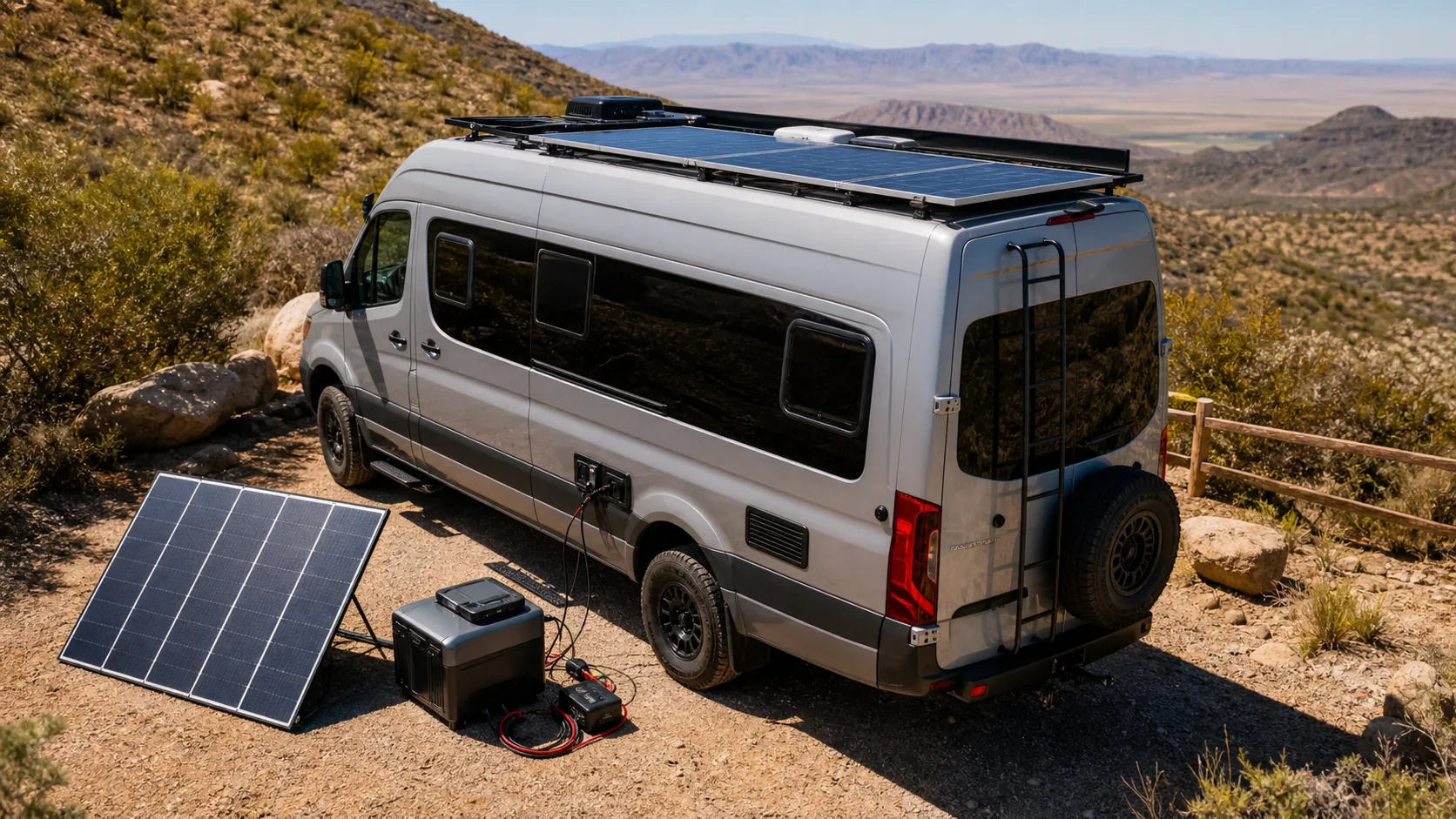
Until you're on the road, RV solar sounds easy. Just because you have a panel on the roof doesn't necessarily mean you are off-grid and free. Solar is just one of the components. There is a lot more to it than that, including the power rating of the panels, the amount of sunlight you get, the size of the charge controller, the batteries you will be storing, the size of the inverter you are powering, the alternator charging, shore power charging, cable size, fusing, and finally what you hope to power. A large size solar system is not always the best RV solar setup. It's the system that matches the way the owner camps. Induction cooking plus the use of Starlink, laptop computers, fans, and a 12V refrigerator plus a fan and an air conditioner sometimes are not something that can be powered by a 12V receptor/lights system on a weekend trailer.
RoadReviewer Take
Solar works but batteries make the RV independent. The bank is filled by panels. The bank is used to carry the loads. No matter how good the brochure might look, the system will let you down if its battery capacity and inverter output are not matched with the charging speed.
Explain what is meant by the Energy Budget First.
Use loads, not panels. Write down the things that will be on every day; refrigerator, lights, water pump, vent fans, furnace blower, phone charging, laptops, router, CPAP machine, induction cooktop, microwave, coffee maker, or air conditioner. The small DC loads accumulate over time. Batteries can be quickly depleted by heating elements and motor loads. The standard mode of life for many RVs is to use their refrigeration and furnace blowers. During the cold weather months, the furnace fan can consume a lot more electricity than most realize. During hot weather, it's the wall that all battery systems run into - air conditioning. Certain high quality systems may utilize batteries for A/C, but it's still quite a demand and should be planned openly.
Panels Are Not Rated for Real Life
The 400 watts does not mean the 400 watts. The standard test conditions are used for panel rating. Real output varies by angle of the sun, shade, dirt, heat, roof layout, wire loss and controller efficiency. Too much shade in the wrong portion of an array will reduce production by more than anticipated. It is convenient to use panels, but not always the best solution for a flat roof. There are portable panels that can be moved into the sun when your RV is in the shaded area; however, they require set up time and space. If you are a serious boondocker, both can be used: fixed panels for poor camp site angles; portable panels for bad angles.
How to use charge controllers and wiring.
The charge controller acts as the connection point between the solar panels and batteries. For better systems MPPT controllers are used, as they have a greater ability to harvest energy at varying voltage and light levels. The size of the controller needs to match the panel array and battery voltage. Wiring should be correctly sized with the correct fuses or circuit breakers. Many casual builds fall apart at this point. The future troubleshooter can then struggle with thin wire, messy grounds, no strain relief, poor crimps, no disconnects and confusing labelling. A clean solar install should be serviceable, and not just "day one."
Lead-Acid Versus Lithium
Lead acid batteries are more inexpensive initially, but they have a limit on their usable capacity and require more maintenance. Lithium iron phosphate batteries are more expensive, but provide greater depth of charge, lower weight, higher charge and discharge rates, flat voltage and longer cycle life if operated appropriately. They require appropriate charging facilities and temperature control. Lithium isn't a panacea. This could be a problem if the converter, solar controller, alternator charging system, or inverter are incorrect. Cold charging is particularly crucial. Some lithium batteries are fitted with internal heaters or low-temperature cutoff. Others demand the system designer to manage this outside the system.
The first step to sizing inverters is to consider surge rather than ego.
An inverter is used to change the battery DC to household AC. Make it to size for use. For the laptop and chargers it's OK to have a small inverter. Larger inverter might be required for a microwave, coffee maker, hair dryer, induction cooking or some tools. A larger inverter does not necessarily imply better, however, as larger inverters can draw more current standby and cabling will be heavier. The inverter must also be sized to the batteries. Even the 3000-watt inverter on a small battery bank could be a short-term solution, but this will not make an off-grid system comfortable.
Alternator and Shore Charging
Solar takes a long time as compared to shore power or alternator charging. That is the reason that present vans and adventure RVs frequently use the DC to DC charger supplied by the vehicle alternator. It can recover battery power during travel, which is useful for travelling people who relocate frequently. It's also possible to use upgraded charging paths on Towables, although the factory 7 pin is typically limited. The importance of shore charging remains. The ideal converter/charger, or inverter/charger, should be configured for the specific battery chemistry. Charging equipment should be checked, not assumed to be compatible if owner changes from flooded lead-acid to lithium.
Solar is great at.
Solar is great for maintaining battery power, powering 12V refrigeration, lights and fans, charging devices and for prolonging hookups. It is also quiet. No fuel, no fumes, no generator hours, and no campsite noise. That's important when camping on public lands and campsites. Solar is not as good at high load comfort unless it is the primary system. When it comes to solar package, the discussion shifts to air conditioning, electric heat and extended induction cooking times.
Buying Advice
Request the actual numbers: panel wattage, controller model, battery capacity (amp hours and watt hours), inverter rating, charger rating, alternator charging amps, wire gauge, fuse layout and if space can be made for expansion. When the seller says it has solar, dig some more.